1. Search Result
Search Result
Results for "

Bursaphelenchus xylophilus

" in MedChemExpress (MCE) Product Catalog:

6

Inhibitors & Agonists

1

Biochemical Assay Reagents

1

Natural
Products

Cat. No. Product Name Target Research Areas Chemical Structure
  • HY-NP0147
    Wheat Germ Agglutinin (Fluorescein)
    1 Publications Verification

    WGA (Fluorescein)

    Fluorescent Dye Infection Neurological Disease
    Wheat Germ Agglutinin (WGA) Fluorescein is a classic fluorescent label that specifically binds to sugar residues such as N-acetylglucosamine, N-acetylneuraminic acid and sialic acid. Wheat Germ Agglutinin Fluorescein performs regionally differential fluorescent staining of the ocular surface epithelial glycocalyx to assess its integrity, and causes no damage to the eye at safe concentrations. Wheat Germ Agglutinin Fluorescein is also used for staining structures including red blood cells, cultured cells, bacteria and pine wood nematodes, and facilitates the isolation of wheat-associated plant-growth-promoting rhizobacterial strains. Wheat Germ Agglutinin Fluorescein can be applied to the detection of ocular glycocalyx integrity and the research of related diseases such as pine wilt disease .
    Wheat Germ Agglutinin (Fluorescein)
  • HY-W278867

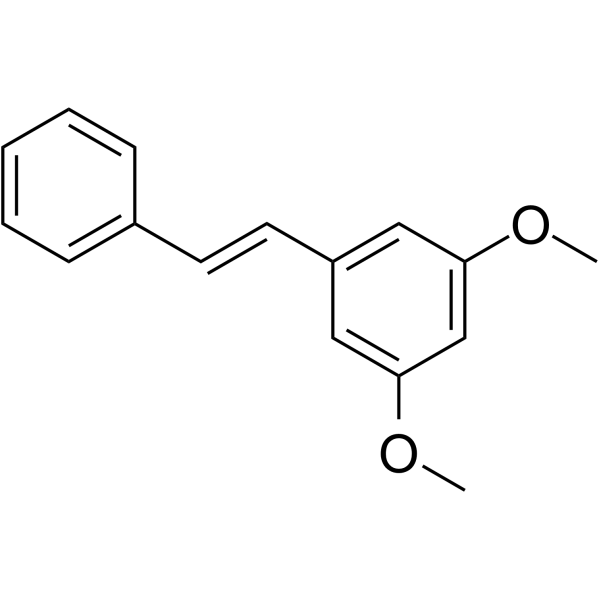
    trans-Pinosylvin dimethyl ether

    Cholinesterase (ChE) Neurological Disease Inflammation/Immunology
    trans-3,5-Dimethoxystilbene (trans-Pinosylvin dimethyl ether) is a natural stilbenoid metabolite. trans-3,5-Dimethoxystilbene acts as an acetylcholinesterase inhibitor with a IC50 of 9 μM against Electrophorus electricus acetylcholinesterase. trans-3,5-Dimethoxystilbene binds to acetylcholinesterase and blocks acetylcholine hydrolysis, thereby increasing acetylcholine levels in the cholinergic synaptic cleft. trans-3,5-Dimethoxystilbene can be used in the research of neurodegenerative diseases such as Alzheimer's disease .
    trans-3,5-Dimethoxystilbene
  • HY-173264

    Parasite Insecticide Infection
    SDH-IN-24 (Compound 51) is an inhibitor of succinate dehydrogenase (SDH). The LC50 against the second-stage juveniles of Bursaphelenchus xylophilus (B. xylophilus) is 6.9 mg/L, and the IC50 for SDH is 15.0 μM. SDH-IN-24 exerts its nematicidal activity by inhibiting the activity of SDH to interfere with the energy metabolism of nematodes. Meanwhile, it inhibits the motility, feeding, and reproduction of nematodes, induces oxidative stress, reduces the protein content of nematodes, and impairs their antioxidant capacity. SDH-IN-24 can be used in the research related to anti-nematode fields .
    SDH-IN-24
  • HY-171720

    Asc-C6

    Drug Derivative Others
    Ascr#12 (Asc-C6) is an ascaroside derivative that exhibits extremely low activity in inducing the dauer (dormant larval) stage. Ascr#12 enhances the reproductive capacity of the invasive pine wood nematode .
    Ascr#12
  • HY-183949

    Insecticide Cholinesterase (ChE) Reactive Oxygen Species (ROS) Infection
    Insecticidal agent 33 is an AChE inhibitor with nematicidal activity. Insecticidal agent 33 impairs locomotor activity of Caenorhabditis elegans, and induces oxidative damage in Caenorhabditis elegans, including elevated reactive oxygen species (ROS) levels, lipofuscin accumulation, lipid deposition, and disrupted cellular homeostasis. Insecticidal agent 33 can be used for the research of plant-parasitic nematode infection .
    Insecticidal agent 33
  • HY-171722

    Asc-C9

    Insecticide PGC-1α Infection Cancer
    Ascr#10 (Asc-C9) is an orally active thermogenesis inducer and insecticide that can be obtained from Monochamus alternatus. Ascr#10 binds to the insect adipokinetic hormone (AKH) receptor (Ka=272 µM) and stimulates mitochondrial biogenesis via the PGC1α-UCP4 axis. Consequently, Ascr#10 induces UCP4-mediated uncoupled respiration, reduces the ATP/ADP ratio and accelerates lipid mobilization, thereby driving the thermogenesis process. Ascr#10 delays pupation and exerts specific chemotaxis toward dispersive fourth-stage pinewood nematode LIV larvae. Ascr#10 promotes cold acclimation of Monochamus alternatus larvae through metabolic inhibition and cryoprotectant accumulation, enhancing their survival rate under cold stress. Ascr#10 also induces browning of white adipose tissue and activates brown adipose tissue in mice, thereby helping the body resist cold and tumor growth. Ascr#10 can be widely applied to research related to pine wilt disease, lung tumors and cold stress .
    Ascr#10

Inquiry Online

Your information is safe with us. * Required Fields.

Salutation


Country or Region *

Applicant Name *


Organization Name *

Department *


Email Address *


Product Name *

Cat. No.


Requested quantity *

Phone Number *


Remarks

Inquiry Online

Inquiry Information

Product Name:
Cat. No.:
Quantity:
MCE Japan Authorized Agent:

