

1. Search Result
Search Result
Results for "

Ca2 binding

" in MedChemExpress (MCE) Product Catalog:

90

Inhibitors & Agonists

1

Screening Libraries

14

Fluorescent Dyes

18

Biochemical Assay Reagents

13

Peptides

3

Natural
Products

6

Isotope-Labeled Compounds

4

Antibodies

Cat. No. Product Name Target Research Area
  • HY-P1077
    CALP1
    3 Publications Verification

    mGluR Phosphodiesterase (PDE) Apoptosis Calmodulin Inflammation/Immunology
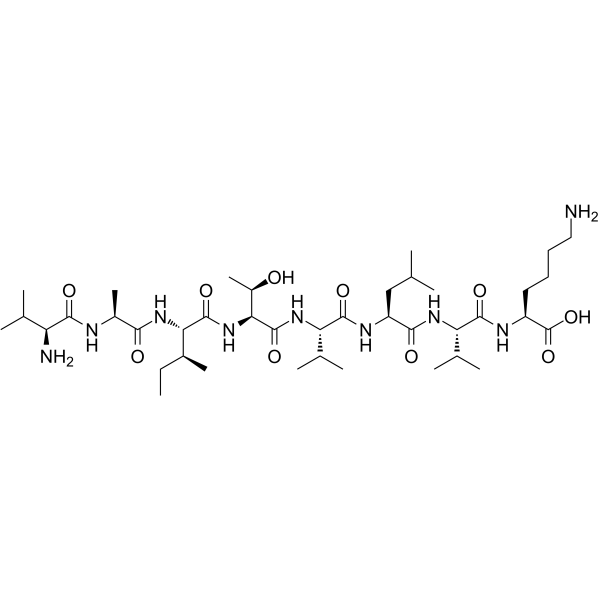
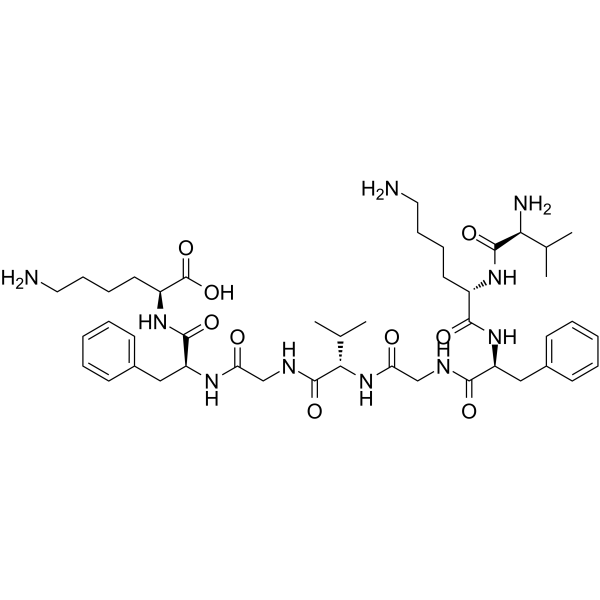
    CALP1 is a calmodulin (CaM) agonist (Kd of 88 µM) with binding to the CaM EF-hand/Ca 2+-binding site. CALP1 blocks calcium influx and apoptosis (IC50 of 44.78 µM) through inhibition of calcium channel opening. CALP1 blocks glutamate receptor channels and blocks a store-operated nonselective cation channel. CALP1 activates CaM-dependent phosphodiesterase activity .
  • HY-P1075
    CALP3
    2 Publications Verification

    Calcium Channel Neurological Disease Cancer
    CALP3, a Ca 2+-like peptide, is a potent Ca 2+ channel blocker that activates EF hand motifs of Ca 2+-binding proteins. CALP3 can functionally mimic increased [Ca 2+]i by modulating the activity of Calmodulin (CaM), Ca 2+ channels and pumps. CALP3 has the potential in controlling apoptosis in diseases such as AIDS or neuronal loss due to ischemia .
  • HY-P1805

    Calmodulin Neurological Disease
    Calmodulin Binding Peptide 1 is a high-affinity (pM) CaM-binding peptide derived from smooth muscle myosin light chain kinase (MLCK peptide). The interface of the complex formed by Calmodulin Binding Peptide 1 and Ca 2+-CaM can be specifically bound by small-molecule inhibitors, serving as a key target for selective regulation of smooth muscle contraction and development of anti-CaM drugs .
  • HY-P1077A
    CALP1 TFA
    3 Publications Verification

    mGluR Phosphodiesterase (PDE) Apoptosis Calmodulin Inflammation/Immunology
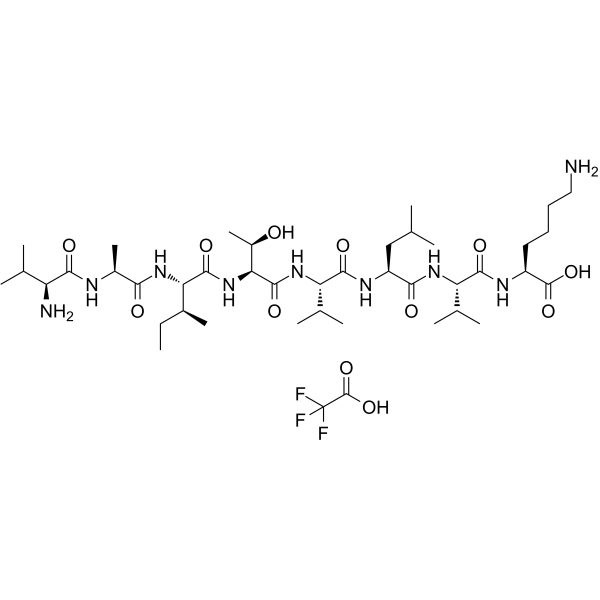
    CALP1 TFA is a calmodulin (CaM) agonist (Kd of 88 µM) with binding to the CaM EF-hand/Ca 2+-binding site. CALP1 TFA blocks calcium influx and apoptosis (IC50 of 44.78 µM) through inhibition of calcium channel opening. CALP1 TFA blocks glutamate receptor channels and blocks a store-operated nonselective cation channel. CALP1 TFA activates CaM-dependent phosphodiesterase activity .
  • HY-P1076A

    Calmodulin Inflammation/Immunology
    CALP2 TFA is a calmodulin (CaM) antagonist (Kd of 7.9 µM) with high affinity for binding to the CaM EF-hand/Ca 2+-binding site. CALP2 TFA inhibits CaM-dependent phosphodiesterase activity and increases intracellular Ca 2+ concentrations. CALP2 TFA potently inhibits of adhesion and degranulation. CALP2 TFA is also a strong activator of alveolar macrophages .
  • HY-P5436

    Peptides Others
    SK-MLCK M13 is a biological active peptide. (M-13 is a peptide that represents CAM-binding domain of Calmodulin (CaM) target proteins. CaM is an ubiquitous Ca2+ binding protein.)
  • HY-P5988

    PKC Cancer
    N-myristoyl-RKRTLRRL inhibits binding of PKC substrates. N-myristoyl-RKRTLRRL inhibits Ca 2+- and phosphatidylserine (PS)-dependent histone phosphorylation with IC50 of 5 μM. histone phosphorylation with IC50 of 80 μM .
  • HY-P10316

    Calmodulin-Dependent Protein Kinase I (299-320) binding Domain

    CaMK Others
    CaMKI (299-320) refers to a peptide consisting of residues 299-320 of Calcium/calmodulin-dependent protein kinase I (CaMKI). CaMKI (299-320), as a protein kinase, has a high affinity interaction with Ca 2+-CAM (Kd≤1 nM≤1 nM), which can phosphorylate specific substrate proteins, thereby regulating their activity. CaMKI (299-320) contains the CAM-binding domain and the self-inhibition domain, and CaMKI (299-320) can be used to study cell physiological processes, including cell proliferation, differentiation, and apoptosis .
  • HY-P1075A

    Calcium Channel Neurological Disease Cancer
    CALP3 TFA, a Ca 2+-like peptide, is a potent Ca 2+ channel blocker that activates EF hand motifs of Ca 2+-binding proteins. CALP3 TFA can functionally mimic increased [Ca 2+]i by modulating the activity of Calmodulin (CaM), Ca 2+ channels and pumps. CALP3 TFA has the potential in controlling apoptosis in diseases such as AIDS or neuronal loss due to ischemia .
  • HY-P1076

    Calmodulin Inflammation/Immunology
    CALP2 is a calmodulin (CaM) antagonist ( (Kd of 7.9 µM)) with high affinity for binding to the CaM EF-hand/Ca 2+-binding site. CALP2 inhibits CaM-dependent phosphodiesterase activity and increases intracellular Ca 2+ concentrations. CALP2 potently inhibits of adhesion and degranulation. CALP2 is also a strong activator of alveolar macrophages .
  • HY-P2471

    Calmodulin Neurological Disease
    Neurogranin (48-76), mouse is a peptide corresponding to residues 48-76 of Neurogranin. Neurogranin, a calmodulin-binding protein, is exclusively expressed in the post-synapse, and mediates NMDAR driven synaptic plasticity by regulating the calcium-calmodulin (Ca 2+-CaM) pathway .
  • HY-P11700

    MHC Inflammation/Immunology
    AAPDARETA is a mutated MHC-associated peptide with reduced binding affinity to H-2D b MHC molecules. AAPDARETA activates subsets of mouse main olfactory epithelium sensory neurons and induces Ca 2+ transients .
  • HY-P11825

    Bacterial Infection
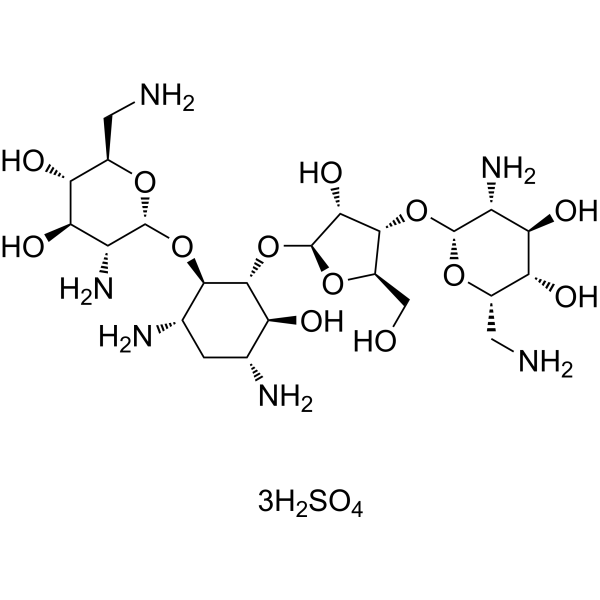
    APH-IN-1 is an Aminoglycoside phosphotransferase (APH) inhibitor with a Kd values of 63 nM against Escherichia coli APH(3′)-Ia. APH-IN-1 binds primarily to the ATP-binding pocket of APH in an ATP-competitive manner, with binding affinity enhanced by divalent metal ions (Mg 2+ and Ca 2+). APH-IN-1 can be used for the research of aminoglycoside-resistant bacterial infections .

Inquiry Online

Your information is safe with us. * Required Fields.

Salutation


Country or Region *

Applicant Name *


Organization Name *

Department *


Email Address *


Product Name *

Cat. No.


Requested quantity *

Phone Number *


Remarks

Inquiry Online

Inquiry Information

Product Name:
Cat. No.:
Quantity:
MCE Japan Authorized Agent:

