



Benzocaine (hydrochloride)
Based on 1 publication(s) in Google Scholar
Benzocaine hydrochloride is an orally active local anesthetic. Benzocaine hydrochloride non-competitively inhibits the binding of Ca-ATPase to Ca2+, with an IC50 of 47.1 mM. Benzocaine hydrochloride exerts anesthetic effects by blocking voltage-gated sodium channels. Benzocaine hydrochloride induces methemoglobinemia in various experimental animals.
For research use only. We do not sell to patients.
- Purity : 99.83%
- CAS No.: 23239-88-5
- Formula: C9H12ClNO2
- Molecular Weight:201.65
-
Storage:
4°C, sealed storage, away from moisture and light
* In solvent : -80°C, 6 months; -20°C, 1 month (sealed storage, away from moisture and light)


To place orders, for customer services and technical support, please contact: MedChemExpress USA
Tel: 609-228-6898 E-mail: [email protected] [email protected]


-
 Biological Activity
-
Chemical Information
-
Solvent & Solubility
- Purity & Documentation
- References
-
 Help & FAQs


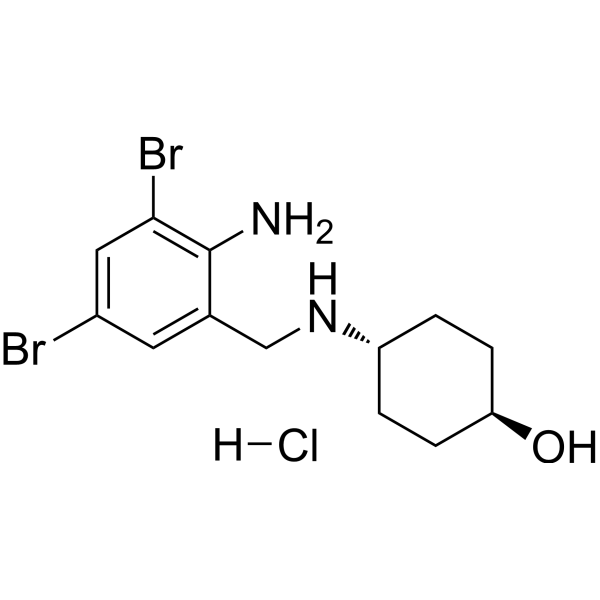
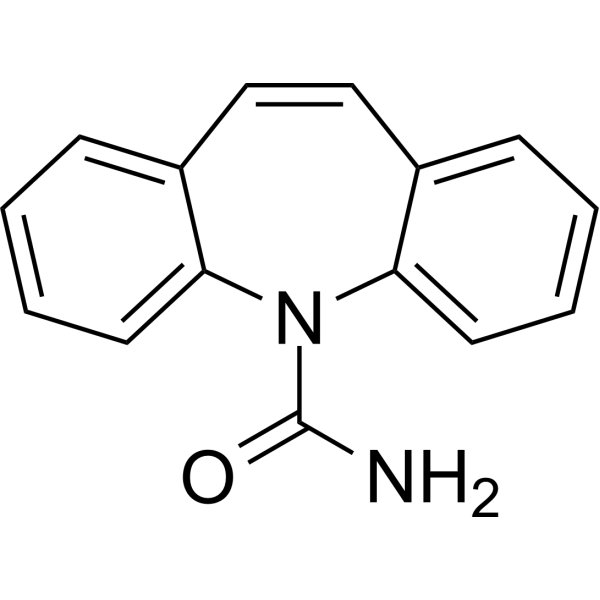

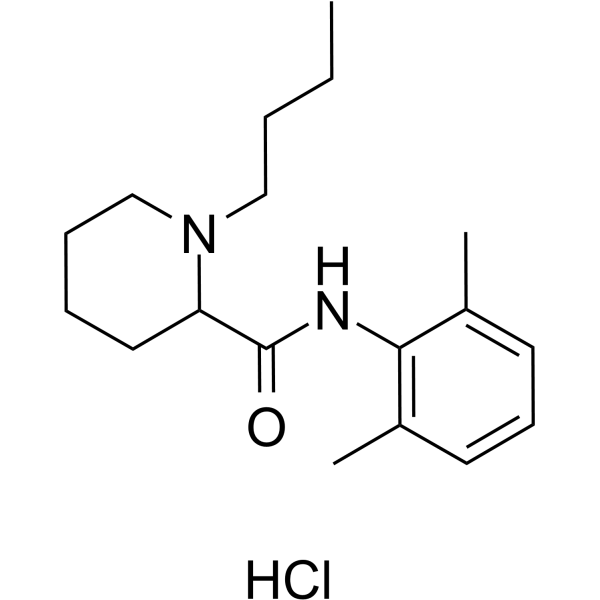
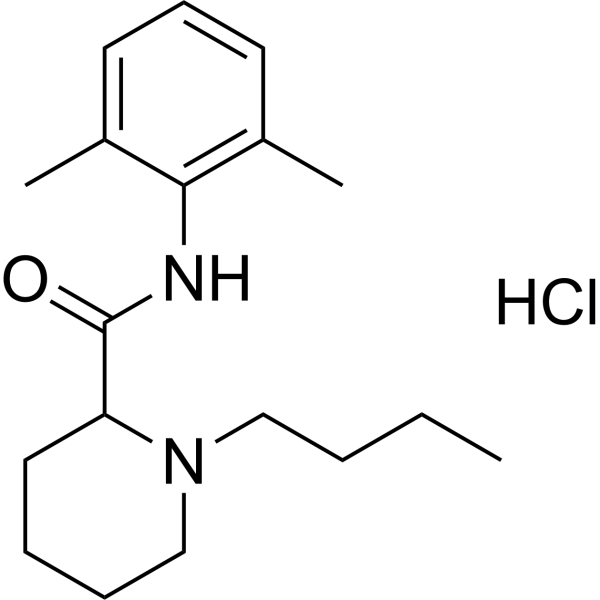

Publications Citing Use of MedChemExpress (MCE) Benzocaine (hydrochloride)
MoreAll Calcium Channel Isoforms
More

Biological Activity
Description
In Vitro
Benzocaine hydrochloride (0.1-3.0 mM; 1 mM) persistently blocks wild-type µ1 muscle voltage-gated Na+ channels expressed in HEK293t cells, with an IC50 of 0.8 mM[1].
MedChemExpress (MCE) has not independently confirmed the accuracy of these methods. They are for reference only.
Clinical Trial
| NCT Number | Sponsor | Condition | Start Date |
Phase

|
|---|---|---|---|---|
| NCT01329991 | Plexxikon| | 2011-05 | PHASE1 |


Chemical Information
-
CAS No. 23239-88-5
-
Appearance Solid
-
Molecular Weight 201.65
-
Formula C9H12ClNO2
-
Color White to off-white
-
SMILES
O=C(OCC)C1=CC=C(N)C=C1.[H]Cl
-
Shipping
Room temperature in continental US; may vary elsewhere.
-
Storage
4°C, sealed storage, away from moisture and light
* In solvent : -80°C, 6 months; -20°C, 1 month (sealed storage, away from moisture and light)


Publications (1)
-
Journal Impact Factor
-
Most Recent
-
Stem Cell Res Ther
Local anesthetics impair the growth and self-renewal of glioblastoma stem cells by inhibiting ZDHHC15-mediated GP130 palmitoylation. [Abstract]2021 Feb 4;12(1):107. PMID: 33541421


Solvent & Solubility
In Vitro:
DMSO : 250 mg/mL (1239.77 mM; Need ultrasonic; Hygroscopic DMSO has a significant impact on the solubility of product, please use newly opened DMSO)
Please refer to the solubility information to select the appropriate solvent. Once prepared, please aliquot and store the solution to prevent product inactivation from repeated freeze-thaw cycles.
Storage method and period of stock solution: -80°C, 6 months; -20°C, 1 month (sealed storage, away from moisture and light). When stored at -80°C, please use it within 6 months. When stored at -20°C, please use it within 1 month.
Please refer to the solubility information to select the appropriate solvent. Once prepared, please aliquot and store the solution to prevent product inactivation from repeated freeze-thaw cycles.
Storage method and period of stock solution: -80°C, 6 months; -20°C, 1 month (sealed storage, away from moisture and light). When stored at -80°C, please use it within 6 months. When stored at -20°C, please use it within 1 month.
Concentration (start) × Volume (start) = Concentration (final) × Volume (final)
In Vivo:
Select the appropriate dissolution method based on your experimental animal and administration route.
- For the following dissolution methods, please ensure to first prepare a clear stock solution using an In Vitro approach and then sequentially add co-solvents:
- To ensure reliable experimental results, the clarified stock solution can be appropriately stored based on storage conditions. As for the working solution for In Vivo experiments, it is recommended to prepare freshly and use it on the same day.
- The percentages shown for the solvents indicate their volumetric ratio in the final prepared solution. If precipitation or phase separation occurs during preparation, heat and/or sonication can be used to aid dissolution.
Add each solvent one by one: 10% DMSO 40% PEG300 5% Tween-80 45% Saline
Solubility: ≥ 2.08 mg/mL (10.31 mM); Clear solution
This protocol yields a clear solution of ≥ 2.08 mg/mL (saturation unknown).
Taking 1 mL working solution as an example, add 100 μL DMSO stock solution (20.8 mg/mL) to 400 μL PEG300, and mix evenly; then add 50 μL Tween-80 and mix evenly; then add 450 μL Saline to adjust the volume to 1 mL.
Preparation of Saline: Dissolve 0.9 g sodium chloride in ddH₂O and dilute to 100 mL to obtain a clear Saline solution.
Add each solvent one by one: 10% DMSO 90% (20% SBE-β-CD in Saline)
Solubility: ≥ 2.08 mg/mL (10.31 mM); Clear solution
This protocol yields a clear solution of ≥ 2.08 mg/mL (saturation unknown).
Taking 1 mL working solution as an example, add 100 μL DMSO stock solution (20.8 mg/mL) to 900 μL 20% SBE-β-CD in Saline, and mix evenly.
Preparation of 20% SBE-β-CD in Saline (4°C, storage for one week): 2 g SBE-β-CD powder is dissolved in 10 mL Saline, completely dissolve until clear.
In Vivo Dissolution Calculator
Please enter the basic information of animal experiments:
-
-
-
-
Recommended: Prepare an additional quantity of animals to account for potential losses during experiments.
Please enter your animal formula composition:
-
%DMSO +
Recommended: Keep the proportion of DMSO in working solution below 2% if your animal is weak.
-
%+
-
+%Tween-80 + +
-
%Saline +
The co-solvents required include: DMSO, . All of co-solvents are available by MedChemExpress (MCE). , Tween 80. All of co-solvents are available by MedChemExpress (MCE).
Working solution concentration: 0.22 mg/mL
Method for preparing stock solution: mg drug dissolved in μL DMSO. Stock solution concentration: mg/mL. * In solvent : -80°C, 6 months; -20°C, 1 month (sealed storage, away from moisture and light)
1. Take μL DMSO stock solution;
2. Add μL .
μL , mix evenly;
3. Then add μL Tween 80, mix evenly;
4. Then add μL
Please ensure that the stock solution in the first step is dissolved to a clear state, and add co-solvents in sequence. You can use ultrasonic heating (ultrasonic cleaner, recommended frequency 20-40 kHz), vortexing, etc. to assist dissolution.


Purity & Documentation
-
Data Sheet (273 KB)
-
SDS (393 KB)
- English - EN (393 KB)
- Français - FR (393 KB)
- Deutsch - DE (393 KB)
- Norwegian - NO (393 KB)
- Español - ES (393 KB)
- Swedish - SV (393 KB)
- Italian - IT (393 KB)
- Korean - KR (393 KB)
- Portuguese - PT (393 KB)
-
Handling Instructions (2659 KB)
References
[1]. Wang GK, et al. A common local anesthetic receptor for benzocaine and etidocaine in voltage-gated mu1 Na+ channels. Pflugers Arch. 1998 Jan;435(2):293-302. [Content Brief]
[2]. Di Croce D, et al. Drug action of benzocaine on the sarcoplasmic reticulum Ca-ATPase from fast-twitch skeletal muscle. Naunyn Schmiedebergs Arch Pharmacol. 2015;388(11):1163-1170. [Content Brief]
[3]. Davis JA, et al. Benzocaine-induced methemoglobinemia attributed to topical application of the anesthetic in several laboratory animal species. Am J Vet Res. 1993;54(8):1322-1326. [Content Brief]


Complete Stock Solution Preparation Table
Please refer to the solubility information to select the appropriate solvent. Once prepared, please aliquot and store the solution to prevent product inactivation from repeated freeze-thaw cycles.
Storage method and period of stock solution: -80°C, 6 months; -20°C, 1 month (sealed storage, away from moisture and light). When stored at -80°C, please use it within 6 months. When stored at -20°C, please use it within 1 month.
| Optional Solvent | Concentration Solvent Mass | 1 mg | 5 mg | 10 mg | 25 mg |
|---|---|---|---|---|---|
| DMSO | 1 mM | 4.9591 mL | 24.7954 mL | 49.5909 mL | 123.9772 mL |
| 5 mM | 0.9918 mL | 4.9591 mL | 9.9182 mL | 24.7954 mL | |
| 10 mM | 0.4959 mL | 2.4795 mL | 4.9591 mL | 12.3977 mL | |
| 15 mM | 0.3306 mL | 1.6530 mL | 3.3061 mL | 8.2651 mL | |
| 20 mM | 0.2480 mL | 1.2398 mL | 2.4795 mL | 6.1989 mL | |
| 25 mM | 0.1984 mL | 0.9918 mL | 1.9836 mL | 4.9591 mL | |
| 30 mM | 0.1653 mL | 0.8265 mL | 1.6530 mL | 4.1326 mL | |
| 40 mM | 0.1240 mL | 0.6199 mL | 1.2398 mL | 3.0994 mL | |
| 50 mM | 0.0992 mL | 0.4959 mL | 0.9918 mL | 2.4795 mL | |
| 60 mM | 0.0827 mL | 0.4133 mL | 0.8265 mL | 2.0663 mL | |
| 80 mM | 0.0620 mL | 0.3099 mL | 0.6199 mL | 1.5497 mL | |
| 100 mM | 0.0496 mL | 0.2480 mL | 0.4959 mL | 1.2398 mL |


Benzocaine (hydrochloride) Related Classifications
HY-Y0258A Related Classifications
 Powered by Bioz
Keywords
- Benzocaine (hydrochloride)
- 23239-88-5
- Sodium Channel
- Calcium Channel
- rabbit sarcoplasmic reticulum Ca-ATPase
- methemoglobinemia
- μ1-F1579A Na+ channel
- HEK293t cells
- p-aminobenzoic acid
- μ1-N1584A Na+ channel
- sarcoplasmic reticulum Ca-ATPase
- etidocaine
- μ1-I1575A Na+ channel
- voltage-gated μ1 Na+ channel
- Inhibitor
- inhibitor
- inhibit