1. Search Result
Search Result
Results for "

Escherichia coli K12

" in MedChemExpress (MCE) Product Catalog:

9

Inhibitors & Agonists

1

Peptides

1

Natural
Products

2

Recombinant Proteins

Cat. No. Product Name Target Research Areas Chemical Structure
  • HY-P2876

    Bacterial Others
    Tryptophanase is a zymogen-converting enzyme and inducible enzyme that can convert its inactive precursor form into an active enzyme without additional polypeptide synthesis. In Escherichia coli K12, tryptophanase functions as an inducible enzyme, and its induction kinetics are similar to those of β-galactosidase. Tryptophanase catalyzes the conversion of L-tryptophan to indole .
    Tryptophanase
  • HY-118391

    N-Benzoyl-L-phenylalanine; Bz-L-Phe-OH

    Carboxypeptidase Others
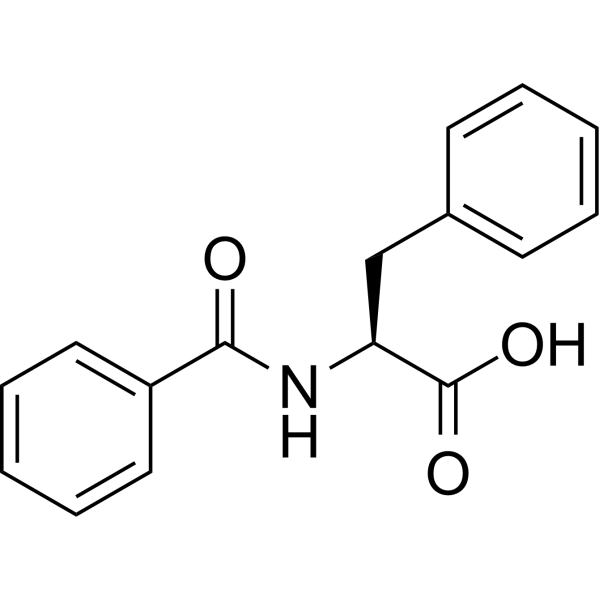
    Benzoyl-L-phenylalanine (N-Benzoyl-L-phenylalanine) is a chorisate mutase-prephenate dehydrogenase inhibitor .
    Benzoyl-L-phenylalanine
  • HY-N12320

    Antibiotic Infection
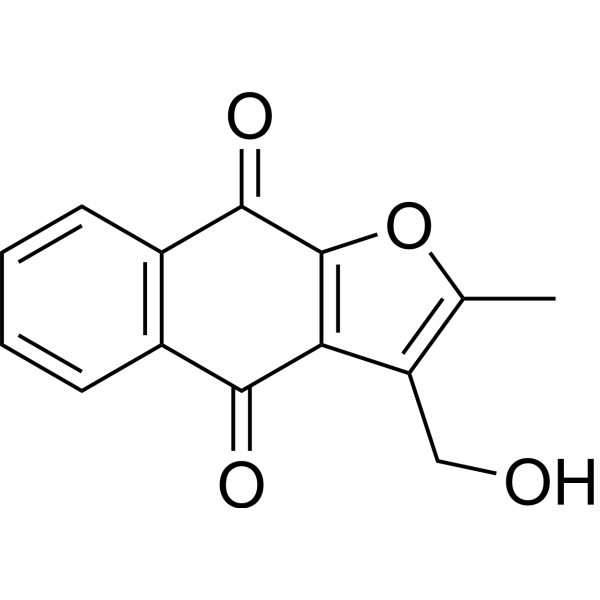
    Majoranaquinone exhibits a high antibacterial effect against 4 Staphylococcus, 1 Moraxella, and 1 Enterococcus strains. Majoranaquinone shows substantial efflux pump inhibitory activity in Escherichia coliATCC 25922 strain. Majoranaquinone is found to be an effective biofilm formation inhibitor on E.coli, ATCC 25922 and E. coli K-12 AG100 bacteria .
    Majoranaquinone
  • HY-135599

    Bacterial Infection
    Lysine hydroxamate is an amino acid hydroxamate that inhibits the growth of Escherichia coli K-12. Of the other amino acid hydroxamates tested, only L-lysine hydroxamate reduced the growth rate. The inhibition of growth by L-serine hydroxamate could be rapidly reversed by adding L-serine to the bacterial culture or by removing the analog by filtration. This reversal was specific for L-serine. L-alanine, glycine, or adenine had no effect on the inhibited culture. There was no evidence for active transport of the analog.
    Lysine hydroxamate
  • HY-144728

    Bacterial Infection
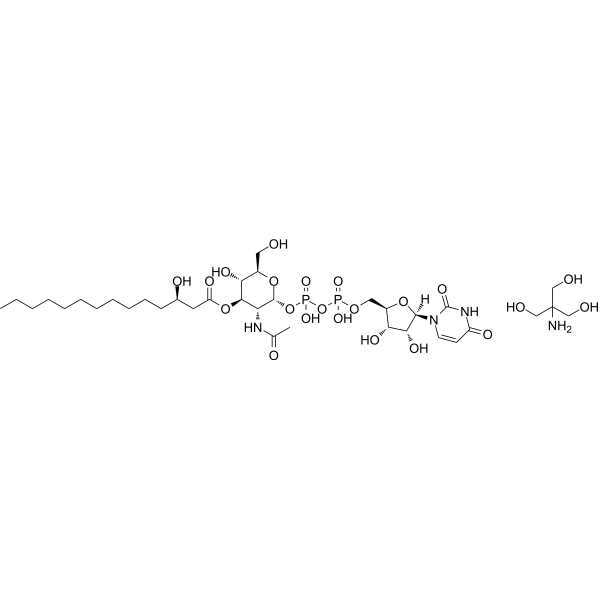
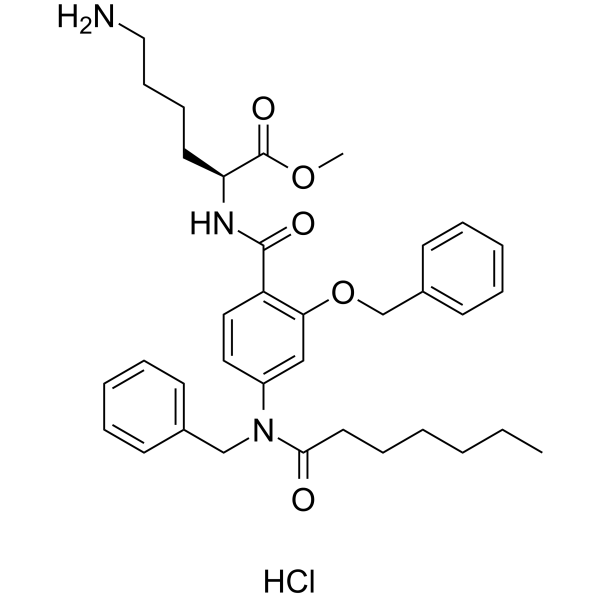
    MraY-IN-1 (compound 12a) is a potent  MraY inhibitor with an IC50 value of 140 μM. MraY-IN-1 has antimicrobial activity against Escherichia coli K12, Bacillus subtilis W23 and Pseudomonas fluorescens Pf-5 with MIC50s of 7 µg/mL, 12 µg/mL and 46 µg/mL, respectively. MraY-IN-1 can be used for researching anti-bacteria .
    MraY-IN-3 hydrochloride
  • HY-181939

    Bacterial Infection
    Antibacterial agent 329 (Compound 9c) is an antibacterial agent. Antibacterial agent 329 inhibits the activity of MraY. Antibacterial agent 329 exhibits antibacterial activity against Escherichia coli K12 and Bacillus subtilis W23 with a MIC of 16 μg/mL, but shows no activity against Pseudomonas fluorescens Pf-5. Antibacterial agent 329 exerts antibacterial activity against Acinetobacter baumannii 19606, Staphylococcus aureus MRSA USA300 JE2, Enterobacter cloacae 19434, Klebsiella pneumoniae 700603 and Enterococcus faecium 19434, with MIC values of 8, 8, 16-32, 16-32 and 16 μg/mL, respectively, while it shows no activity against Pseudomonas aeruginosa NCTC 13437 .
    Antibacterial agent 329
  • HY-163383

    L-EOP

    Bacterial Infection
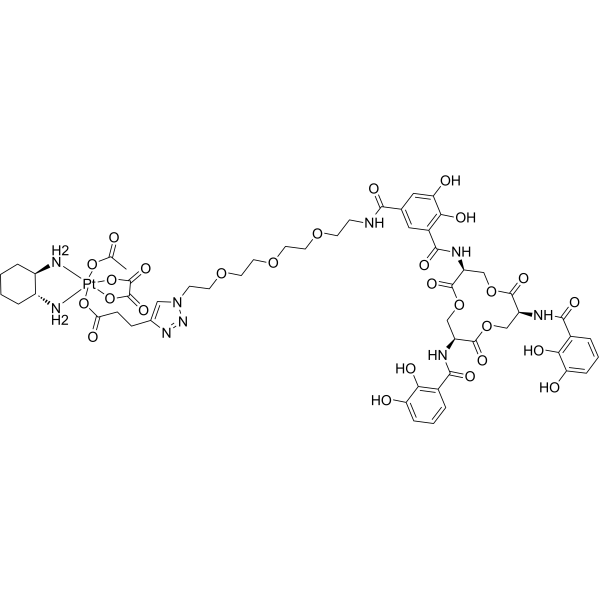
    L-Ent-oxPt IV (L-EOP) is a Oxaliplatin (HY-17371)-based siderophore-platinum conjugate. L-Ent-oxPt IV exhibits selectivity towards Escherichia coli and antibacterial activity through DNA damage .
    L-Ent-oxPt(IV)
  • HY-W614122

    4-COOH-Hippuric acid; 4-[(Carboxymethyl)amino]benzoic acid

    Drug Derivative Others
    4-((Carboxymethyl)amino)benzoic acid (4-COOH-Hippuric acid) is a derivative of 4-Aminobenzoic acidchorismate (PABA) (HY-B1008). 4-((Carboxymethyl)amino)benzoic acid is a competitive inhibitor of 4-Amino-4-deoxychorismate synthase .
    4-((Carboxymethyl)amino)benzoic acid
  • HY-N15117A

    Antibiotic Bacterial Infection
    Polymyxin P1 TFA is a lipopeptide antibiotic belonging to the Polymyxin family, and it is a secondary metabolite produced by the rhizosphere bacterium Paenibacillus polymyxa M-1. Polymyxin P1 TFA binds to bacterial outer membrane lipopolysaccharides, permeabilizes cell membranes, and induces dense protrusions on the cell surface of phytopathogenic Erwinia strains. Polymyxin P1 TFA inhibits the growth of phytopathogenic Erwinia amylovora and E. carotovora. Polymyxin P1 TFA can be used for the research of fire blight and soft rot .
    Polymyxin P1 TFA

Inquiry Online

Your information is safe with us. * Required Fields.

Salutation


Country or Region *

Applicant Name *


Organization Name *

Department *


Email Address *


Product Name *

Cat. No.


Requested quantity *

Phone Number *


Remarks

Inquiry Online

Inquiry Information

Product Name:
Cat. No.:
Quantity:
MCE Japan Authorized Agent:

