6 Results for "

Glycerophospholipid metabolism

" in MedChemExpress (MCE) Product Catalog:
Products (6)

6 Results for "Glycerophospholipid metabolism" in MCE Product Catalog:

2
2 Cited Publications
Cat. No.: HY-122949
CAS No.: 91590-76-0
Pureté:  ≥97.0%
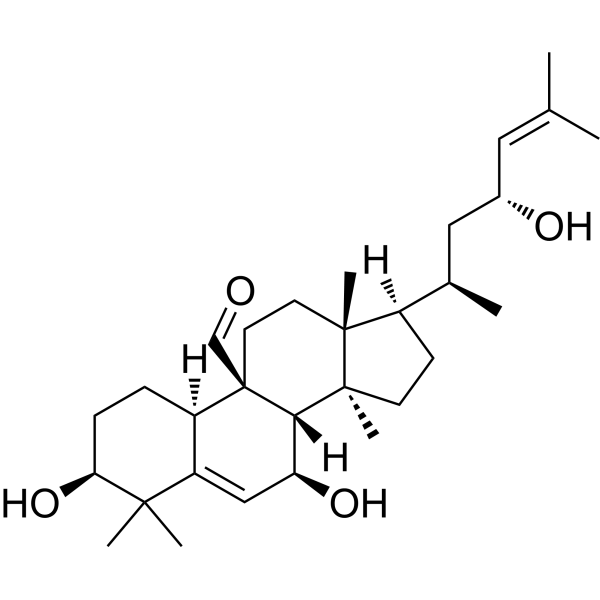
Momordicine I is a cucurbitane-type triterpenoids. Momordicine I suppresses glioma growth by promoting apoptosis and impairing mitochondrial oxidative phosphorylation. Momordicine I inhibits glycolysis, lipid metabolism, induces autophagy in HNC cells to suppress head and neck cancer growth. Momordicine I alleviates isoproterenol-induced cardiomyocyte hypertrophy through suppression of PLA2G6 and DGK-ζ. Momordicine I exerts its cardiovascular benefits by upregulating nitric oxide, inhibiting the activity of angiotensin-converting enzyme (ACE), activating the PI3K/Akt pathway, reducing oxidative stress and inflammation. Momordicine I inhibits AKT1, IL-6, and SRC, suggesting its potential application in type 2 diabetes .
loading...
    loading...
2
2 Cited Publications
Cat. No.: HY-P2733D
Target:  

Endogenous Metabolite

Domaines de recherche:  

Metabolic Disease

Glycerol 3-phosphate Oxidase, Streptococcus thermophilus (EC 1.1.3.21), is an oxidoreductase that acts on the CH-OH group in donor molecules and uses oxygen as an acceptor. Glycerol 3-phosphate Oxidase participates in glycerophospholipid metabolism and utilizes a cofactor, FAD. The two substrates of Glycerol 3-phosphate Oxidase are sn-glycerol-3-phosphate and O2, while its two products are glycerophosphate and H2O2.
loading...
    loading...
Cat. No.: HY-143203
CAS No.: 7266-53-7
Pureté:  ≥98.0%
Synonyms: 1-Stearoyl-2-linoleoyl-sn-glycero-3-phosphoethanolamine
Target:  

Liposome

Domaines de recherche:  

Cardiovascular Disease Cancer

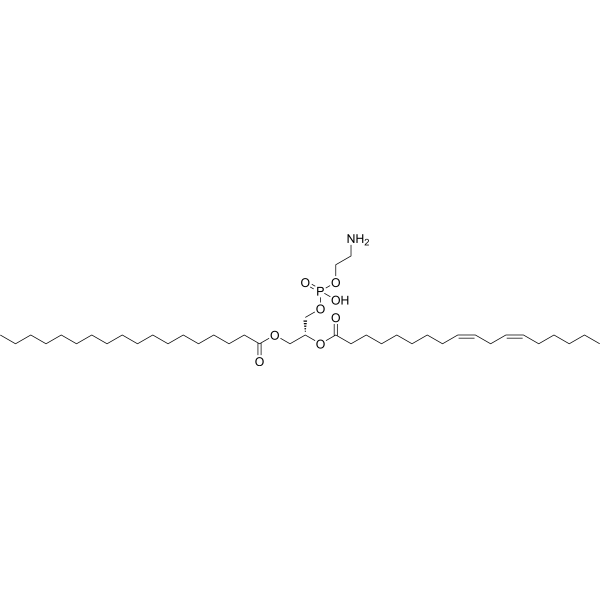
18:0-18:2 PE (1-Stearoyl-2-linoleoyl-sn-glycero-3-phosphoethanolamine) is a glycerophospholipid compound and an essential component of biological cell membranes. 18:0-18:2 PE possesses biological activities including regulation of phospholipid metabolism, antioxidant activity, maintenance of cell membrane fluidity, immune protection, and regulation of signaling pathways. 18:0-18:2 PE in the hot processing process, its unsaturated fatty acids will degrade to form a variety of odor active compounds. 18:0-18:2 PE can be applied in food processing and research on phospholipid metabolism-related diseases .
loading...
    loading...
Cat. No.: HY-E71004
Domaines de recherche:  

Metabolic Disease

L-α-glycerophosphate oxidase, microorganism (EC 1.1.3.21), is an oxidoreductase that acts on the CH-OH group of donor molecules and uses oxygen as an acceptor. L-α-glycerophosphate oxidase participates in glycerophospholipid metabolism and utilizes a cofactor, FAD.
loading...
    loading...
Cat. No.: HY-E71004A
Domaines de recherche:  

Others

L-α-glycerophosphate oxidase, Pediococcus sp. (EC 1.1.3.21), is an oxidoreductase that acts on the CH-OH group of donor molecules and uses oxygen as an acceptor. L-α-glycerophosphate oxidase participates in glycerophospholipid metabolism and utilizes a cofactor, FAD.
loading...
    loading...
Cat. No.: HY-185900
CAS No.: 132338-91-1
Target:  

Endogenous Metabolite

Domaines de recherche:  

Metabolic Disease

PC (15:0/18:2 (9Z,12Z)) is a phosphatidylcholine and biomarker. PC (15:0/18:2 (9Z,12Z)) is negatively correlated with beef marbling traits. PC (15:0/18:2 (9Z,12Z)) is associated with cadmium-induced lipid metabolism disorders in rats. PC (15:0/18:2 (9Z,12Z)) can be used for research related to lipid metabolism disorders .
loading...
    loading...

