20 Results for "

Lycopersicon esculentum

" in MedChemExpress (MCE) Product Catalog:
Products (20)

20 Results for "Lycopersicon esculentum" in MCE Product Catalog:

2
2 Cited Publications
Cat. No.: HY-N2166
CAS No.: 17406-45-0
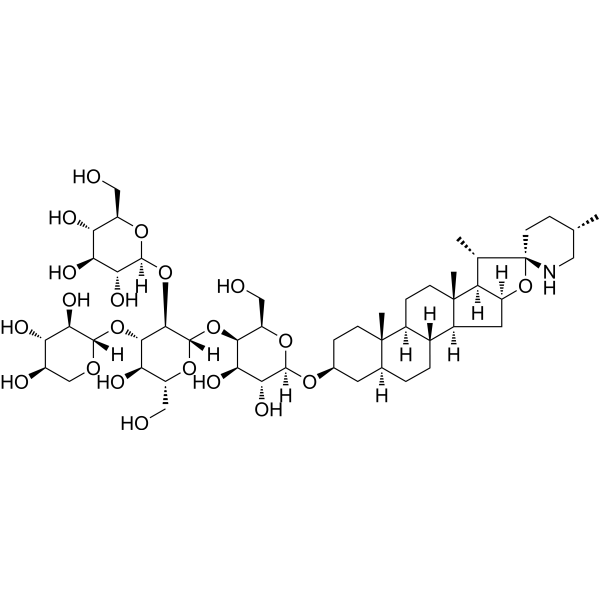
Synonyms: α-Tomatine; Lycopersicin; Tomatin
Tomatine is a glycoalkaloid, found in the tomato plant (Lycopersicon esculentum Mill.). Tomatine elicits neurotoxicity in RIP1 kinase and caspase-independent manner. Tomatine promotes the upregulation of nuclear apoptosis inducing factor (AIF) in neuroblastoma cells. Tomatine also inhibits 20S proteasome activity .
loading...
    loading...
Cat. No.: HY-NP188
Synonyms: LEL (FITC)
Lycopersicon esculentum (Tomato) Lectin (FITC) is Lycopersicon esculentum (Tomato) Lectin (HY-NP071) labeled with FITC (HY-66019). Lycopersicon esculentum (Tomato) Lectin (FITC) binds to poly-N-acetyllactosamine oligosaccharides. Lycopersicon esculentum (Tomato) Lectin (FITC) is a major component of carbohydrates on the surface of endothelial and epithelial cells .
loading...
    loading...
Cat. No.: HY-NP148
Synonyms: LEL (Biotin)
Lycopersicon esculentum (Tomato) Lectin Biotin is a plant lectin that can be used as a probe to specifically bind biomolecules (such as polysaccharides, peptides, etc.). Lycopersicon esculentum (Tomato) Lectin Biotin is a biological material or organic compound that can be used in life science research .
loading...
    loading...
Cat. No.: HY-NP0136
Synonyms: LEL (Fluorescein)
Lycopersicon esculentum (Tomato) Lectin (LEL) Fluorescein is a plant lectin that can be used as a probe to specifically bind biomolecules (such as polysaccharides, peptides, etc.).Lycopersicon esculentum (Tomato) Lectin (LEL) Fluorescein is a biological material or organic compound that can be used in life science research .
loading...
    loading...
Cat. No.: HY-NP071
Synonyms: LEL
Lycopersicon esculentum (Tomato) Lectin (LEL) specifically recognizes and binds to sugar structures, that combines with fluorescein for fluorescent labeling and imaging of cells and tissues. Lycopersicon esculentum (Tomato) Lectin is used to visualizes the vasculature within transplanted tissues by labeling with fluorescein .
loading...
    loading...
Cat. No.: HY-N13254
Moringa Extract is the extract of Moringa with antioxidative and antibacterial activity. Moringa Extract increases Nrf2 and NQO1 expression, scavenges radicals, reduces oxidative stress, inhibits growth of Staphylococcus aureus and Escherichia coli. Moringa Extract can be used for the research of dietary supplements, cosmetics, and natural water purification .
loading...
    loading...
Cat. No.: HY-N2166R
CAS No.: 17406-45-0
Synonyms: α-Tomatine (Standard); Lycopersicin (Standard); Tomatin (Standard)
Tomatine is a glycoalkaloid, found in the tomato plant (Lycopersicon esculentum Mill.). Tomatine elicits neurotoxicity in RIP1 kinase and caspase-independent manner. Tomatine promotes the upregulation of nuclear apoptosis inducing factor (AIF) in neuroblastoma cells. Tomatine also inhibits 20S proteasome activity .
loading...
    loading...
Cat. No.: HY-NP071A
Synonyms: LEL-AF350
Lycopersicon esculentum (Tomato) Lectin-AF350 (LEL-AF350) is Lycopersicon esculentum lectin (LEL) labeled with the AF350 fluorescent dye. Lycopersicon esculentum (Tomato) lectin specifically recognizes and binds to glycan structures, primarily targeting N-acetyl-β-D-glucosamine residues. Lycopersicon esculentum (Tomato) Lectin-AF350 can be used to study glycosylation and localize glycan structures on cell surfaces and in tissue sections (Ex/Em = 346/445 nm).
loading...
    loading...
Cat. No.: HY-NP071B
Synonyms: LEL-AF405
Lycopersicon esculentum (Tomato) Lectin-AF405 (LEL-AF405) is Lycopersicon esculentum lectin (LEL) labeled with the AF405 fluorescent dye. Lycopersicon esculentum (Tomato) lectin specifically recognizes and binds to glycan structures, primarily targeting N-acetyl-β-D-glucosamine residues. Lycopersicon esculentum (Tomato) Lectin-AF405 can be used to study glycosylation and localize glycan structures on cell surfaces and in tissue sections (Ex/Em = 405/435 nm).
loading...
    loading...
Cat. No.: HY-NP071C
Synonyms: LEL-AF488
Lycopersicon esculentum (Tomato) Lectin-AF488 (LEL-AF488) is Lycopersicon esculentum lectin (LEL) labeled with the AF488 fluorescent dye. Lycopersicon esculentum (Tomato) lectin specifically recognizes and binds to glycan structures, primarily targeting N-acetyl-β-D-glucosamine residues. Lycopersicon esculentum (Tomato) Lectin-AF488 can be used to study glycosylation and localize glycan structures on cell surfaces and in tissue sections (Ex/Em = 470/520 nm).
loading...
    loading...
Cat. No.: HY-NP071D
Synonyms: LEL-AF568
Lycopersicon esculentum (Tomato) Lectin-AF568 (LEL-AF568) is Lycopersicon esculentum lectin (LEL) labeled with the AF568 fluorescent dye. Lycopersicon esculentum (Tomato) lectin specifically recognizes and binds to glycan structures, primarily targeting N-acetyl-β-D-glucosamine residues. Lycopersicon esculentum (Tomato) Lectin-AF568 can be used to study glycosylation and localize glycan structures on cell surfaces and in tissue sections (Ex/Em = 579/603 nm).
loading...
    loading...
Cat. No.: HY-NP071E
Synonyms: LEL-AF594
Lycopersicon esculentum (Tomato) Lectin-AF594 (LEL-AF594) is Lycopersicon esculentum lectin (LEL) labeled with the AF594 fluorescent dye. Lycopersicon esculentum (Tomato) lectin specifically recognizes and binds to glycan structures, primarily targeting N-acetyl-β-D-glucosamine residues. Lycopersicon esculentum (Tomato) Lectin-AF594 can be used to study glycosylation and localize glycan structures on cell surfaces and in tissue sections (Ex/Em = 590/617 nm).
loading...
    loading...
Cat. No.: HY-NP071H
Synonyms: LEL-AF647
Lycopersicon esculentum (Tomato) Lectin-AF647 (LEL-AF647) is Lycopersicon esculentum lectin (LEL) labeled with the AF647 fluorescent dye. Lycopersicon esculentum (Tomato) lectin specifically recognizes and binds to glycan structures, primarily targeting N-acetyl-β-D-glucosamine residues. Lycopersicon esculentum (Tomato) Lectin-AF647 can be used to study glycosylation and localize glycan structures on cell surfaces and in tissue sections (Ex/Em = 650/665 nm).
loading...
    loading...
Cat. No.: HY-NP071I
Synonyms: LEL-AF680
Lycopersicon esculentum (Tomato) Lectin-AF680 (LEL-AF680) is Lycopersicon esculentum lectin (LEL) labeled with the AF680 fluorescent dye. Lycopersicon esculentum (Tomato) lectin specifically recognizes and binds to glycan structures, primarily targeting N-acetyl-β-D-glucosamine residues. Lycopersicon esculentum (Tomato) Lectin-AF680 can be used to study glycosylation and localize glycan structures on cell surfaces and in tissue sections (Ex/Em = 684/707 nm).
loading...
    loading...
Cat. No.: HY-NP071J
Synonyms: LEL-Cy3
Lycopersicon esculentum (Tomato) Lectin-Cy3 (LEL-Cy3) is Lycopersicon esculentum lectin (LEL) labeled with the Cy3 fluorescent dye. Lycopersicon esculentum (Tomato) lectin specifically recognizes and binds to glycan structures, primarily targeting N-acetyl-β-D-glucosamine residues. Lycopersicon esculentum (Tomato) Lectin-Cy3 can be used to study glycosylation and localize glycan structures on cell surfaces and in tissue sections (Ex/Em = 554/568 nm).
loading...
    loading...
Cat. No.: HY-NP071K
Synonyms: LEL-Cy5
Lycopersicon esculentum (Tomato) Lectin-Cy5 (LEL-Cy5) is Lycopersicon esculentum lectin (LEL) labeled with the Cy5 fluorescent dye. Lycopersicon esculentum (Tomato) lectin specifically recognizes and binds to glycan structures, primarily targeting N-acetyl-β-D-glucosamine residues. Lycopersicon esculentum (Tomato) Lectin-Cy5 can be used to study glycosylation and localize glycan structures on cell surfaces and in tissue sections (Ex/Em = 554/568 nm).
loading...
    loading...
Cat. No.: HY-NP071L
Synonyms: LEL-Cy7
Lycopersicon esculentum (Tomato) Lectin-Cy7 (LEL-Cy7) is Lycopersicon esculentum lectin (LEL) labeled with the Cy7 fluorescent dye. Lycopersicon esculentum (Tomato) lectin specifically recognizes and binds to glycan structures, primarily targeting N-acetyl-β-D-glucosamine residues. Lycopersicon esculentum (Tomato) Lectin-Cy7 can be used to study glycosylation and localize glycan structures on cell surfaces and in tissue sections (Ex/Em = 554/568 nm).
loading...
    loading...
Cat. No.: HY-N2166A
CAS No.: 17605-83-3
Synonyms: α-Tomatine hydrochloride; Lycopersicin hydrochloride; Tomatin hydrochloride
Target:  

Proteasome Apoptosis

Research Areas:  

Neurological Disease

Tomatine hydrochloride is a glycoalkaloid, found in the tomato plant (Lycopersicon esculentum Mill.). Tomatine hydrochloride elicits neurotoxicity in RIP1 kinase and caspase-independent manner. Tomatine hydrochloride promotes the upregulation of nuclear apoptosis inducing factor (AIF) in neuroblastoma cells. Tomatine hydrochloride also inhibits 20S proteasome activity .
loading...
    loading...
Cat. No.: HY-182491
CAS No.: 450398-31-9
Cytochalasin Z2 is a 24-oxa-[14]cytochalasan. Cytochalasin Z2 is isolated from wheat cultures of Pyrenophora semeniperda. Cytochalasin Z2 shows no activity in root elongation assays of wheat and tomato seedlings .
loading...
    loading...
Cat. No.: HY-23201
CAS No.: 1035557-09-5
Synonyms: Phytoprostane A1; PPA1
Research Areas:  

Others

A1-Phytoprostane-I (Phytoprostane A1) is a cyclopentenone-type phytoprostane that forms via free radical-catalyzed non-enzymatic oxidation of α-linolenic acid. A1-Phytoprostane-I exhibits multiple biological activities, including inducing the accumulation of phytoalexins (e.g., Scopoletin (HY-N0342)) in tobacco cells, activating mitogen-activated protein kinases (MAPK) in tomato cells, and inducing the expression of glutathione-S-transferase 1 (Glutathione-S-transferase 1) in Arabidopsis thaliana .
loading...
    loading...
  • 1

