12 Results for "

Neurodegenerative tauopathies

" in MedChemExpress (MCE) Product Catalog:
Products (12)

12 Results for "Neurodegenerative tauopathies" in MCE Product Catalog:

Cat. No.: HY-D0961
CAS No.: 1562-85-2
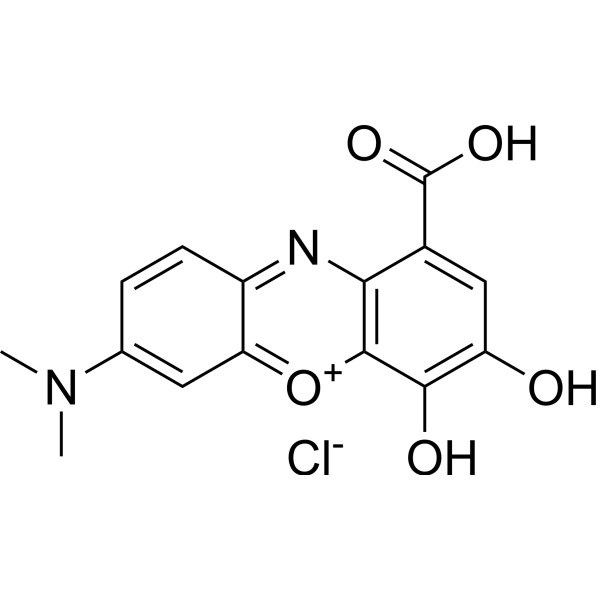
Gallocyanine chloride is a synthetic blue dyestuff that can be used as a potential agent for the research of Alzheimer's disease and related neurodegenerative tauopathies. Gallocyanine chloride inhibits DKK1/LRP6 interaction (IC50=6.38 μM), activates Wnt signaling pathway, and causes β-catenin accumulation. Gallocyanine chloride exhibits anti-metastasis, anti-inflammatory and anti-fibrosis activities. Gallocyanine chloride can be used as a fluorescent probe for detection of superoxide anion radicals .
loading...
    loading...
Cat. No.: HY-161307
CAS No.: 2276680-91-0
Research Areas:  

Neurological Disease

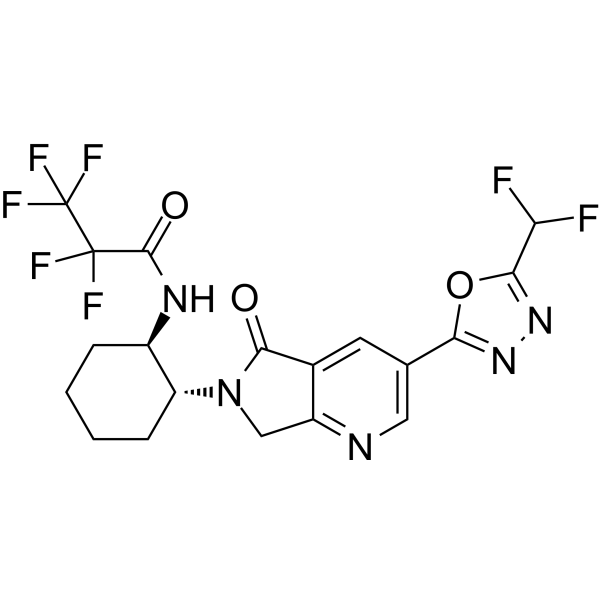
T-518 is an orally active, BBB-penetrant and potent DFMO-based HDAC6 inhibitor with high selectivity (IC50 = 36 nM). T-518 improves axonal transport. T-518 ameliorates object recognition deficit. T-518 can be studied in research for Alzheimer’s disease and tauopathy .
loading...
    loading...
Cat. No.: HY-174311
CAS No.: 2648407-76-3
Target:  

Glycosidase

GT-02216 can bind to GCase allosterically and enhance its activity. GT-02216 enhances the activity of GCase in primary human fibroblasts dose-dependently reduces the accumulation of its substrate, hexosylsphingosine (HexCer). GT-02216 reduces the Tau accumulation in mutant GBA1 fibroblasts. GT-02216 can be used for the study of Parkinson’s disease .
loading...
    loading...
Cat. No.: HY-156586
CAS No.: 1884154-02-2
Purity:  99.63%
Synonyms: ASN90
Target:  

OGA Tau Protein

Research Areas:  

Neurological Disease

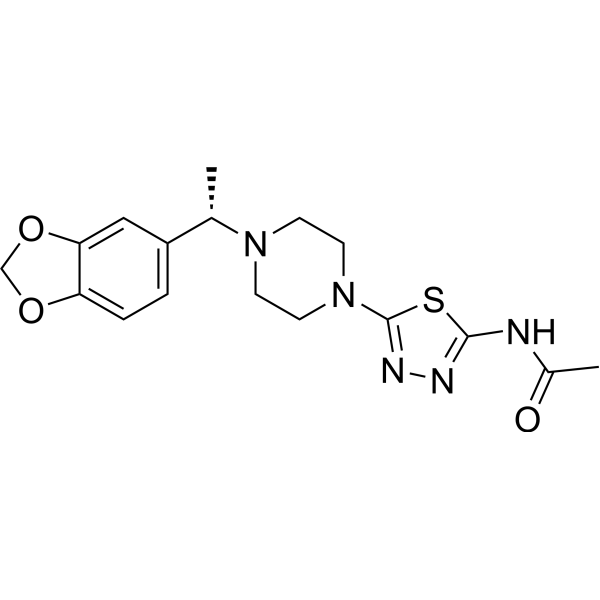
Egalognastat (ASN90) is a selective, brain-penetrant and orally active O-GlcNAcase (OGA) enzyme inhibitor with an IC50 value of 10.2 nM. Egalognastat increases O-GlcNAcylation of intracellular proteins like tau and α-synuclein, preventing their aggregation and toxicity. Egalognastat does not inhibit hexosaminidase (Hex). Egalognastat can be used for the research of neurodegenerative diseases, such as tauopathies and α-synucleinopathies (e.g., Alzheimer’s disease and Parkinson’s disease) .
loading...
    loading...
Cat. No.: HY-P10861A
Target:  

Tau Protein

Research Areas:  

Neurological Disease

RI-AG03 acetate is a proteolytically stable tau aggregation inhibitor that crosses the blood-brain barrier and exhibits oral efficacy. RI-AG03 acetate inhibits tau aggregation and promotes the formation of alternative amorphous aggregates that are non-amyloidogenic. RI-AG03 acetate mediates cellular uptake through direct membrane penetration and macropinocytosis, and its conjugation with cell-penetrating peptide sequences (CPPs) enhances the binding of cells to liposomes. RI-AG03 acetate suppresses aggregation-dependent neurodegenerative and behavioral phenotypes, and extends the lifespan of Drosophila models of tauopathy. RI-AG03 acetate can be used for research on tau-related diseases such as Alzheimer's disease .
loading...
    loading...
Cat. No.: HY-148112
CAS No.: 851871-94-8
Purity:  99.91%
Target:  

Casein Kinase

Research Areas:  

Neurological Disease

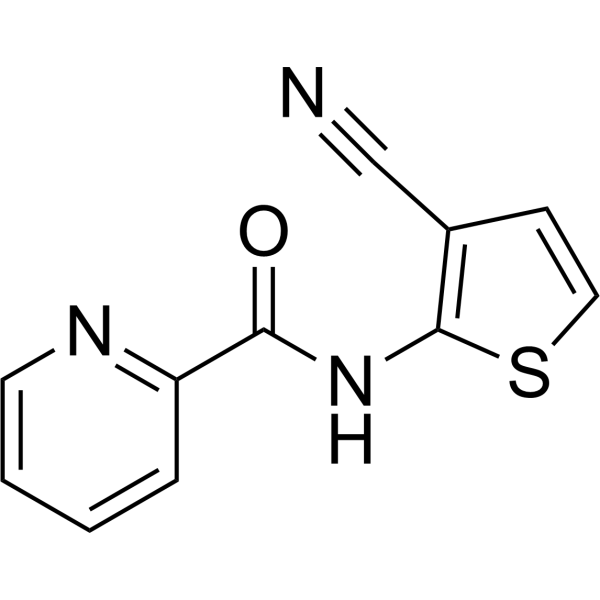
Casein kinase 1δ-IN-1 is an inhibitor of casein kinase 1δ (CK1δ). Casein kinase 1δ-IN-1 can be used for the research of neurodegenerative diseases such as tauopathies .
loading...
    loading...
Cat. No.: HY-P10861
Target:  

Tau Protein

Research Areas:  

Neurological Disease

RI-AG03 is a proteolytically stable tau aggregation inhibitor that crosses the blood-brain barrier and exhibits oral efficacy. RI-AG03 inhibits tau aggregation and promotes the formation of alternative amorphous aggregates that are non-amyloidogenic. RI-AG03 mediates cellular uptake through direct membrane penetration and macropinocytosis, and its conjugation with cell-penetrating peptide sequences (CPPs) enhances the binding of cells to liposomes. RI-AG03 suppresses aggregation-dependent neurodegenerative and behavioral phenotypes, and extends the lifespan of Drosophila models of tauopathy. RI-AG03 can be used for research on tau-related diseases such as Alzheimer's disease .
loading...
    loading...
Cat. No.: HY-176540
CAS No.: 2699937-76-1
Target:  

Microtubule/Tubulin

Research Areas:  

Neurological Disease

Microtubule stabilizer-1 (compound 69) is a brain-penetrant microtubule (MT) stabilizer. Microtubule stabilizer-1 increases acetylated α-tubulin (AcTub) levels and prevents the characteristic loss of neuronal MTs that is observed after incubation with Okadaic acid (HY-N6785). Microtubule stabilizer-1 can be used for the study of Alzheimer’s disease (AD) and related neurodegenerative tauopathies .
loading...
    loading...
Cat. No.: HY-W835959
CAS No.: 2361566-66-5
Target:  

Tau Protein

Research Areas:  

Neurological Disease

ACI-3024 is an an orally active and highly selective Tau protein aggregation inhibitor. ACI-3024 decrease the β-sheet content and seeding properties of pathological Tau from different Tauopathies, leading to a significant rescue of the Tau-induced neurodegeneration and neuroinflammation in a cellular model. ACI-3024 is promising for research of neurodegenerative diseases .
loading...
    loading...
Cat. No.: HY-176936
CAS No.: 1283397-08-9
Target:  

Tau Protein

Research Areas:  

Neurological Disease

Tau-aggregation-IN-5 is a Tau-aggregation inhibitor (EC50 = 0.31 μM). Tau-aggregation-IN-5 targets P4HB covalently and activates mild ER stress. Tau-aggregation-IN-4 can be used for the study of neurodegenerative disorders such as Alzheimer’s and Pick’s diseases .
loading...
    loading...
Cat. No.: HY-178927
Target:  

Tau Protein

Research Areas:  

Neurological Disease

Tau-aggregation-IN-4 is a Tau-aggregation inhibitor (EC50 = 2.99 μM). Tau-aggregation-IN-4 can be used for the study of neurodegenerative disorders such as Alzheimer’s and Pick’s diseases .
loading...
    loading...
Cat. No.: HY-180548
MRC37 is a high-affinity TRIM21 ligand with a Kd of 0.4 µM. MRC37 targets the IgG Fc-binding pocket in the PRYSPRY domain of TRIM21, mimics the "HHNY" epitope, and inhibits substrate-induced aggregation and activation of TRIM21 via competitive blockade of antibody binding. MRC37 effectively blocks TRIM21-mediated antiviral immunity (such as adenovirus neutralization) and Trim-Away targeted protein degradation without cytotoxicity. MRC37 antagonizes TRIMTAC activity, and its multiple modification sites do not affect target binding, making it suitable as a degrader warhead for research on viral immunity and neurodegenerative diseases such as tauopathies .
loading...
    loading...
  • 1

