
10 Results for "

T-lymphoblastic leukemia cells

" in MedChemExpress (MCE) Product Catalog:
Products (10)

10 Results for "T-lymphoblastic leukemia cells" in MCE Product Catalog:

1
1 Cited Publications
Cat. No.: HY-170620
Target:  

PROTACs PARP

Research Areas:  

Cancer

PARP1 PROTAC 180055 is a PARP1 PROTAC degrader that recruits VHL, with DC50 values of 180 nM and 240 nM in T47D and MDA-MB-231 cells, respectively. PARP1 PROTAC 180055 selectively kills BRCA-mutant tumor cells by inducing PARP1 ubiquitination and proteasomal degradation, thereby blocking PARylation, NAD + depletion and DNA trapping. PARP1 PROTAC 180055 can be used in the research of breast cancer, ovarian cancer, colorectal cancer, acute T-lymphoblastic leukemia, prostate cancer and osteosarcoma .
loading...
    loading...
Cat. No.: HY-P99650
CAS No.: 2367001-70-3
Synonyms: WT1

Research Areas:  

Cancer

Grisnilimab (WT1) is an IgG2a monoclonal antibody targeting CD7. Grisnilimab only binds to lymphoid tissues and T lymphocytes, with no off-target binding to normal tissues. Grisnilimab can be used to synthesize the immunotoxin WT1-SMPT-dgRTA, which exerts cytotoxic effects on T-lymphoblastic leukemia cells. Grisnilimab is applicable to relevant research on leukemia .
loading...
    loading...
Cat. No.: HY-161828
CAS No.: 3103763-70-5
Target:  

PROTACs CDK

Research Areas:  

Cancer

JWZ-5-13 is a CDK7 PROTAC degrader. JWZ-5-13 inhibits the proliferation of cancer cells. JWZ-5-13 is applicable to the research of ovarian cancer, diffuse large B-cell lymphoma, acute T-lymphoblastic leukemia and non-small cell lung cancer .
loading...
    loading...
Cat. No.: HY-103275
CAS No.: 241127-58-2
Purity:  99.02%
Synonyms: NSC 680410
Target:  

Bcr-Abl Apoptosis

Research Areas:  

Cancer

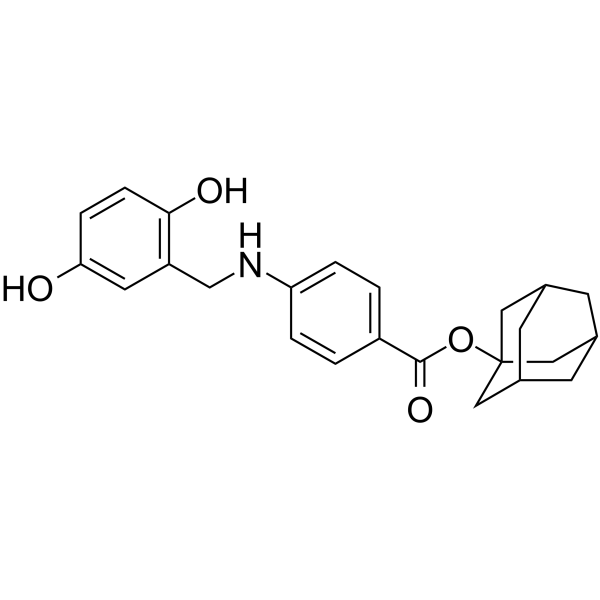
Adaphostin (NSC 680410), the adamantyl ester of AG957, is a potent p210 bcr/abl inhibitor (IC50=14 μM). Adaphostin induces apoptosis in T-lymphoblastic human leukemia cell lines (IC50 ranging from 17 to 216 nM). Adaphostin has significant and selective activity against chronic and acute myeloid leukemia cells. Adaphostin increased the level of reactive oxygen species (ROS) within CLL B cells .
loading...
    loading...
Cat. No.: HY-179234
Research Areas:  

Cancer

LD5097 is a highly effective and selective PROTAC degrader targeting RIPK1. LD5097 can rapidly and efficiently downregulate RIPK1 and significantly enhance TNFα-mediated apoptosis in Jurkat cells. LD5097 significantly increases the levels of cleaved caspase-3/7 and PARP. LD5097 can be used for the study of acute T-lymphoblastic leukemia .
loading...
    loading...
Cat. No.: HY-134778
CAS No.: 1675202-86-4
Target:  

PD-1/PD-L1

Research Areas:  

Cancer

BMS-103 is a PDL1 inhibitor (IC50 = 79.1 nM) (kd = 44 nM). BMS-103 reduces the survival rate of acute T-lymphoblastic leukemia cells and ovarian cells. BMS-103 can be used in research on acute T-lymphoblastic leukemia and cancers such as ovarian cancer .
loading...
    loading...
Cat. No.: HY-134779
CAS No.: 1675203-24-3
Target:  

PD-1/PD-L1

Research Areas:  

Cancer

BMS-142 is a PDL1 inhibitor (IC50 = 96.7 nM) (kd = 13.2 nM). BMS-142 can reduce the survival rate of acute T-lymphoblastic leukemia cells and ovarian cancer cells. BMS-142 can be used in research on cancers such as acute T-lymphoblastic leukemia and ovarian cancer .
loading...
    loading...
Cat. No.: HY-103275R
CAS No.: 241127-58-2
Synonyms: NSC 680410 (Standard)
Research Areas:  

Cancer

Adaphostin (Standard) is the analytical standard of Adaphostin. This product is intended for research and analytical applications. Adaphostin (NSC 680410), the adamantyl ester of AG957, is a potent p210bcr/abl inhibitor (IC50=14 μM). Adaphostin induces apoptosis in T-lymphoblastic human leukemia cell lines (IC50 ranging from 17 to 216 nM). Adaphostin has significant and selective activity against chronic and acute myeloid leukemia cells. Adaphostin increased the level of reactive oxygen species (ROS) within CLL B cells .
loading...
    loading...
Cat. No.: HY-182081
CAS No.: 3006800-41-2
Research Areas:  

Cancer

Tubulin polymerization-IN-90 is a tubulin polymerization inhibitor. Tubulin polymerization-IN-90 disrupts tubulin polymerization by binding to the nocodazole-binding site on β-tubulin. Tubulin polymerization-IN-90 induces the release of extracellular vesicles marked by the tetraspanin CD63. Tubulin polymerization-IN-90 induces the release of IL-8 from cells. Tubulin polymerization-IN-90 reduces the viability of cancer cells. Tubulin polymerization-IN-90 can be used in the research of cancers such as acute T-lymphoblastic leukemia .
loading...
    loading...
Cat. No.: HY-123113
CAS No.: 65886-71-7
Synonyms: Kymarabine; Ara-AC; NSC 281272
Target:  

DNA/RNA Synthesis

Research Areas:  

Cancer

Fazarabine (Kymarabine; Ara-AC; NSC 281272) is an orally active, blood-brain barrier permeable DNA polymerase inhibitor and antitumor agent. Fazarabine interferes with DNA synthesis via intracellular activation into a triphosphate nucleotide that directly incorporates into DNA, inducing cytotoxicity, myelosuppression, as well as moderate nausea and vomiting. Fazarabine is resistant to deamination by cytidine-deoxycytidine deaminase and undergoes spontaneous aqueous degradation. Fazarabine exerts time-dependent, broad-spectrum activity against leukemia and solid tumors. Fazarabine can be used in research related to refractory malignancies, acute leukemia, and blast-phase chronic myeloid leukemia .
loading...
    loading...

