



PARP1 PROTAC 180055
Based on 1 publication(s) in Google Scholar
PARP1 PROTAC 180055 is a PARP1 PROTAC degrader that recruits VHL, with DC50 values of 180 nM and 240 nM in T47D and MDA-MB-231 cells, respectively. PARP1 PROTAC 180055 selectively kills BRCA-mutant tumor cells by inducing PARP1 ubiquitination and proteasomal degradation, thereby blocking PARylation, NAD+ depletion and DNA trapping. PARP1 PROTAC 180055 can be used in the research of breast cancer, ovarian cancer, colorectal cancer, acute T-lymphoblastic leukemia, prostate cancer and osteosarcoma.
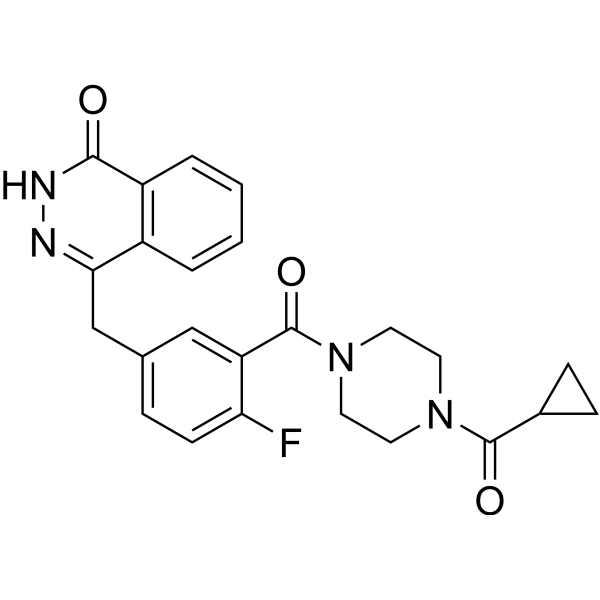
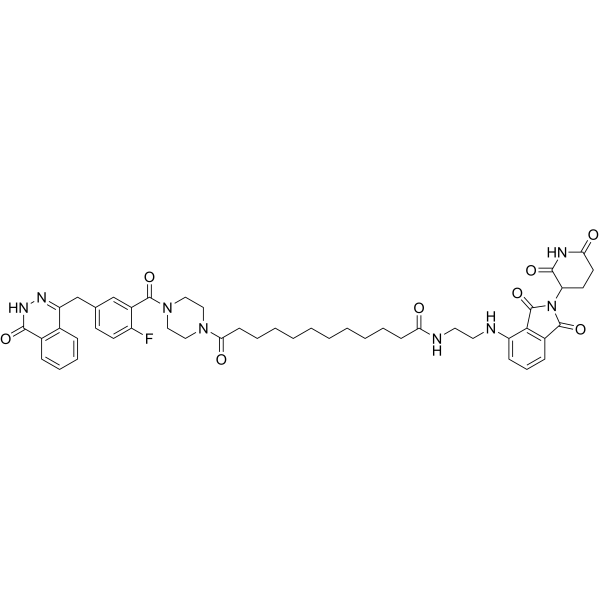
(Pink: PARP-1 ligand (HY-10617A); Blue: VHL ligand (HY-125845); Black: linker (HY-W014787)).
商品は「研究用試薬」です。人や動物の医療用・臨床診断用・食品用の製品ではありません。
研究用途以外に使用した場合、当社は一切の責任を負いかねます。
- 純度 : 99.43%
- 分子式: C51H62FN7O6S
- 分子量:920.14
-
保管条件:
4°C, protect from light
* In solvent : -80°C, 6 months; -20°C, 1 month (protect from light)


To place orders, for customer services and technical support, please contact: MedChemExpress USA
Tel: 609-228-6898 E-mail: [email protected] [email protected]


-
 生物活性
生物活性
-
化学情報
-
溶剤 & 溶解度
- プロトコル
- 純度とドキュメンテーション
- 参考文献
-
 Help & FAQs


MedChemExpress(MCE)の使用を引用している文献 PARP1 PROTAC 180055
MorePROTACs アイソフォーム固有の製品をすべて表示
More

生物活性
製品説明
IC50 & Target
[1]|
PARP1 180 nM (DC50, T47D cells) |
PARP1 240 nM (DC50, MDA-MB-231 cells) |
Cellular Effect
|
Cell Line

|
Type | Value | Description | References |
|---|---|---|---|---|
| T47D | DC50 |
180 nM
|
Half-maximal degradation of PARP1 protein in human T47D breast cancer cells measured via western blot after 24 h incubation.
Half-maximal degradation of PARP1 protein in human T47D breast cancer cells measured via western blot after 24 h incubation.
|
39695097 |
| MDA-MB-231 | DC50 |
240 nM
|
Half-maximal degradation of PARP1 protein in human MDA-MB-231 breast cancer cells measured via western blot after 24 h incubation.
Half-maximal degradation of PARP1 protein in human MDA-MB-231 breast cancer cells measured via western blot after 24 h incubation.
|
39695097 |
体外実験
PARP1 PROTAC 180055 (1-2000 nM; 12-72 h) selectively and reversibly degrades PARP1 in a ubiquitin-proteasome system-dependent manner in T47D and MDA-MB-231 breast cancer cell lines, with DC50 values of 180 nM and 240 nM, respectively[1].
PARP1 PROTAC 180055 (100-1000 nM; 24 h) effectively degrades PARP1 in an additional 12 cancer cell lines covering breast cancer, ovarian cancer, colorectal cancer, leukemia, prostate cancer, and osteosarcoma[1].
PARP1 PROTAC 180055 (1 μM; 1-24 h) inhibits the catalytic activity of PARP1 and prevents NAD+ depletion and PARylation in T47D, MDA-MB-231 and MOLT4 cancer cell lines[1].
PARP1 PROTAC 180055 (10 μM; 3-6 days) induces potent cytotoxicity in BRCA1-mutant MOLT4 acute T-lymphoblastic leukemia cells[1].
PARP1 PROTAC 180055 (1 μM; 24 h) induces ubiquitination of PARP1 in human breast cancer T47D cells[1].
PARP1 PROTAC 180055 (1 μM; 24 h) induces ubiquitination modification of PARP1 in human triple-negative breast cancer cells MDA-MB-231[1].
PARP1 PROTAC 180055 (1 μM; 24 h) inhibits H2O2-induced poly (ADP-ribose) formation in human breast cancer T47D cells[1].
PARP1 PROTAC 180055 (1 μM; 24 h) inhibits H2O2-induced poly (ADP-ribose) formation in MOLT4 human acute lymphoblastic leukemia cells[1].
PARP1 PROTAC 180055 (1-10 μM; 72 h) moderately reduces the viability of MOLT4 human acute lymphoblastic leukemia cells[1].
PARP1 PROTAC 180055 (1-10 μM; 48 h) reduces PARP1 chromatin retention, DNA damage, and G2 cell cycle arrest in T47D and MOLT4 cancer cell lines[1].
PARP1 PROTAC 180055 (10 μM; 48 h) does not induce significant cell cycle disorder in the human triple-negative breast cancer cell line MDA-MB-231[1].
PARP1 PROTAC 180055 (10 μM; 48 h) does not induce significant cell cycle disorder in primary hepatocytes[1].
PARP1 PROTAC 180055 (1-10 μM; 72 h) does not reduce the viability of primary cardiomyocytes[1].
MedChemExpress (MCE) has not independently confirmed the accuracy of these methods. They are for reference only. Further protocols information, click here.
-
Cell Line:MDA-MB-468 breast, IGROV1, A2780, Hey, CAOV1, OVK18, OC316, OVCAR3 ovarian, RKO colorectal, MOLT4 acute T-lymphoblastic leukemia, DU 145 prostate, U-2 OS osteosarcoma cancer cell lines
-
Concentration:100, 1000 nM
-
Incubation Time:24 h
-
Result:Significantly reduced PARP1 protein levels in all tested cancer cell lines following 24 h treatment at 100 nM or 1000 nM.
-
Cell Line:BRCA1-mutated MOLT4 acute T-lymphoblastic leukemia cells
-
Concentration:1, 5, 10 μM
-
Incubation Time:72, 144 h
-
Result:Induced substantial cytotoxicity in BRCA1-mutated MOLT4 cells.
-
Cell Line:T47D human breast cancer cells and MOLT4 human acute lymphoblastic leukemia cells
-
Concentration:1 μM
-
Incubation Time:24 h
-
Result:Strongly reduced PAR formation induced by H2O2.
-
Cell Line:MDA-MB-231 human triple-negative breast cancer cells and primary hepatocyte cells
-
Concentration:10 μM
-
Incubation Time:48 h
-
Result:Resulted in a cell cycle profile similar to DMSO control, with no substantial shift in G1, S, or G2/M phase distribution compared to control.
-
Cell Line:primary cardiomyocytes and MOLT4 human acute lymphoblastic leukemia cells
-
Concentration:1, 5, 10 μM
-
Incubation Time:72 h
-
Result:Maintained high cell viability, with no significant reduction compared to baseline levels at 1, 5, and 10 μM.
-
Cell Line:T47D, MDA-MB-231 breast cancer cell lines
-
Concentration:1 μM
-
Incubation Time:24 h
-
Result:Promoted PARP1 ubiquitination;
Induced degradation that is blocked by MG132 and VHL knockdown.
体内実験
MedChemExpress (MCE) has not independently confirmed the accuracy of these methods. They are for reference only.
-
Animal Model:NSG (immunodeficient, subcutaneous MOLT4 tumor xenografts with BRCA1 mutation)[1]
-
Dosage:40 mg/kg
-
Administration:once daily; 16 days
-
Result:Reduced tumor size compared to control.
Showed no significant weight loss during treatment.
Effectively degraded PARP1 in tumor tissues.
Showed no significant alterations in erythrocyte count, hemoglobin levels, platelet counts, neutrophil count, lymphocyte count, or glutamic-pyruvic transaminase levels relative to control.
-
Animal Model:NSG (immunodeficient, subcutaneous A2780 tumor xenografts with BRCA mutation)[1]
-
Dosage:40 mg/kg
-
Administration:once daily; 16 days
-
Result:Reduced tumor size compared to control.
Showed no significant weight loss during treatment.
Effectively degraded PARP1 in tumor tissues.


化学情報
-
性状 Solid
-
分子量 920.14
-
分子式 C51H62FN7O6S
-
Color Light yellow to yellow
-
SMILES
O=C1NCCC2=C(C3=CC=C(CN(C)C(CCCCCCCCC(N[C@H](C(N4C[C@H](O)C[C@H]4C(NCC5=CC=C(C6=C(C)N=CS6)C=C5)=O)=O)C(C)(C)C)=O)=O)C=C3)NC7=CC(F)=CC1=C72
-
輸送条件
Room temperature in continental US; may vary elsewhere.
-
保管条件
4°C, protect from light
* In solvent : -80°C, 6 months; -20°C, 1 month (protect from light)


Publications (1)
-
Journal Impact Factor
-
Most Recent


溶剤 & 溶解度
体外:
DMSO : 100 mg/mL (108.68 mM; Need ultrasonic; Hygroscopic DMSO has a significant impact on the solubility of product, please use newly opened DMSO)
Please refer to the solubility information to select the appropriate solvent. Once prepared, please aliquot and store the solution to prevent product inactivation from repeated freeze-thaw cycles.
Storage method and period of stock solution: -80°C, 6 months; -20°C, 1 month (protect from light). When stored at -80°C, please use it within 6 months. When stored at -20°C, please use it within 1 month.
Please refer to the solubility information to select the appropriate solvent. Once prepared, please aliquot and store the solution to prevent product inactivation from repeated freeze-thaw cycles.
Storage method and period of stock solution: -80°C, 6 months; -20°C, 1 month (protect from light). When stored at -80°C, please use it within 6 months. When stored at -20°C, please use it within 1 month.
濃度 (開始) × 体積 (開始) = 濃度 (終了) × 体積 (終了)

プロトコル
-
Breast Cancer Modeling
Breast cancer is a heterogeneous cancer, and it has been distinguished into four subtypes: luminal A, luminal B, HER2-positive and basal-like. Molecular mutations, epigenetic alterations, hormone exposure and immune microenvironment are related to the progression of breast cancer.


純度とドキュメンテーション
-
データシート (289 KB)
-
SDS (252 KB)
- English - EN (252 KB)
- Français - FR (252 KB)
- Deutsch - DE (252 KB)
- Norwegian - NO (252 KB)
- Español - ES (252 KB)
- Swedish - SV (252 KB)
- Italian - IT (252 KB)
- Korean - KR (252 KB)
- Portuguese - PT (252 KB)
-
取扱説明書 (2659 KB)
参考文献


Complete Stock Solution Preparation Table
Please refer to the solubility information to select the appropriate solvent. Once prepared, please aliquot and store the solution to prevent product inactivation from repeated freeze-thaw cycles.
Storage method and period of stock solution: -80°C, 6 months; -20°C, 1 month (protect from light). When stored at -80°C, please use it within 6 months. When stored at -20°C, please use it within 1 month.
| Optional Solvent | Concentration Solvent Mass | 1 mg | 5 mg | 10 mg | 25 mg |
|---|---|---|---|---|---|
| DMSO | 1 mM | 1.0868 mL | 5.4340 mL | 10.8679 mL | 27.1698 mL |
| 5 mM | 0.2174 mL | 1.0868 mL | 2.1736 mL | 5.4340 mL | |
| 10 mM | 0.1087 mL | 0.5434 mL | 1.0868 mL | 2.7170 mL | |
| 15 mM | 0.0725 mL | 0.3623 mL | 0.7245 mL | 1.8113 mL | |
| 20 mM | 0.0543 mL | 0.2717 mL | 0.5434 mL | 1.3585 mL | |
| 25 mM | 0.0435 mL | 0.2174 mL | 0.4347 mL | 1.0868 mL | |
| 30 mM | 0.0362 mL | 0.1811 mL | 0.3623 mL | 0.9057 mL | |
| 40 mM | 0.0272 mL | 0.1358 mL | 0.2717 mL | 0.6792 mL | |
| 50 mM | 0.0217 mL | 0.1087 mL | 0.2174 mL | 0.5434 mL | |
| 60 mM | 0.0181 mL | 0.0906 mL | 0.1811 mL | 0.4528 mL | |
| 80 mM | 0.0136 mL | 0.0679 mL | 0.1358 mL | 0.3396 mL | |
| 100 mM | 0.0109 mL | 0.0543 mL | 0.1087 mL | 0.2717 mL |


PARP1 PROTAC 180055 関連分類
HY-170620 関連分類
 Powered by Bioz