1. Search Result
Search Result
Results for "

TEAD-IN-1

" in MedChemExpress (MCE) Product Catalog:

16

Inhibitors & Agonists

3

Peptides

1

Natural
Products

Cat. No. Product Name Target Research Areas Chemical Structure
  • HY-B0990
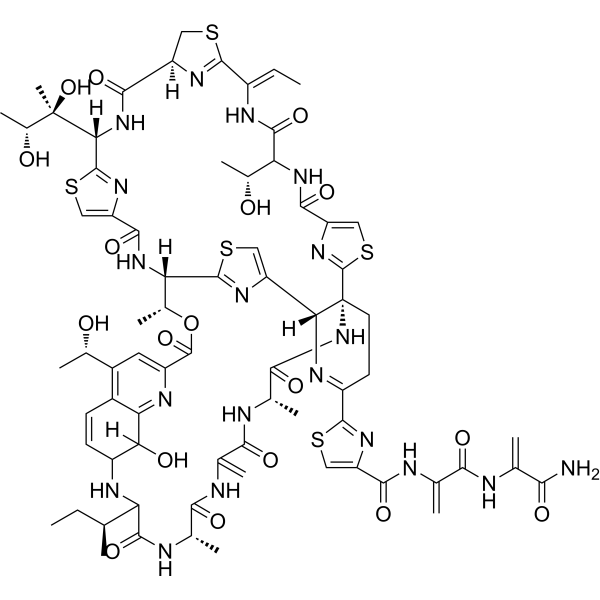
    Thiostrepton
    Maximum Cited Publications
    24 Publications Verification

    Bacterial Antibiotic YAP Infection
    Thiostrepton is a thiazole antibiotic which selectively inhibits FOXM1. FOXM1 binds to YAP/TEAD complex. YAP/TEAD/FOXM1 complex binding at regulatory regions of genes governing cell cycle may impact cell proliferation [1].
    Thiostrepton
  • HY-137479

    YAP Cancer
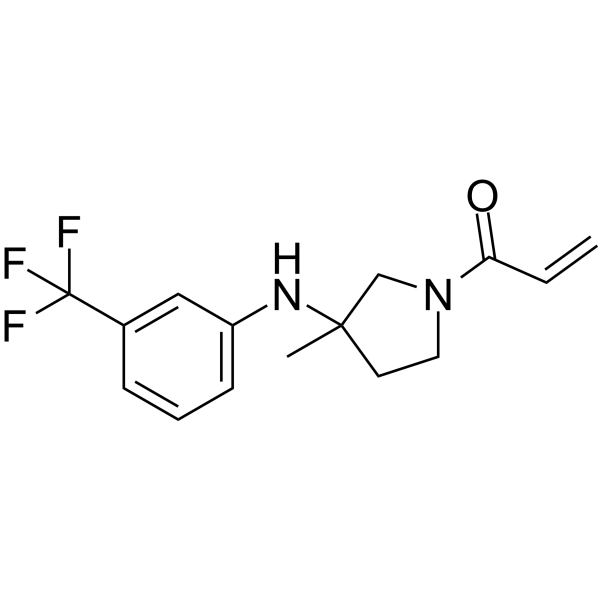
    TEAD-IN-1 (Compound 2) is potent TEAD autopalmitoylation inhibitor, with an IC50 of 603 nM. TEAD-IN-1 increases the interaction of TEAD and VGLL4. TEAD-IN-1 decreases the interaction of YAP and TEAD. TEAD-IN-1 can be used for the research of cancer [1] .
    TEAD-IN-1
  • HY-P2244
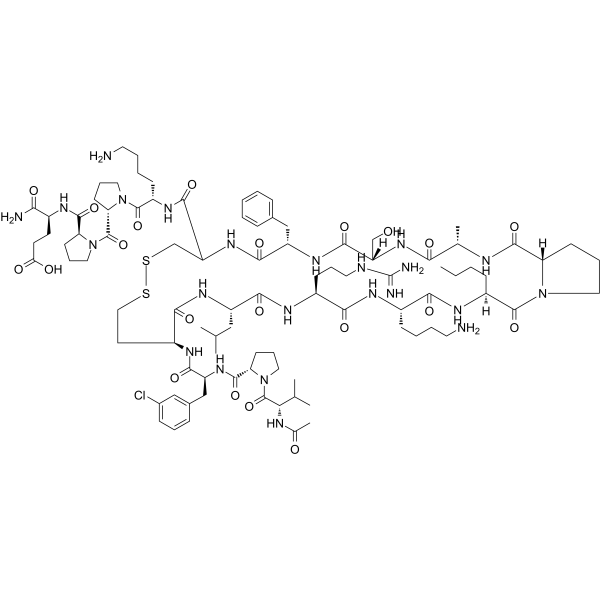
    YAP-TEAD-IN-1
    2 Publications Verification

    YAP Cancer
    YAP-TEAD-IN-1 is a potent and competitive inhibitor of?YAP–TEAD interaction (IC50=25 nM). YAP-TEAD-IN-1 is a 17mer peptide and shows a higher the binding affinity to TEAD1 (Kd=15 nM) than YAP (50-171) (Kd=40 nM) [1].
    YAP-TEAD-IN-1
  • HY-P2244A
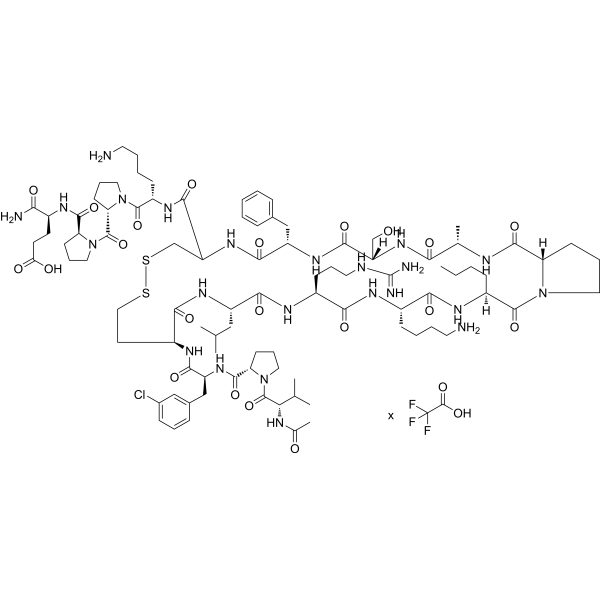
    YAP-TEAD-IN-1 TFA
    2 Publications Verification

    YAP Cancer
    YAP-TEAD-IN-1 TFA is a potent and competitive peptide inhibitor of YAP-TEAD interaction (IC50=25 nM). YAP-TEAD-IN-1 TFA is a 17mer peptide and shows a higher the binding affinity to TEAD1 (Kd=15 nM) than YAP (50-171) (Kd= 40 nM) [1].
    YAP-TEAD-IN-1 TFA
  • HY-158342

    PROTACs YAP Cancer
    PROTAC TEAD degrader-1 is a TEAD2 degrader and antiproliferative agent with selective activity toward TEAD2 relative to other TEAD family members. PROTAC TEAD degrader-1 relies on CRBN and the proteasome system for TEAD2 degradation; disruption of CRBN binding attenuates this activity. PROTAC TEAD degrader-1 decreases expression of YAP target genes CYR61 and CTGF. PROTAC TEAD degrader-1 can be used for the research of NF2-deficient cancer [1].
    PROTAC TEAD degrader-1
  • HY-139603
    MYF-01-37
    1 Publications Verification

    YAP Cancer
    MYF-01-37 is a covalent TEAD inhibitor targeting Cys380. MYF-01-37 has a reversible inhibition on YAP/TEAD interaction .
    MYF-01-37
  • HY-174275

    YAP Inflammation/Immunology Cancer
    TEAD1/3/4-IN-1 is an orally active inhibitor of TEAD1/3/4. TEAD1/3/4-IN-1 inhibits the YAP/TAZ-TEAD interaction, with its EC50 being 2 nM. TEAD1/3/4-IN-1 has anti-proliferative activity against NCI-H226 cells. TEAD1/3/4-IN-1 can be used in the research of lung squamous cell carcinoma [1].
    TEAD1/3/4-IN-1
  • HY-161569

    YAP Cancer
    TEAD-IN-11 (compound 38) has a good inhibitory effect on TEAD1 (IC50=8.7 nM), TEAD2 (IC50=3.4 nM), TEAD3 (IC50=5.6 nnM). TEAD-IN-11 has good selective activity against TEAD1-3 as a covalent inhibitor. TEAD-IN-11 can be used for cancer research [1].
    TEAD-IN-11
  • HY-159912

    YAP Cancer
    pan-TEAD-IN-1 (Compound 3) is an orally active pan-TEAD inhibitor targeting the palmitoylation site of TEAD, disrupting its interaction with the coactivators YAP/TAZ, thereby suppressing the transcriptional upregulation of oncogenes (e.g., Ctgf and Cyr61) in the Hippo signaling pathway. pan-TEAD-IN-1 exhibits excellent activity with a luciferase IC50 of 0.36 nM and an H226 cell IC50 of 1.52 nM. It also shows favorable pharmacokinetics (AUC0–∞ = 228.7 μg/mL·min, T1/2 = 183.9 min). In TEAD-dependent xenograft mouse models, pan-TEAD-IN-1 significantly inhibited tumor growth, showing promise for research in TEAD-dependent cancers [1].
    pan-TEAD-IN-1
  • HY-158400

    Ligands for Target Protein for PROTAC YAP Cancer
    TEAD ligand 1 is the ligand for target protein TEAD. TEAD ligand 1 is utilized for synthesis of PROTAC TEAD degrader-1 (HY-158342) [1].
    TEAD ligand 1
  • HY-170311

    YAP Cancer
    YAP/TEAD-IN-1 (compound 4) is a potent YAP and TEAD inhibitor. YAP/TEAD-IN-1 shows antioxidant activity. YAP/TEAD-IN-1 shows antiproliferation activity for tumor cells. YAP/TEAD-IN-1 shows little cytotoxic activity for human normal cells [1].
    YAP/TEAD-IN-1
  • HY-158343

    E3 Ligase Ligand-Linker Conjugates Cancer
    Thalidomide-NH-PEG2-C2-CH2 is a conjugate of E3 ligase ligand and linker. Thalidomide-NH-PEG2-C2-CH2 is utilized for synthesis of PROTAC TEAD degrader-1 (HY-158342) [1].
    Thalidomide-NH-PEG2-C2-CH2
  • HY-147209

    YAP Metabolic Disease
    DC-TEAD3in03 is a subtype-selective and covalent TEAD3 inhibitor with an IC50 of 0.16 μM. DC-TEAD3in03 exhibits the inhibitory activity on TEAD1/2/4 reduced by more than 100 times. DC-TEAD3in03 has the IC50 for TEAD3 of 1.15 μM in the GAL4-TEAD reporter gene experiment in cells, and it does not interfere with the β-catenin pathway. DC-TEAD3in03 reduces the growth rate of the zebrafish tail fin. DC-TEAD3in03 can be used to study the proportional growth of appendages in vertebrates [1].
    DC-TEAD3in03
  • HY-185230

    PROTACs YAP Cancer
    HC278 is a selective TEAD1/TEAD3 PROTAC degrader. HC278 induces proteasome-dependent degradation by forming a stable ternary complex with CRBN/DDB1. HC278 is applicable to the research of mesothelioma [1].
    HC278
  • HY-181533

    Ligands for E3 Ligase IAP Cancer
    IAP ligand 9 is an ASX-series, non-peptidic SMAC mimetic and IAP binder with high cell permeability. IAP ligand 9 selectively targets cIAP1-BIR3, XIAP-BIR3, exhibits extremely weak binding affinity for XIAP-BIR2, with a KD of 100 nM for cIAP1-BIR3 and 10 nM for XIAP-BIR2. IAP ligand 9 can be used to synthesize IAP-recruiting protein degraders (IPD), and can calibrate the cell permeability and cellular-level target binding assays of the IPD molecule SNIPER (TEAD)-1 (HY-181607). IAP ligand 9 and its series of degraders can be used in the research of solid tumors such as malignant pleural mesothelioma associated with abnormal activation of the Hippo pathway [1].
    IAP ligand 9
  • HY-181532

    Ligands for E3 Ligase IAP Cancer
    IAP ligand 8 is an ASX-series, non-peptidic SMAC mimetic and IAP binder with high cell permeability. IAP ligand 8 selectively targets cIAP1-BIR3, XIAP-BIR2 (with a KD of 15.8 nM for both). IAP ligand 8 serves as an IAP ligand moiety to synthesize IAP-recruiting protein degrader (IPD) (HY-181590). This IPD simultaneously forms two ternary complexes, cIAP1-A538-TEAD1 and XIAP-A538-TEAD1, and efficiently degrades TEAD1 via a dual E3 recruitment mechanism, while inducing the autodegradation of cIAP1. IAP ligand 8 and its series of degraders are applicable to targeted research on Hippo pathway-dysregulated cancers such as NF2-mutant mesothelioma [1].
    IAP ligand 8

Inquiry Online

Your information is safe with us. * Required Fields.

Salutation


Country or Region *

Applicant Name *


Organization Name *

Department *


Email Address *


Product Name *

Cat. No.


Requested quantity *

Phone Number *


Remarks

Inquiry Online

Inquiry Information

Product Name:
Cat. No.:
Quantity:
MCE Japan Authorized Agent:

