14 Results for "

amide coupling reactions

" in MedChemExpress (MCE) Product Catalog:
Products (14)

14 Results for "amide coupling reactions" in MCE Product Catalog:

Cat. No.: HY-Y1703
CAS No.: 148893-10-1
Research Areas:  

Others

HATU is a third-generation uronium salt peptide coupling reagent. HATU increases the rate of peptide coupling reactions, activates amino acids, promotes peptide bond formation in both solution-phase and solid-phase synthesis, and also facilitates peptide assembly, fragment coupling, and linear peptide cyclization. HATU can promote the N-acylation of chitosan to generate amide-linked cationic derivatives with a controllable degree of substitution. HATU is commonly used in amine acylation reactions .
loading...
    loading...
Cat. No.: HY-100138
CAS No.: 173308-19-5
Purity:  ≥98.0%
Research Areas:  

Cancer

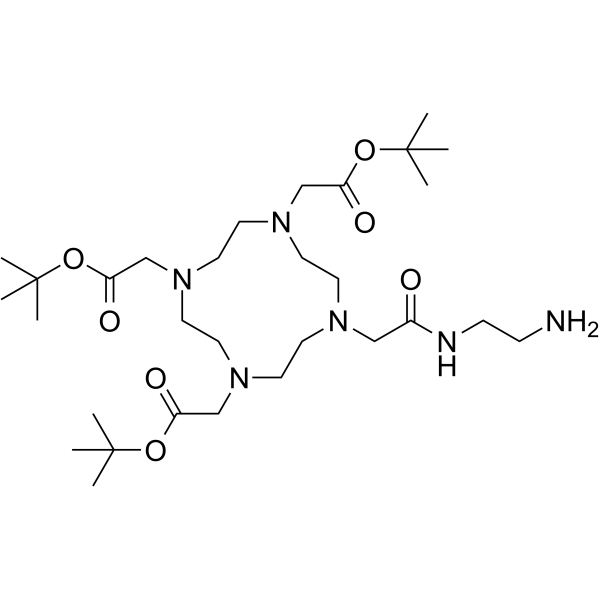
2-Aminoethyl-mono-amide-DOTA-tris(tBu ester) is a metal chelator precursor containing a DOTA macrocyclic structure. DOTA can form highly stable complexes with metal ions (such as 68Ga, 177Lu) through four nitrogen atoms and four carboxylic acid groups to mediate targeted delivery of radionuclides. The tert-butyl ester group (tBu ester) of 2-Aminoethyl-mono-amide-DOTA-tris(tBu ester) also protects the carboxylic acid group during synthesis, and forms a free carboxyl group after deprotection reaction for coupling with targeting molecules (such as antibodies, peptides). 2-Aminoethyl-mono-amide-DOTA-tris(tBu ester) may be combined with tumor pre-targeting systems through bioorthogonal reactions (such as reverse electron demand Diels-Alder reaction) to study radioactive imaging or therapy of tumor tissues, and is mainly used in tumor pre-targeting research in the field of nuclear medicine .
loading...
    loading...
Cat. No.: HY-W099632
CAS No.: 25354-97-6
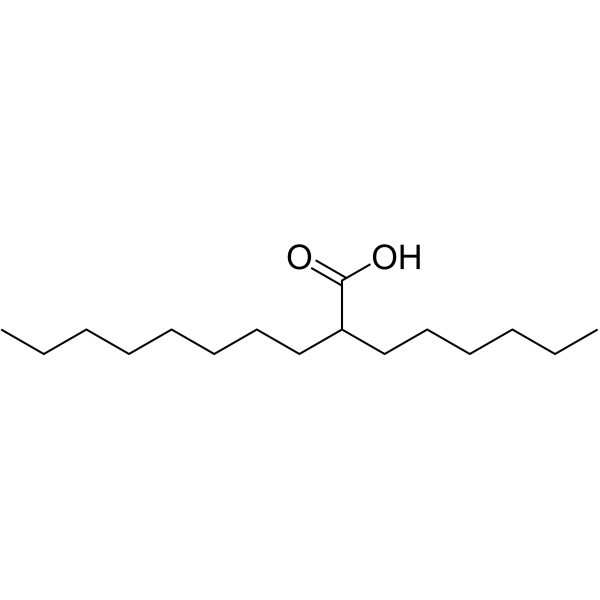
2-Hexyldecanoic acid is a lipid containing one carboxylic acid group and two non-polar tails. In the presence of EDC, HATU and DCC, carboxylic acid groups can undergo continuous amide coupling reactions with amine-containing biomolecules to form stable amide bonds. 2-Hexyldecanoic acid can be used as an aerolysin inhibitor to prevent bacterial pathogens. 2-Hexyldecanoic acid can cause contact dermatitis .
loading...
    loading...
Cat. No.: HY-171854
CAS No.: 3040121-49-8
SB-583355 (Compound 56) is a potent G2A antagonist. SB-583355 can be prepared by a Suzuki reaction between 4-methoxyphenyl boronic acid and 3-bromo-4-hydroxybenzoic acid following the conditions followed by an amide coupling reaction. SB-583355 blocks the activation of G2A mediated either by 9-HOPE or T-10148 in human G2A expressing CHO-K1 cells. SB-583355 can be studied in research for inflammation, myeloid leukemia, and neuropathic pain .
loading...
    loading...
Cat. No.: HY-W158239
CAS No.: 144059-86-9
Target:  

Drug Metabolite

Research Areas:  

Others

4-Methyl-2-[4-(trifluoromethyl) phenyl]-1,3-thiazole-5-carboxylic acid is a substituted thiazole carboxylic acid synthetic intermediate and a metabolite of GW 501516 (HY-10838), which is detected in horse plasma and hair samples after administration .
loading...
    loading...
Cat. No.: HY-151686
CAS No.: 1454558-58-7
Purity:  95.02%
Research Areas:  

Others

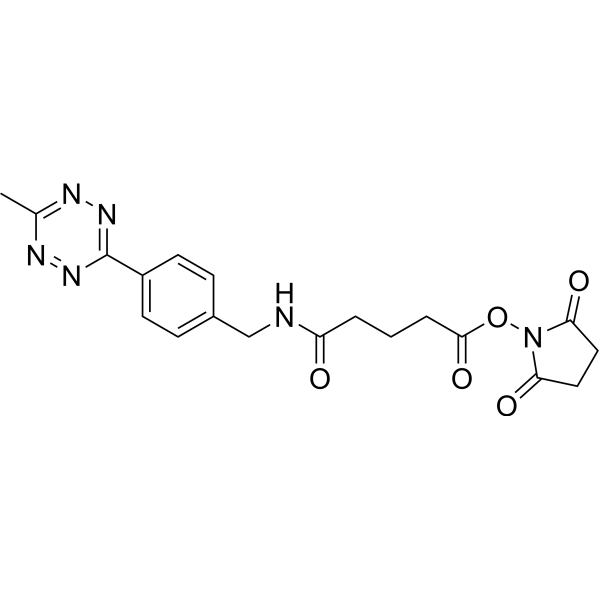
Bz-(Me)Tz-NHS is a methyltetrazine carboxylic acid NHS ester that enables conjugation of the tetrazine moiety to the 5' end of oligonucleotides via amide coupling reaction, and it is used in oligonucleotide template-mediated fluorescent bioorthogonal cycloaddition reactions. Bz-(Me) Tz-NHS is applicable to click chemistry-related studies .
loading...
    loading...
Cat. No.: HY-W014692
CAS No.: 76387-70-7
Synonyms: N-t-Boc-amino-D-alanine; Boc-D-Dap-OH
Research Areas:  

Others

Boc-D-2,3-diaminopropionic acid (N-t-Boc-amino-D-alanine; Boc-D-Dap-OH) is a Boc-protected D-diamino acid building block that serves as a precursor for the synthesis of fluorescent carbon dots and fluorescent D-amino acid probes (such as HADA and NADA), and can be used in amide coupling reactions. Boc-D-2,3-diaminopropionic acid is applicable to fluorescent probe development and chemical biology research .
loading...
    loading...
Cat. No.: HY-P11428
CAS No.: 2425606-55-7
Research Areas:  

Others

DBCO-cyclo (RGDfK) is a clickable DBCO-modified cyclic RGD peptide, and also a DBCO derivative of cyclo (RGDfK) (HY-P0023). DBCO-cyclo (RGDfK) is synthesized via an amide coupling reaction between DBCO-NHS ester and cyclo (RGDfK). DBCO-cyclo (RGDfK) can react with azide groups through copper-free click chemistry (SPAAC) to immobilize RGD peptides onto biomaterials or hydrogels. The RGD sequence in DBCO-cyclo (RGDfK) is recognizable by cellular integrins and promotes cell adhesion. DBCO-cyclo (RGDfK) can be used in studies related to tissue engineering, 3D cell culture, and surface functionalization of biomaterials .
loading...
    loading...
Cat. No.: HY-D3484
AF 532 carboxylic acid is a derivative of Alexa Fluor 532 containing a carboxylic acid group; it is used for amide coupling reactions (Ex/Em = 531/554 nm) .
loading...
    loading...
Cat. No.: HY-D3359
Cy5.5 bis-acid is a derivative of Cyanine5.5 (Cy5.5) containing carboxylic acid groups, used for amide coupling reactions (Ex/Em = 675/694 nm).
loading...
    loading...
Cat. No.: HY-D3340
AMCA-PEG4-acid is a derivative of AMCA featuring a carboxylic acid group for use in amide coupling reactions. It incorporates a PEG4 linker to enhance solubility and reduce steric hindrance (Ex/Em = 347/444 nm).
loading...
    loading...
Cat. No.: HY-D3531
CAS No.: 2183473-11-0
TAMRA-C6-acid is a derivative of TAMRA (tetramethylrhodamine) featuring a carboxylic acid group for use in amide coupling reactions. TAMRA-C6-acid is primarily used for further bioconjugation and derivatization (Ex/Em = 553/576 nm).
loading...
    loading...
Cat. No.: HY-W099632R
CAS No.: 25354-97-6
Research Areas:  

Others

Dipotassium glycyrrhizinate (Standard) is the analytical standard of Dipotassium glycyrrhizinate. This product is intended for research and analytical applications. 2-Hexyldecanoic acid is a lipid containing one carboxylic acid group and two non-polar tails. In the presence of EDC, HATU and DCC, carboxylic acid groups can undergo continuous amide coupling reactions with amine-containing biomolecules to form stable amide bonds. 2-Hexyldecanoic acid can be used as an aerolysin inhibitor to prevent bacterial pathogens. 2-Hexyldecanoic acid can cause contact dermatitis.
loading...
    loading...
Cat. No.: HY-100138R
CAS No.: 173308-19-5
2-Aminoethyl-mono-amide-DOTA-tris(tBu ester) (Standard) is the analytical standard of 2-Aminoethyl-mono-amide-DOTA-tris(tBu ester) (HY-100138). This product is intended for research and analytical applications. 2-Aminoethyl-mono-amide-DOTA-tris(tBu ester) is a metal chelator precursor containing a DOTA macrocyclic structure. DOTA can form highly stable complexes with metal ions (such as 68Ga, 177Lu) through four nitrogen atoms and four carboxylic acid groups to mediate targeted delivery of radionuclides. The tert-butyl ester group (tBu ester) of 2-Aminoethyl-mono-amide-DOTA-tris(tBu ester) also protects the carboxylic acid group during synthesis, and forms a free carboxyl group after deprotection reaction for coupling with targeting molecules (such as antibodies, peptides). 2-Aminoethyl-mono-amide-DOTA-tris(tBu ester) may be combined with tumor pre-targeting systems through bioorthogonal reactions (such as reverse electron demand Diels-Alder reaction) to study radioactive imaging or therapy of tumor tissues, and is mainly used in tumor pre-targeting research in the field of nuclear medicine .
loading...
    loading...
  • 1