137 Results for "

chemical screening

" in MedChemExpress (MCE) Product Catalog:
Products (137)

137 Results for "chemical screening" in MCE Product Catalog:

3
3 Cited Publications
Cat. No.: HY-K1099

MCE Endotoxin Detection Kit (Recombinant Factor C) is suitable for the detection of endotoxins in therapeutic injectable drugs for human use (such as chemical drugs, antibiotics, and biologics), as well as in medical devices including dialysis fluids and implantable devices. It can be applied throughout raw material screening, process development, manufacturing, and commercialization stages.

loading...
    loading...
Cat. No.: HY-D0860
CAS No.: 5704-04-1
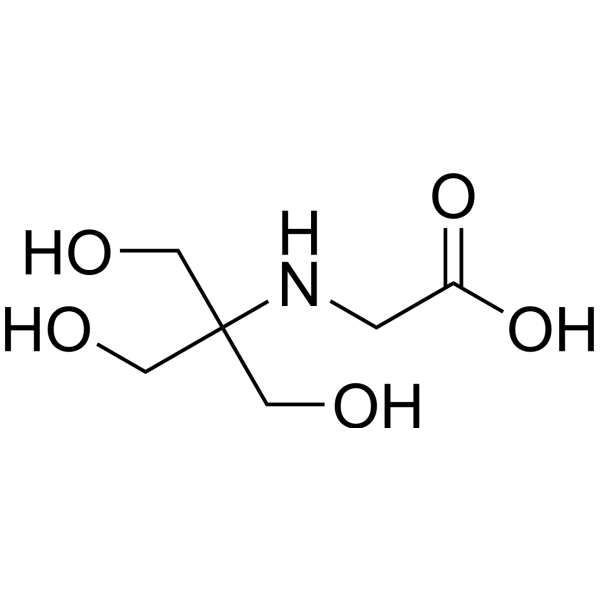
Tricine is widely used as a buffer in protein electrophoresis, nucleic acid analysis, and immunology, which can help adjust pH and stabilize chemical reactions. In addition, the compound can also be used in research in certain medical fields, such as in antibody detection and drug screening.
loading...
    loading...
Cat. No.: HY-149461
CAS No.: 1956368-15-2
Purity:  99.81%
Research Areas:  

Others

KB-05 is an electrophilic fragment molecule that can be used in DIA-based quantitative chemical proteomic screening studies.
loading...
    loading...
Cat. No.: HY-171179
CAS No.: 1357578-02-9
BD-Oligo is an oligomer-specific fluorescent chemical probe. BD-Oligo preferentially identifies Aβ oligomer assemblies over monomers or fibrils by using diversity-directed fluorescent library (DOFL) screening and computational techniques. BD-Oligo exhibits dynamic oligomer monitoring capabilities during Aβ peptide fibril formation as Aβ is induced to form oligomers and ultimately fibrils over time. BD-Oligo also exhibits blood-brain barrier permeability with the ability to stain Aβ oligomers in vivo .
loading...
    loading...
Cat. No.: HY-152197
CAS No.: 938893-79-9
Target:  

PARP

Research Areas:  

Cancer

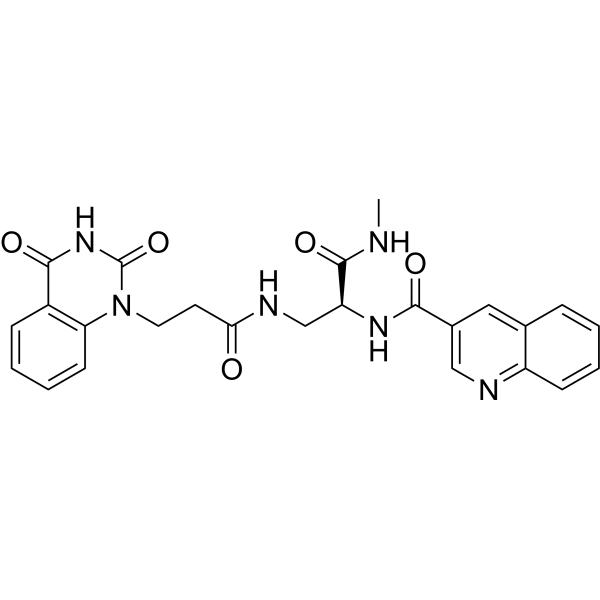
Tankyrase-IN-3 is a tankyrase 1 (TNKS1) inhibitor with an IC50 value of 22 nM. Tankyrase-IN-3 can be used for the research of cancer .
loading...
    loading...
Cat. No.: HY-125629
CAS No.: 339337-07-4
Target:  

Others

Research Areas:  

Others

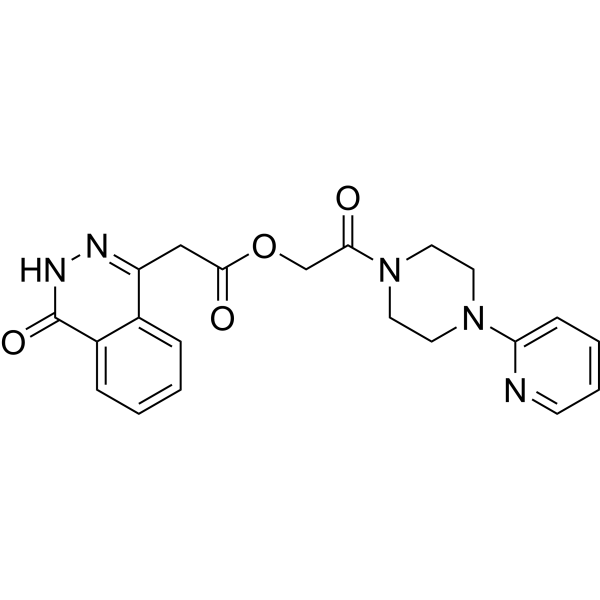
Primordazine B is a small molecule compound identified by chemical screening in zebrafish embryos with the activity of selectively destroying Primordial Germ Cells (PGCs). Primordazine B inhibits a process called Poly(A)-tail Independent Non-canonical Translation (PAINT) without inhibition of polyadenylate tail dependent typical translation (PAT). Primordazine B can be used to study translational control of cells in specific physiological or pathological states, such as gene expression regulation during cell dormancy, viral infection, or stress conditions .
loading...
    loading...
Cat. No.: HY-152198
Target:  

PARP

Research Areas:  

Cancer

Tankyrase-IN-4 is a tankyrase 1 (TNKS1) inhibitor with an IC50 value of 0.8 nM. Tankyrase-IN-4 can be used for the research of cancer .
loading...
    loading...
Cat. No.: HY-19072
CAS No.: 84768-09-2
Target:  

Angiotensin Receptor

Research Areas:  

Cardiovascular Disease

BRL-36378 is an ACE inhibitor that inhibits angiotensin-converting enzyme activity. BRL-36378 can be used in ligand-based virtual screening to identify new leading structures for chemical optimization .
loading...
    loading...
Cat. No.: HY-114939
CAS No.: 110871-16-4
Target:  

DNA/RNA Synthesis

Research Areas:  

Others

Phelorphan is a purine MTH1 inhibitor identified through chemical array screening. Although it targets cellular MTH1, its cytotoxicity to cancer cells is weaker than that of other reported inhibitors. The cytotoxicity of MTH1 inhibitors may be attributed to off-target effects, and MTH1 is not essential for cancer cell survival.
loading...
    loading...
Cat. No.: HY-L0096V
1,400,000 compounds
Vitas-M Screening Compounds Library (stock) contains about 1,400,000 chemical substances. They are synthetic small molecule organic compounds for biological screening and lead optimization. Select any number of items as a "cherry pick".
Cat. No.: HY-L0095V
270,000 compounds
OTAVAchemicals Screening Collection contains about 270,000 re-supply compounds for prompt delivery. All compounds have undergone quality control to confirm their chemical structures.
Cat. No.: HY-LD002
100 billion compounds

The discovery of hit molecule is a cornerstone of drug development. Among the diverse tools available, DNA-encoded libraries have emerged a revolutionary platform for high-throughput screening. Compared with traditional HTS, DEL features shorter screening processes, lower costs, simpler assays, and larger library capacities.

DEL Construction utilizes split-and-pool synthesis, a combinatorial chemistry approach that involves iterative splitting, reaction, and pooling. This strategy enables rapid, exponential assembly of fragments in minimal steps without the need for individual compound synthesis andassoicicated isolation or purification steps, thus greatly reducing overall costs. The technology enables simultaneous affinity screeningof massive compound collections to target proteins in a single step. By coupling chemical structures with unique DNA barcodes, each compound is tagged with a distinct DNA sequence for convenient tracking and decoding.DELs readily enable the construction and efficient screening of libraries containing millions to billions of compounds. As a result, DEL screening combines the dual advantages of high efficiency and low cost, making DEL a transformative technology in modern drug discovery.

The DEL kit consists of 50 independent libraries with a total scale of 100 billion compounds. It is constructed through stepwise combinatorial chemistry strategies involving 2-, 3-, and 4-round synthesis. By employing diverse scaffolds and flexible linking strategies, it encompasses various ring systems, linear frameworks, and heterocyclic structures. Screening can be achieved solely through affinity, independent of target-specific activity detection methods. This library is suitable for DEL screening against a wide range of targets.

Cat. No.: HY-L0093V
10,119 compounds
Diversity-based screening continues to be a vital tool for drug discovery. Efficiency and productivity can be improved by using screening libraries that offer maximum diversity whilst retaining drug-like properties. Chemspace Scaffold derived set composes 10,119 compounds, which including 3,373 scaffolds, 3 compounds per each. This library has exceptional coverage of drug-like chemical space.
Cat. No.: HY-L0103V
680,000 compounds
UORSY Screening Compounds Library contains about 680,000 compounds. The library has extensively developed a polymerization synthesis method that provides a highly diverse chemical structure. More than 85% of the compounds in the library have drug-like physicochemical properties, and more than 35% of the compounds have lead-like properties.
Cat. No.: HY-L0087V
503,810 compounds
Life Chemicals Collection of small organic molecules for high-throughput screening currently contains 503,810 off-the-shelf products. The Collection is being permanently replenished with de novo designed products having optimal physicochemical parameters for drug discovery.
Cat. No.: HY-L904
1,394 compounds

The MCE 1K Drug Fragment Library consists of 1,394 drug fragments. These drug fragments are derived from 2,946 FDA-approved drug molecules, and fragments from one drug can appear in other drugs, so these fragments are somewhat correlated with good PK/PD properties. Fragment-based screening can reserve enough chemical space for subsequent structural optimization. This compound library is an essential tool for drug screening based on FBDD (Fragment-Based Drug Discovery).

Cat. No.: HY-401563
CAS No.: 676116-04-4
Research Areas:  

Neurological Disease

5-HT2A antagonist 4 methanesulfonate (Example 29) is a dopamine D2 receptor and serotonin 5HT2A receptor antagonist. 5-HT2A antagonist 4 methanesulfonate can be used for the study of central nervous system diseases .
loading...
    loading...
Cat. No.: HY-L0107V
13,236 compounds
Natural products are small molecules produced naturally by any organism including primary and secondary metabolites. Nowadays, new drugs based on Natural products are successfully applied to treat tumors, viral and bacterial diseases, and nervous disorders. In response to the current drug discovery demand, we created this natural product-like compound library with 13,236 in-stock synthetic compounds similar to natural ones. The library was designed by 2D fingerprint similarity filtering, chemical descriptor-based and natural-likeness scoring selection. These compounds are useful tools for high throughput screening (HTS) and high content screening (HCS) programs.
Cat. No.: HY-L186
54 compounds

Neurotransmitters are chemical messengers that allows a neuron's electrical signal to pass to a postsynaptic neuron or effect target. Neurotransmitters include amino acids, monoamines, and peptides, while other neurotransmitters are composed of metabolites such as nitric oxide and carbon monoxide. The function of neurotransmitters is closely related to the disease of life, helping to regulate the body's heartbeat, blood pressure, breathing, sleep, aging and muscle activity. Therefore, research based on neurotransmitters can help to increase human understanding of diseases.

MCE collects and organizes 54 neurotransmitters and is a tool library for drug screening and mechanism research.

Cat. No.: HY-L0088V
50,240 compounds
Life Chemicals presents a number of exclusive Pre-Plated Diversity Sets composed of 50,240 novel compounds with optimal physicochemical properties selected from Life Chemicals collection of newly synthesized items by dissimilarity search with an average Tanimoto threshold of 82%. These Diverse Screening Sets are ideal starting points for customers looking for a wide range of dissimilarity to screen against a number of targets from different classes or where little information is available on targeted protein structure.

