

15 Results for "

cutaneous melanoma

" in MedChemExpress (MCE) Product Catalog:
Products (15)

15 Results for "cutaneous melanoma" in MCE Product Catalog:

1
1 Cited Publications
Cat. No.: HY-P1181A
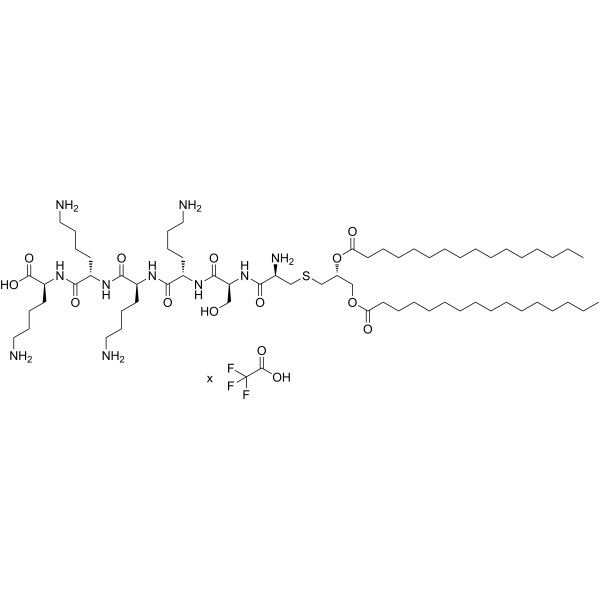
Pam2CSK4 TFA is a TLR2 agonist. Pam2CSK4 TFA induces the expression of iNOS and NO in macrophage cell lines via TBK1 and MyD88 molecules. Pam2CSK4 TFA activates the NF-κB and Bruton's tyrosine kinase signaling pathways in platelets, and promotes platelet-endothelial cell interactions. TLR2 activation triggered by Pam2CSK4 TFA expands myeloid-derived suppressor cells (MDSCs) and suppresses anti-tumor immune responses in the tumor microenvironment. Pam2CSK4 TFA acts as a Th2-polarizing adjuvant in mouse vaccine models against Leishmania major and Brugia malayi. Pam2CSK4 TFA can be used in the research of various diseases, including thromboinflammatory diseases, sepsis, atherosclerosis, heart failure, influenza, lymphoma, melanoma, cutaneous leishmaniasis and lymphatic filariasis .
loading...
    loading...
Cat. No.: HY-P990717
CAS No.: 2736407-54-6
Synonyms: IMC-F106C

Target:  

CD3

Research Areas:  

Cancer

Brenetafusp is a TCR/anti-CD3 bispecific fusion protein, consisting of a TCR targeting the PRAME peptide and an anti-CD3 scFv effector domain. Brenetafusp redirects CD3 + T cells to kill PRAME + tumor cells. Brenetafusp can be used in research related to cutaneous melanoma, non-small cell lung cancer, ovarian cancer, endometrial cancer, triple-negative breast cancer, and small cell lung cancer .
loading...
    loading...
Cat. No.: HY-P1181
CAS No.: 868247-72-7
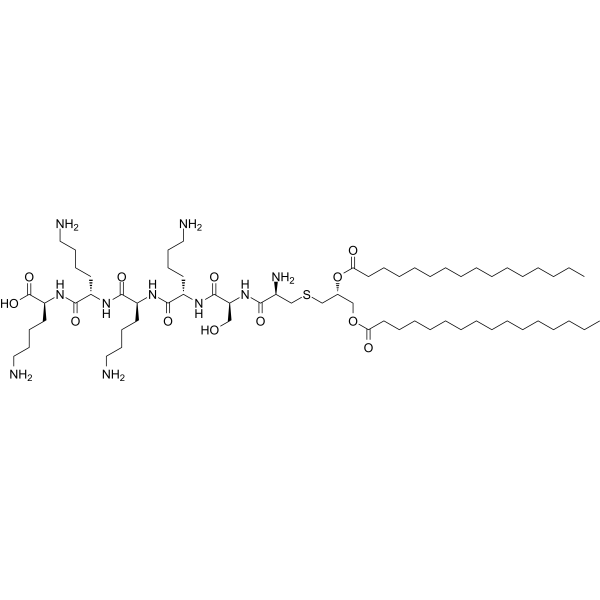
Pam2CSK4 is a TLR2 agonist. Pam2CSK4 induces the expression of iNOS and NO in macrophage cell lines via TBK1 and MyD88 molecules. Pam2CSK4 activates the NF-κB and Bruton's tyrosine kinase signaling pathways in platelets, and promotes platelet-endothelial cell interactions. TLR2 activation triggered by Pam2CSK4 expands myeloid-derived suppressor cells (MDSCs) and suppresses anti-tumor immune responses in the tumor microenvironment. Pam2CSK4 acts as a Th2-polarizing adjuvant in mouse vaccine models against Leishmania major and Brugia malayi. Pam2CSK4 can be used in the research of various diseases, including thromboinflammatory diseases, sepsis, atherosclerosis, heart failure, influenza, lymphoma, melanoma, cutaneous leishmaniasis and lymphatic filariasis .
loading...
    loading...
Cat. No.: HY-P99266
CAS No.: 652153-01-0
Synonyms: Anti-Human CD4 Recombinant Antibody
Zanolimumab (Anti-Human CD4 Recombinant Antibody) is a fully human monoclonal antibody targets CD4. Zanolimumab effectively inhibits T-cell receptor (TCR) signal transduction. Zanolimumab can be used for the research of heumatoid arthritis, psoriasis, melanoma, cutaneous and peripheral T-cell lymphoma .
loading...
    loading...
Cat. No.: HY-W997836
CAS No.: 74923-08-3
Synonyms: 4-AHP
Target:  

Endogenous Metabolite

Research Areas:  

Cancer

4-Amino-3-hydroxyphenylalanine dihydrochloride (4-AHP) is a photodegradation product of eumelanin. 4-Amino-3-hydroxyphenylalanine dihydrochloride can be used to investigate the development of cutaneous melanoma and age-related macular degeneration .
loading...
    loading...
Cat. No.: HY-P99760
CAS No.: 2168561-20-2
Synonyms: BCD-145

Target:  

CTLA-4

Research Areas:  

Cancer

Nurulimab is a cytotoxic T-lymphocyte-associated antigen 4 (CTLA-4) human monoclonal antibody. Nurulimab binds to CTLA-4 and blocks its interaction with ligands, stimulating T-cell proliferation, cytokine production, and inducing an antitumor immune response. Nurulimab can be used for the research of unresectable or metastatic melanoma and advanced cutaneous melanoma .
loading...
    loading...
Cat. No.: HY-139430
CAS No.: 2138-43-4
Purity:  98.03%
Synonyms: 4-IPC
Target:  

Tyrosinase

Research Areas:  

Inflammation/Immunology

4-Isopropylcatechol is a potent and irreversible cutaneous depigmenting agent. 4-Isopropylcatechol significantly inhibits protein biosynthesis in mouse melanoma cells containing high levels of tyrosinase. 4-Isopropylcatechol can be use to study hyperpigmentation of skins .
loading...
    loading...
Cat. No.: HY-18658B
CAS No.: 1638193-48-2
Synonyms: NVP-HDM201 succinate; HDM201 succinate
Target:  

MDM-2/p53

Research Areas:  

Cancer

Siremadlin (NVP-HDM201) succinate is an MDM2 inhibitor and cell cycle regulator. Siremadlin succinate blocks the p53-binding pocket of MDM2, inhibits MDM2-mediated ubiquitination and degradation of p53, thereby activating the p53 pathway in p53 wild-type cells. Siremadlin succinate can be used in the research of cutaneous melanoma .
loading...
    loading...
Cat. No.: HY-181129
Research Areas:  

Cancer

ADAR1i-124 is an A-to-I RNA editing inhibitor by inhibiting the catalytic activities of both ADAR1p150 and ADAR1p110. ADAR1i-124 activates type I interferon (IFN) and ZBP1 pathways and dose-dependently inhibits viability across different types of cancer cell lines. ADAR1i-124 can induce cells apoptosis and necroptosis. ADAR1i-124 can be used for the research of cancer, such as cutaneous melanoma and ovarian cancer .
loading...
    loading...
Cat. No.: HY-184827
CAS No.: 871544-55-7
Target:  

Drug Intermediate

Research Areas:  

Cancer

1-(2-Chloroacetyl)-3-(2,3-dimethylphenyl) urea is an anticancer agent. 1-(2-Chloroacetyl)-3-(2,3-dimethylphenyl) urea inhibits the growth of colon cancer, cutaneous melanoma and breast cancer. 1-(2-Chloroacetyl)-3-(2,3-dimethylphenyl) urea can be used in the research of colon cancer, cutaneous melanoma and breast cancer .
loading...
    loading...
Cat. No.: HY-N19312
CAS No.: 28164-57-0
Diospyrin is a dinaphthoquinone anticancer agent with pro-apoptotic (apoptosis) activity, glutathione S-transferase (Glutathione S-transferase) inhibitory activity, and topoisomerase (Topoisomerase) I inhibitory activity. Diospyrin is present in the heartwood of various Diospyros plants and can be used for research on Ehrlich ascites carcinoma, acute myeloid leukemia, chronic myeloid leukemia, mammary adenocarcinoma, cervical epithelial carcinoma, malignant cutaneous melanoma, laryngeal epidermoid carcinoma, human osteosarcoma, and human lymphoblastic carcinoma .
loading...
    loading...
Cat. No.: HY-184506
R4VPL3-1 is a PROTAC-like degrader that simultaneously targets RNF4 and VHL, and also acts as a ferroptosis inducer. R4VPL3-1 induces iron-dependent lipid peroxidation and ferroptosis-mediated rapid cell death in cancer cells. R4VPL3-1 is applicable to research on human melanoma, human cutaneous squamous cell carcinoma, metastatic human sarcoma, malignant peripheral nerve sheath tumor, pigmented villonodular synovitis, undifferentiated pleomorphic sarcoma, myxofibrosarcoma, and lung adenocarcinoma .
loading...
    loading...
Cat. No.: HY-184595
CAS No.: 3037312-75-4
Target:  

Ligands for E3 Ligase

Research Areas:  

Others

(6-OH)-SBP-0636457 is an E3 ubiquitin ligase ligand. (6-OH)-SBP-0636457 can be used to synthesize PROTAC Bcl-xL degrader-1 (HY-131188) .
loading...
    loading...
Cat. No.: HY-P85531
Synonyms: Cdk 4; cdk4; CDK4 protein; CDK4_HUMAN; Cell division kinase 4; Cell division protein kinase 4; CMM 3; CMM3; Crk3; Cyclin dependent kinase 4; Cyclin-dependent kinase 4; melanoma cutaneous malignant 3; MGC14458; p34 cdk4; PSK J3; PSK-J3.

Host:  

Mouse

Application:  

WB

Reactivity:  

Human, Mouse, Rat

loading...
    loading...
Cat. No.: HY-185447
CAS No.: 3086566-93-7
Target:  

PD-1/PD-L1

Research Areas:  

Cancer

Biotin-itaconate is a biotin-labeled itaconic anhydride that targets PD-L1. Biotin-itaconate acts as a biotin probe for in vitro alkylation assays to identify itaconate-modified protein substrates-typically substrates containing cysteine ​​residues. Biotin-itaconate is applicable to cancer research .
loading...
    loading...
  • 1

