
1. Search Result
Search Result
Results for "

cytokinesis

" in MedChemExpress (MCE) Product Catalog:

20

Inhibitors & Agonists

1

Bibliotecas de Screening

1

Fluorescent Dyes

1

Biochemical Assay Reagents

2

Inhibitory Antibodies

4

Natural
Products

1

Recombinant Proteins

5

Antibodies

Targets Recommended:
Cat. No. Nombre del producto Target Áreas de investigación Chemical Structure
  • HY-P9977
    Amivantamab
    3 Publications Verification

    JNJ-61186372

    EGFR Inflammation/Immunology Cancer
    Amivantamab (JNJ-61186372) is a human EGFR-MET bispecific antibody with immune anticancer activity. Amivantamab inhibits ligand binding, promotes endocytosis and degradation of receptor-antibody complexes, and induces Fc-dependent cytokinesis in macrophages and antibody-dependent cytotoxicity in natural killer cells .
    Amivantamab
  • HY-12054
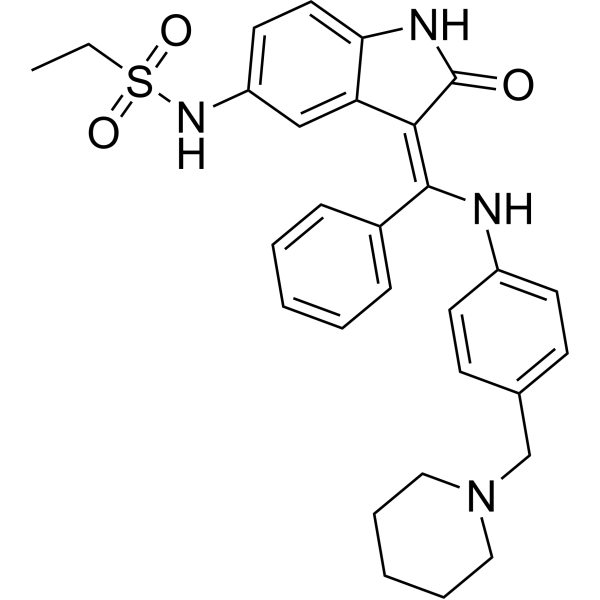
    Hesperadin
    10+ Cited Publications

    Aurora Kinase Autophagy Influenza Virus Parasite Cancer
    Hesperadin is an ATP competitive indolinone inhibitor of Aurora A and B. Hesperadin inhibits Aurora B with an IC50 of 250 nM. Hesperadin inhibits the growth of Trypanosoma brucei by blocking nuclear division and cytokinesis. Hesperadin also is a broad-spectrum influenza antiviral .
    Hesperadin
  • HY-W094758A

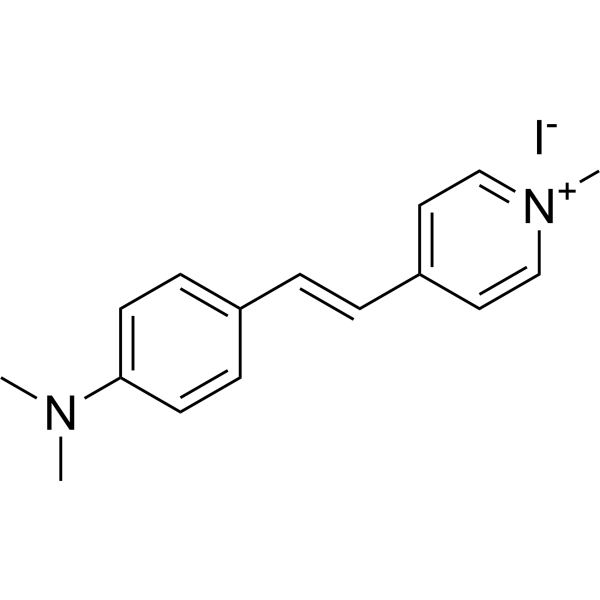
    Fluorescent Dye Cancer
    4-Di-1-ASP is a styryl dye used to stain glioma cells in living brain tissue for analysis of cell structure, viability, proliferation and endocytosis, cytokinesis and phagocytosis, as well as for observation of mitochondrial structures in living cells. 4-Di-1-ASP fluoresces green when imaged microscopically (λexem = 475/606 nm) .
    4-Di-1-ASP
  • HY-P9977A

    EGFR Cancer
    Amivantamab (FUT8-KO) is an anti-EGFR-MET monoclonal antibody expressed by CHO cells with the fucosyltransferase 8 gene (FUT8) knocked out. Fucose deficiency enhances the ADCC effect of the antibody. Amivantamab (FUT8-KO) inhibits ligand binding, promotes endocytosis and degradation of receptor-antibody complexes, and induces Fc-dependent cytokinesis in macrophages and antibody-dependent cytotoxicity in natural killer cells .
    Amivantamab (FUT8-KO)
  • HY-N6701

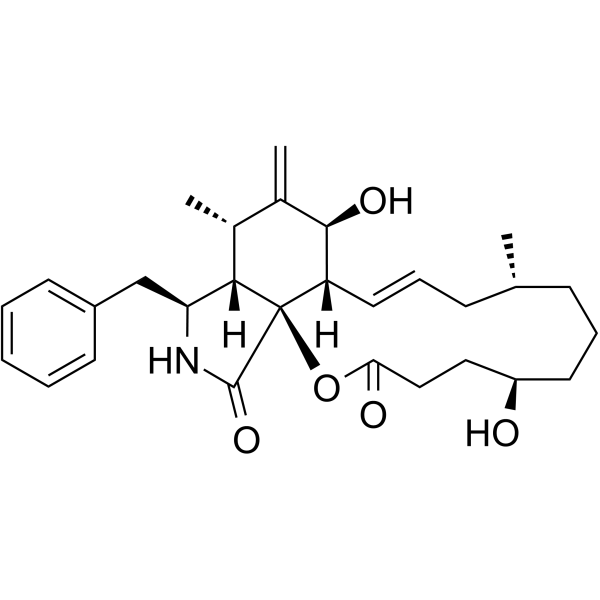
    Arp2/3 Complex DNA/RNA Synthesis Calcium Channel Inflammation/Immunology
    Dihydrocytochalasin B is an Actin disruptor. Dihydrocytochalasin B disrupts actin microfilament bundles, inhibits actin polymerization, and alters intracellular actin cytoskeletal structures. Dihydrocytochalasin B blocks the initiation of DNA synthesis. Dihydrocytochalasin B inhibits Calcium transport. Dihydrocytochalasin B inhibits cytokinesis and alters cell morphology. Dihydrocytochalasin B can be used in studies related to rickets .
    Dihydrocytochalasin B
  • HY-136637

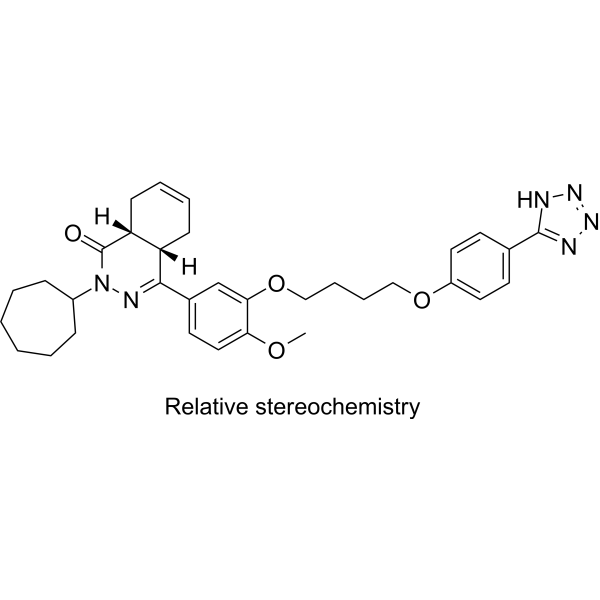
    Phosphodiesterase (PDE) Parasite Infection
    NPD-001 is a potent Trypanosoma brucei phosphodiesterases 1/2 (TbrPDEB1/2) inhibitor, with IC50 values of 4 and 3 nM, respectively. NPD-001 also inhibits hPDE4. NPD-001 can increase cAMP levels in parasites, prevent cytokinesis, and cause the parasites to form multinucleated, multi-flagellated cells that eventually lyse. NPD-001 can be used for the research of infection .
    NPD-001
  • HY-129288

    NEU-391

    EGFR Paraptosis Mitosis Infection
    GW837016X (NEU-391) is an orally active ErbB-2 kinase covalent inhibitor. GW837016X also is a potent antitrypanosome agent. GW837016X inhibits mitosis and cytokinesis .
    GW837016X
  • HY-119648

    Bacterial Infection
    CCR-11 is an antibacterial agent. CCR-11 can inhibit the proliferation of B. subtilis cells with an IC50 value of 1.2 μM. CCR-11 inhibits HeLa cell proliferation with an IC50 value of 18.1 μM. CCR-11 inhibits bacterial cytokinesis by inhibiting FtsZ assembly. CCR-11 can be used for the research of FtsZ-targeted antibacterial agents .
    CCR-11
  • HY-N14569

    Arp2/3 Complex Cancer
    Cytochalasin L has many biological activities, such as inhibiting cytoKinesis reversibly, inhibiting megasophil endocytosis and exocytosis .
    Cytochalasin L
  • HY-N14567

    Arp2/3 Complex Cancer
    Cytochalasin F has many biological activities, such as inhibiting cytoKinesis reversibly, inhibiting megasophil endocytosis and exocytosis .
    Cytochalasin F
  • HY-N14568

    Arp2/3 Complex Cancer
    Cytochalasin G has many biological activities, such as inhibiting cytoKinesis reversibly, inhibiting megasophil endocytosis and exocytosis .
    Cytochalasin G
  • HY-N14696

    Arp2/3 Complex Cancer
    Cytochalasin M has many biological activities, such as inhibiting cytoKinesis reversibly, inhibiting megasophil endocytosis and exocytosis .
    Cytochalasin M
  • HY-152206

    Myosin Neurological Disease
    JB062 is a nonmuscle myosin inhibitor with IC50 values of 1.6, 5.4, and >100 μM for Skeletal muscle myosin, Cardiac muscle myosin, and Smooth muscle myosin II, respectively. JB062 has cytotoxic to human cancer cells but not normal cells. JB062 can be used in research of muscle spasticity, chronic musculoskeletal pain, and hypertrophic cardiomyopathy .
    JB062
  • HY-121998

    Aurora Kinase Others
    Binucleine 2 is an isoform-specific and ATP-competitive inhibitor of Drosophila Aurora B kinase (Ki=0.36 μM), a kinase involved in cell division. It is specific for Drosophila Aurora B kinase, inhibiting it in a dose-dependent manner, with minimal inhibition of human or X. laevis Aurora B kinases at concentrations up to 100 μM. Binucleine 2 induces mitotic and cytokinesis defects in Drosophila Kc167 cells. It prevents Drosophila S2 cells from assembling a contractile ring during cell division when used at a concentration of 40 μM but does not affect ring ingression, suggesting that Aurora B kinase activity is not required for that step.
    Binucleine 2
  • HY-182408

    Glycosyltransferase Others
    Endosidin7 is a specific inhibitor for plant callose deposition during cytokinesis. Endosidin7 inhibits cytokinesis-specific callose deposition at the cell plate, disrupts cell plate maturation, and alters localization of cell plate-associated proteins during late cell plate development. Endosidin7 slows root growth and induces formation of cell wall stubs in Arabidopsis thaliana seedlings .
    Endosidin7
  • HY-179466

    Microtubule/Tubulin Apoptosis Caspase Cancer
    BKT300 is a potent and selective protein regulator of cytokinesis 1 (PRC1) inhibitor. BKT300 inhibits PRC1 dephosphorylation at T481, disrupts actin and microtubule formation, induces G2/M cell cycle arrest, triggers mitotic catastrophe, and promotes apoptosis, thereby inhibiting proliferation and migration of acute myeloid leukemia (AML) cells while sparing normal cells. BKT300 inhibits tumor growth in mouse xenograft AML models. BKT300 can be used for the research of AML .
    BKT300
  • HY-182309

    DNA Methyltransferase Parasite Infection
    SC83288 is a Plasmodium falciparum PfDNMT2 inhibitor with an IC50 of 7 μM. SC83288 disrupts the epigenetic regulation of malaria parasites, blocks DNA replication and nuclear division, arrests the development of the asexual blood stage, induces the formation of pyknotic morphology in malaria parasites, and does not affect cytokinesis after nuclear division or parasite egress. SC83288 is applicable to malaria-related research .
    SC83288
  • HY-W776974

    Myosin Others
    (R)-(+)-Blebbistatin O-Benzoate is a non-muscle myosin II selective inhibitor. (R)-(+)-Blebbistatin O-Benzoate is a derivative of Blebbistatin (HY-13813). (R)-(+)-Blebbistatin O-Benzoate blocks cell membrane bubbling and interferes with directed migration and cytokinesis in vertebrate cells. (R)-(+)-Blebbistatin O-Benzoate inhibits the contraction of mitotic grooves. (R)-(+)-Blebbistatin O-Benzoate can be used as a negative control for (S)-(-)-Blebblastatin .
    (R)-(+)-Blebbistatin O-Benzoate
  • HY-W714214

    Herbicide Microtubule/Tubulin PI3K Akt Apoptosis Autophagy Reactive Oxygen Species (ROS) NF-κB p38 MAPK Infection
    Ethalfluralin is a dinitroaniline herbicide and microtubule inhibitor. Ethalfluralin blocks nuclear division and cytokinesis of parasites by inhibiting intranuclear spindle formation. Ethalfluralin activates the phosphorylation levels of NF-κB and P38 MAPK, inhibits the PI3K/AKT signaling pathway, impairs mitochondrial function, and induces apoptosis, endoplasmic reticulum stress, autophagy, and ROS production. Ethalfluralin is applicable to research related to toxoplasmosis .
    Ethalfluralin
  • HY-Y0070

    Phytohormone Aldehyde Dehydrogenase (ALDH) Cancer
    Cyanamide is a cell division and plant growth inhibitor, as well as an allelochemical derived from Vicia villosa. Cyanamide inhibits root growth and biomass accumulation in a dose-dependent manner by disrupting the formation of mitotic spindles and phragmoplast complexes, reducing the number of mitotic cells and blocking the cell cycle. The effects of Cyanamide are partially reversible after removal from low-concentration environments. Cyanamide is also a specific inhibitor of aldehyde dehydrogenase (ALDH). Although Cyanamide has no direct effect on tumor growth, it can significantly enhance the anti-tumor efficacy of Cyclophosphamide (HY-17420) at non-toxic doses by inhibiting the inactivation of Cyclophosphamide. Cyanamide enables Cyclophosphamide to exert equivalent therapeutic effects at lower doses, effectively inhibiting the growth of primary and metastatic tumors and prolonging the lifespan of tumor-bearing mice. Cyanamide is commonly used in studies related to ha-1 hepatoma and rls lymphosarcoma .
    Cyanamide

Consulta en línea

Your information is safe with us. * Required Fields.

Saludo


Country or Region *

Nombre del solicitante *


Nombre de la Organizaciòn *

Department *


Direcciòn del E-mail *


Nombre del producto *

Cat. No.


Requested quantity *

Número de teléfono *


Observaciones

Consulta en línea

Inquiry Information

Nombre del producto:
Cat. No.:
Cantidad:
MCE Japan Authorized Agent:

