
24 Results for "

free thiol groups

" in MedChemExpress (MCE) Product Catalog:
Products (24)

24 Results for "free thiol groups" in MCE Product Catalog:

2
2 Cited Publications
Cat. No.: HY-159057
CAS No.: 188682-72-6
Purity:  99.92%
Research Areas:  

Others

Biotin-BMCC is a Maliemide (HY-W007324) conjugated biotin molecule that has a high affinity for free thiol groups of cysteines .
loading...
    loading...
Cat. No.: HY-NP008
CAS No.: 9045-23-2
β-Lactoglobulin, a major whey protein, is a small globular protein from the lipocalin family. β-Lactoglobulin is an important source of the essential and branched-chain amino acids (leucine, isoleucine, and valine). β-Lactoglobulin shows antioxidant properties, because it contains two disulfide bonds and one free thiol group. β-Lactoglobulin is a ligand transport agent. β-Lactoglobulin is one of the major allergens in milk and can be utilized in the research for developing safe hypoallergenic dairy products .
loading...
    loading...
Cat. No.: HY-W1048849A
Synonyms: 4-Arm PEG5000-thiol
4-Arm PEG5000-SH (4-Arm PEG5000-thiol) is a multi-arm PEG derivative with thiol groups at each end of the four arms. The reactive free thiol, SH or sulfhydryl groups react selectively with maleimide and transition metal surfaces including gold and silver .
loading...
    loading...
Cat. No.: HY-W1048849B
Synonyms: 4-Arm PEG-thiol (MW 10000)
4-Arm PEG-SH (MW 10000) (4-Arm PEG-thiol (MW 10000)) is a multi-arm PEG derivative with thiol groups at each end of the four arms. The reactive free thiol, SH or sulfhydryl groups react selectively with maleimide and transition metal surfaces including gold and silver .
loading...
    loading...
Cat. No.: HY-W014316
CAS No.: 30007-47-7
Target:  

Bacterial Fungal

Research Areas:  

Infection

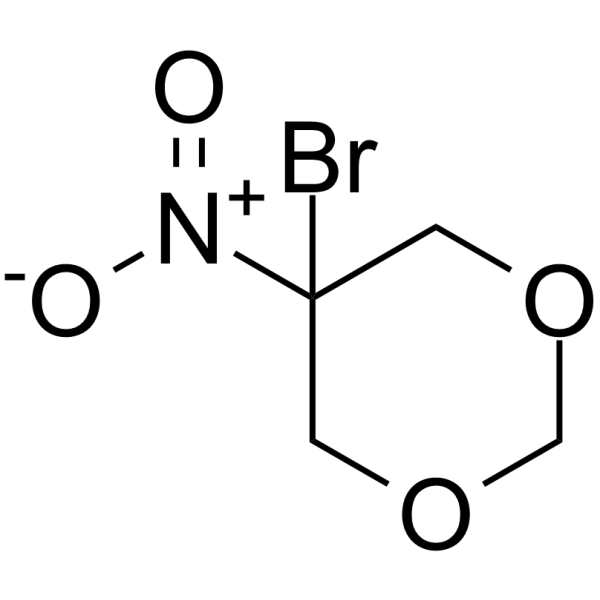
5-Bromo-5-nitro-1,3-dioxane is a broad-spectrum antimicrobial agent active against Gram-positive bacteria, Gram-negative bacteria and fungi. 5-Bromo-5-nitro-1,3-dioxane oxidizes free thiol groups to their corresponding disulfides. 5-Bromo-5-nitro-1,3-dioxane induces intracellular substance leakage in Escherichia coli and Staphylococcus aureus. 5-Bromo-5-nitro-1,3-dioxane modulates the oxygen consumption of Escherichia coli and Staphylococcus aureus .
loading...
    loading...
Cat. No.: HY-W1048849C
Synonyms: 4-Arm PEG20000-thiol
4-Arm PEG20000-SH (4-Arm PEG20000-thiol) is a multi-arm PEG derivative with thiol groups at each end of the four arms. The reactive free thiol, SH or sulfhydryl groups react selectively with maleimide and transition metal surfaces including gold and silver .
loading...
    loading...
Cat. No.: HY-E70264
CAS No.: 799812-86-5
Target:  

Endogenous Metabolite

Research Areas:  

Metabolic Disease

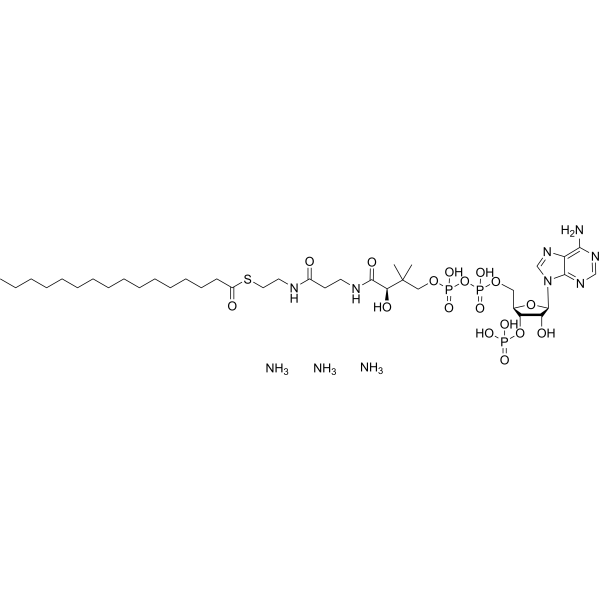
16:0 Coenzyme A triammonium is palmitoyl-CoA, which can serve as a reaction substrate to transfer the palmitoyl group to the free thiol group of the target protein through palmitoylation catalyzed by protein acyl transferases (PATs) .
loading...
    loading...
Cat. No.: HY-W1048849D
Synonyms: 4-Arm PEG40000-thiol
4-Arm PEG40000-SH (4-Arm PEG40000-thiol) is a multi-arm PEG derivative with thiol groups at each end of the four arms. The reactive free thiol, SH or sulfhydryl groups react selectively with maleimide and transition metal surfaces including gold and silver .
loading...
    loading...
Cat. No.: HY-138311
Research Areas:  

Cancer

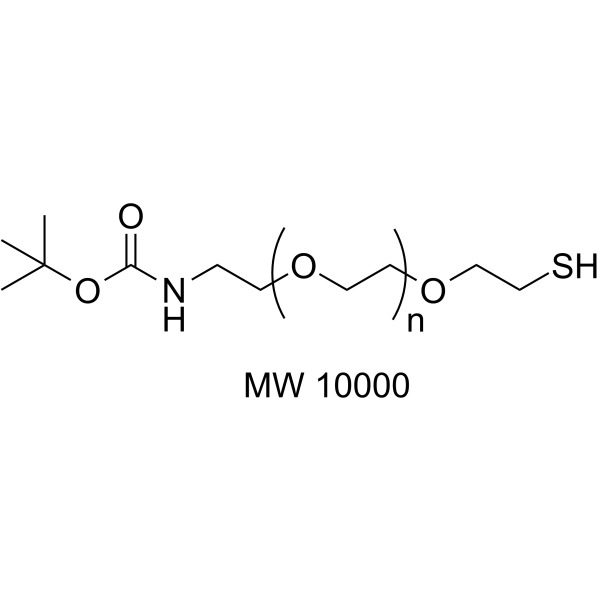
Boc-NH-PEG10000-Thiol is a PEG derivative containing Boc and thiol groups. After acidic deprotection of the Boc terminus, a free amino group is exposed, and the thiol terminus can efficiently couple with various groups, making it suitable for research in ADC drug synthesis, hydrogel construction, and nanoparticle delivery.
loading...
    loading...
Cat. No.: HY-17525
CAS No.: 163269-30-5
Bethoxazin is a yeast DNA topoisomerase II inhibitor with an IC50 of 5.3 μM, and also a broad-spectrum industrial microbicide and covalent adduct-forming agent. Bethoxazin inhibits the catalytic activity of yeast DNA topoisomerase II by reacting with the key free cysteine thiol group on the enzyme. Bethoxazin forms covalent adducts with molecules containing free thiol groups. Bethoxazin inhibits the growth of yeast cells. Bethoxazin can be used in studies related to the growth of fungi, molds and algae .
loading...
    loading...
Cat. No.: HY-W800828
CAS No.: 2512227-27-7
Research Areas:  

Others

Iodoacetamido-PEG3-NHS ester is a PEG reagent containing an Iodoacetamide group and a Boc-protected amino group. The iodoacetamide group is an alkylating agent that can be used to bind covalently with the thiol group. The Boc group can be deprotected under mild acidic conditions to form the free amine.
loading...
    loading...
Cat. No.: HY-W143822
CAS No.: 80441-55-0
Research Areas:  

Others

6-(Tritylthio)hexanoic acid is a linker with a Tst group and a terminal carboxylic acid. The Tst group can be deprotected under acidic conditions to obtain the free thiol which can be used for further conjugations. The terminal carboxylic acid can react with primary amine groups in the presence of activators (e.g. EDC, or HATU) to form a stable amide bond.
loading...
    loading...
Cat. No.: HY-D2094
PerCP Maleimide is a fluorescent dye that reacts with free sulfhydryl groups on proteins. PerCP is a red fluorescence albuminous dye for immunostaining and Maleimide can be leveraged for the preparation of fluorogenic probe, which is mainly used for the specific detection of thiol analytes .
loading...
    loading...
Cat. No.: HY-173390
CAS No.: 2059099-03-3
Research Areas:  

Others

BCN-E-BCN is a strained cycloalkyne-based probe designed for detecting protein sulfenylation, the primary intermediate in protein oxidation. This structurally constrained cycloalkyne compound specifically recognizes sulfenic acid groups formed during thiol oxidation, while remaining completely unreactive toward other oxidative states (such as free thiols, sulfinic, or sulfonic acid groups). Researchers can leverage its efficient conjugation with azide-bearing tags through copper-free click chemistry to amplify detection signals. Compared to conventional detection methods, BCN-E-BCN demonstrates superior reaction kinetics and enhanced sensitivity. With these advantages, BCN-E-BCN shows great promise as an effective tool for protein oxidation research .
loading...
    loading...
Cat. No.: HY-152919
CAS No.: 2387738-43-2
Target:  

ADC Linkers

Research Areas:  

Cancer

Mal-amide-PEG8-Val-Cit-PAB-OH is a cleavable ADC linker featuring a maleimide, a hydrophilic PEG spacer, a Val-Cit dipeptide, and a PAB functional group. Maleimide is used to covalently bind free thiols on the cysteine residues of proteins. The Val-Cit dipeptide is cleaved by cellular proteases within the cell to allow for efficient payload delivery with the help of the PAB structure.
loading...
    loading...
Cat. No.: HY-W014316R
CAS No.: 30007-47-7
Research Areas:  

Infection

5-Bromo-5-nitro-1,3-dioxane (Standard) is the analytical standard of 5-Bromo-5-nitro-1,3-dioxane (HY-W014316). This product is intended for research and analytical applications. 5-Bromo-5-nitro-1,3-dioxane is a broad-spectrum antimicrobial agent active against Gram-positive bacteria, Gram-negative bacteria and fungi. 5-Bromo-5-nitro-1,3-dioxane oxidizes free thiol groups to their corresponding disulfides. 5-Bromo-5-nitro-1,3-dioxane induces intracellular substance leakage in Escherichia coli and Staphylococcus aureus. 5-Bromo-5-nitro-1,3-dioxane modulates the oxygen consumption of Escherichia coli and Staphylococcus aureus .
loading...
    loading...
Cat. No.: HY-D3583
Target:  

Fluorescent Dye

Research Areas:  

Others

AF647 C2 Maleimide is a thiol-reactive Fluorescent labeling reagent. AF647 C2 Maleimide reacts with free thiol groups on Fab′ molecules to form covalent conjugates, enabling fluorescent detection in capillary chip electrophoresis .
loading...
    loading...
Cat. No.: HY-W1048549H
Synonyms: HOOC-PEG1000-thiol
HOOC-PEG1000-SH (HOOC-PEG1000-Thiol) is a reactive thiol PEG derivative with a terminal carboxyl group. The carboxyl group can react with amine or hydroxyl groups to form a stable amide bond or an unstable ester bond. The reaction of the carboxyl group allows the amine or hydroxyl group to be converted into a free thiol with a linear PEG linkage. The generated thiol group can be used to modify the surface of gold nanoparticles or participate in other PEGylation reactions. The PEG linkage between the thiol and carboxyl groups has good water solubility, flexible linker distance and higher stability .
loading...
    loading...
Cat. No.: HY-W1048549J
Synonyms: HOOC-PEG40000-thiol
HOOC-PEG40000-SH (HOOC-PEG40000-Thiol) is a reactive thiol PEG derivative with a terminal carboxyl group. The carboxyl group can react with amine or hydroxyl groups to form a stable amide bond or an unstable ester bond. The reaction of the carboxyl group allows the amine or hydroxyl group to be converted into a free thiol with a linear PEG linkage. The generated thiol group can be used to modify the surface of gold nanoparticles or participate in other PEGylation reactions. The PEG linkage between the thiol and carboxyl groups has good water solubility, flexible linker distance and higher stability .
loading...
    loading...
Cat. No.: HY-E70958
Target:  

Carboxypeptidase

Research Areas:  

Metabolic Disease

Carboxypeptidase G, Pseudomonas sp. (EC 3.4.17.11) is a lysosomal thiol-dependent protease that stepwise cleaves γ-glutamylpteroyl polyγ-glutamic acid to generate pteroyl-α-glutamic acid (folic acid) and free glutamic acid. Carboxypeptidase G is highly specific for the γ-glutamyl bond but not for the C-terminal amino acid of the leaving group. Carboxypeptidase G can be activated by Zn 2+ ions.
loading...
    loading...

