14 Results for "

glucose moiety

" in MedChemExpress (MCE) Product Catalog:
Products (14)

14 Results for "glucose moiety" in MCE Product Catalog:

1
1 Cited Publications
Cat. No.: HY-N9448
CAS No.: 14116-68-8
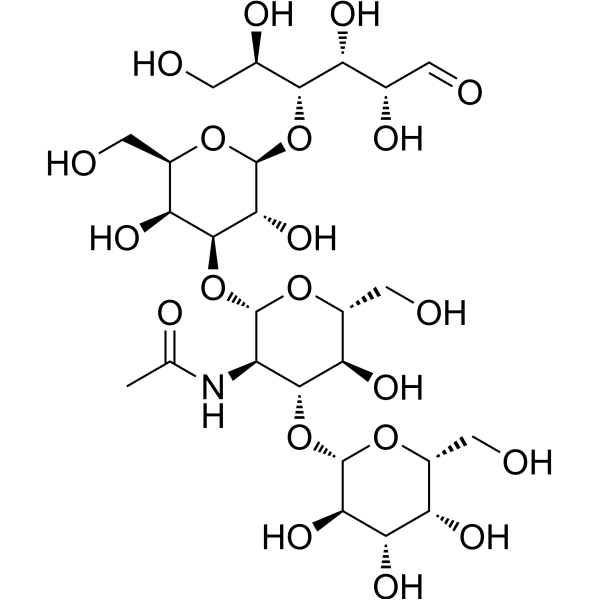
Lacto-N-tetraose is the significant core structure of human milk oligosaccharides (HMOs) naturally existing in human milk. Lacto-N-tetraose is consist of galactose, N-acetylglucosamine, and glucose moieties. Lacto-N-tetraose has prebiotic effect, immune regulatory effect, anti-inflammatory effects, intestinal cell responses regulatory effect, antibacterial activity and antiviral activity. Lacto-N-tetraose has been widely added to infant formula .
loading...
    loading...
1
1 Cited Publications
Cat. No.: HY-107824
CAS No.: 585-99-9
Purity:  99.73%
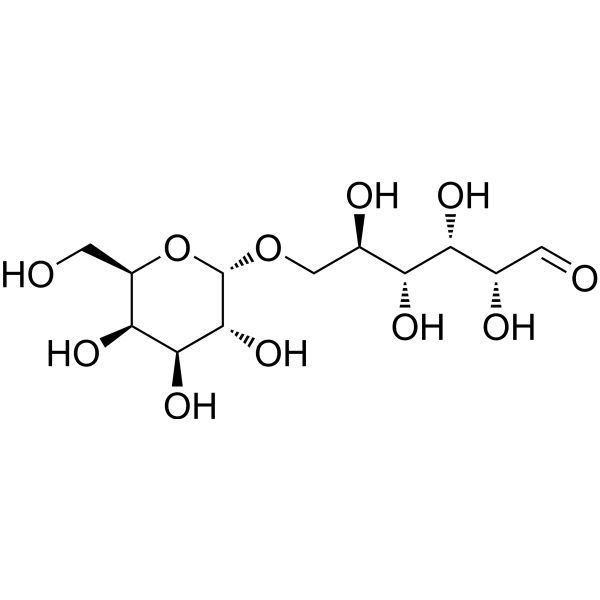
D-Melibiose is a disaccharide which is composed of one galactose and one glucose moiety in an alpha (1-6) glycosidic linkage.
loading...
    loading...
Cat. No.: HY-P2869
CAS No.: 9031-11-2
Synonyms: EC 3.2.1.23; GAL
Target:  

Glycosidase

Research Areas:  

Metabolic Disease

β-Galactosidase, E. coli (EC 3.2.1.23; GAL) is a glycoside hydrolase that hydrolyzes the β-glycosidic bonds formed between galactose and its organic moieties. β-Galactosidase, E. coli can hydrolyze lactose to form glucose and galactose, and enter glycolysis; it can also catalyze the transgalactosylation of lactose into allolactose; allolactose can be cracked into monosaccharides .
loading...
    loading...
Cat. No.: HY-137873
CAS No.: 17833-43-1
Purity:  99.99%
Synonyms: 4-Methylumbelliferyl-α-D-glucose; 4-Methylumbelliferyl-α-D-Glucoside; 4-MU-α-D-Glucopyranoside
Research Areas:  

Others

4-Methylumbelliferyl-α-D-Glucopyranoside (4-Methylumbelliferyl-α-D-Glucose) is a fluorescent substrate for α-glucosidase, which releases the fluorescent moiety 4-methylumbelliferyl (4-MU) upon cleavage. 4-MU has pH-dependent fluorescence excitation activity, with excitation wavelengths of 320 nm at low pH (1.97-6.72) and 360 nm at high pH (7.12-10.3), respectively. The emission wavelength of 4-Methylumbelliferyl-α-D-Glucopyranoside increases with decreasing pH, ranging from 445-455 nm. 4-Methylumbelliferyl-α-D-Glucopyranoside can be used as a biomarker for Fabry and Pompe diseases to quantify α-glucosidase activity in infant blood spot samples.
loading...
    loading...
Cat. No.: HY-120991
CAS No.: 26662-95-3
Purity:  ≥98.0%
Synonyms: 1-Palmitoyl-2-linoleoyl PE; (1-Palmitoyl, 2-linoleoyl)-phosphatidylethanolamine; (1-Palmitoyl, 2-linoleoyl)-phosphoethanolamine
Target:  

Liposome

Research Areas:  

Others

1-Palmitoyl-2-linoleoyl-sn-glycero-3-PE (1-Palmitoyl-2-linoleoyl PE; (1-Palmitoyl, 2-linoleoyl)-phosphatidylethanolamine; (1-Palmitoyl, 2-linoleoyl)-phosphoethanolamine) is a phosphatidylethanolamine phospholipid with a palmitoyl chain at sn-1 and a linoleoyl chain at sn-2, and an oxidation-prone substrate. 1-Palmitoyl-2-linoleoyl-sn-glycero-3-PE undergoes glycation and subsequent oxidation via Fenton system, forming long-chain and short-chain products at C-7, C-8, C-9, C-12 of its sn-2 acyl chain and glycated polar head. 1-Palmitoyl-2-linoleoyl-sn-glycero-3-PE’s glycated form oxidizes more quickly than non-glycated phosphatidylethanolamines and contributes to increased oxidative stress modifications. 1-Palmitoyl-2-linoleoyl-sn-glycero-3-PE can be used for the research of drug delivery .
loading...
    loading...
Cat. No.: HY-P1348
CAS No.: 1197810-60-8
Synonyms: [Gly8,36,Glu22]-GLP-1 (7-37)
Research Areas:  

Metabolic Disease

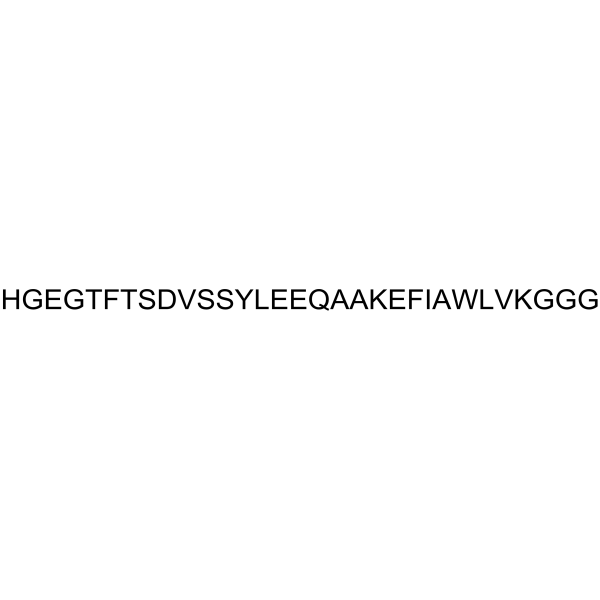
GLP-1 moiety from Dulaglutide ([Gly8,36,Glu22]-GLP-1 (7-37)) is a 31-amino acid fragment derived from Dulaglutide (HY-P0120). GLP-1 moiety from Dulaglutide is a DPP-4-modified GLP-1 analog carrying the [Gly8,36,Glu22] sequence mutation, which acts as a GLP-1 receptor agonist. GLP-1 moiety from Dulaglutide covalently links to the human IgG4 Fc fragment and constitutes a part of the dulaglutide recombinant fusion protein. GLP-1 moiety from Dulaglutide exhibits glucose-dependent insulinotropic activity. GLP-1 moiety from Dulaglutide can be used in research related to type 2 diabetes .
loading...
    loading...
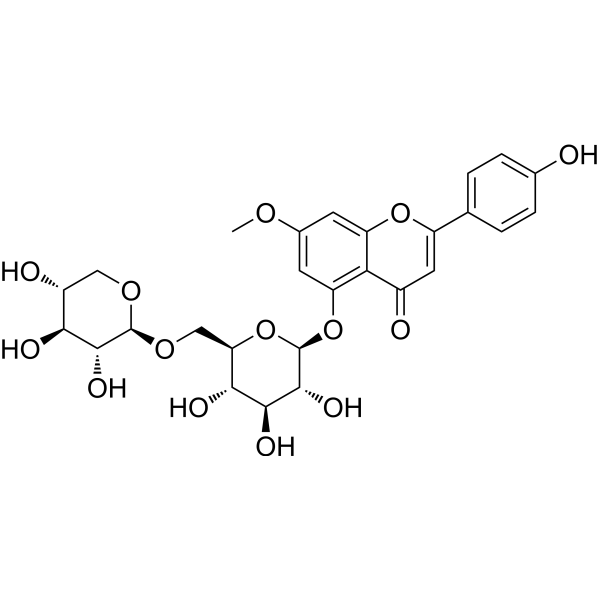
Cat. No.: HY-121597
CAS No.: 77099-20-8
Purity:  95.04%
Yuankanin is a genkwanin-5-bioside, the sugar moiety being composed of xylose and glucose. Yuankanin can be isolated from the methanol extract of the aerial parts of Gnidia involucrata (Thymelaeaceae) .
loading...
    loading...
Cat. No.: HY-P2869I
CAS No.: 9031-11-2
Target:  

Glycosidase

Research Areas:  

Metabolic Disease

β-Galactosidase, Sweet almond is a glycoside hydrolase that hydrolyzes the β-glycosidic bonds formed between galactose and its organic moieties. β-Galactosidase, Sweet almond can hydrolyze lactose to form glucose and galactose, and enter glycolysis; it can also catalyze the transgalactosylation of lactose into allolactose; allolactose can be cracked into monosaccharides .
loading...
    loading...
Cat. No.: HY-107824R
CAS No.: 585-99-9
D-Melibiose (Standard) is the analytical standard of D-Melibiose. This product is intended for research and analytical applications. D-Melibiose is a disaccharide which is composed of one galactose and one glucose moiety in an alpha (1-6) glycosidic linkage.
loading...
    loading...
Cat. No.: HY-N17435
CAS No.: 76344-11-1
Phloridzin 2''-acetate is a dihydrochalcone glycoside found in the leaves of Kalmia latifolia .
loading...
    loading...
Cat. No.: HY-N21539
Trollichinenside I is an acylated flavonoid 8-C-glucoside that occurs in the flowers of Trollius chinensis .
loading...
    loading...
Cat. No.: HY-N21962
CAS No.: 66575-30-2
Synonyms: Sennoside A1
Sennoside G (Sennoside A1) is a glycoside that is found in the leaves of Cassia angustifolia (senna leaves) .
loading...
    loading...
Cat. No.: HY-N9607
CAS No.: 168074-97-3
Uhdenoside is a secoiridoid. Uhdenoside is isolated from the leaves of Fraxinus uhdei (Oleaceae) .
loading...
    loading...
Cat. No.: HY-N17258
CAS No.: 129235-39-8
Quercetin 3-O-(2G-β-D-xylopyranosylrutinoside) is an oviposition inhibitory factor. Quercetin 3-O-(2G-β-D-xylopyranosylrutinoside) can be isolated from the leaves of Orixa japonica. When presented together with the oviposition stimulant from Citrus unshiu (Satsuma mandarin), Quercetin 3-O-(2G-β-D-xylopyranosylrutinoside) inhibits oviposition by gravid female Papilio xuthus (Asian swallowtail) .
loading...
    loading...
  • 1

