10 Results for "

medullary thyroid carcinoma cells

" in MedChemExpress (MCE) Product Catalog:
Products (10)

10 Results for "medullary thyroid carcinoma cells" in MCE Product Catalog:

Cat. No.: HY-W009776
CAS No.: 38937-66-5
Synonyms: Suberohydroxamic acid; SBHA
Target:  

HDAC Apoptosis

Research Areas:  

Cancer

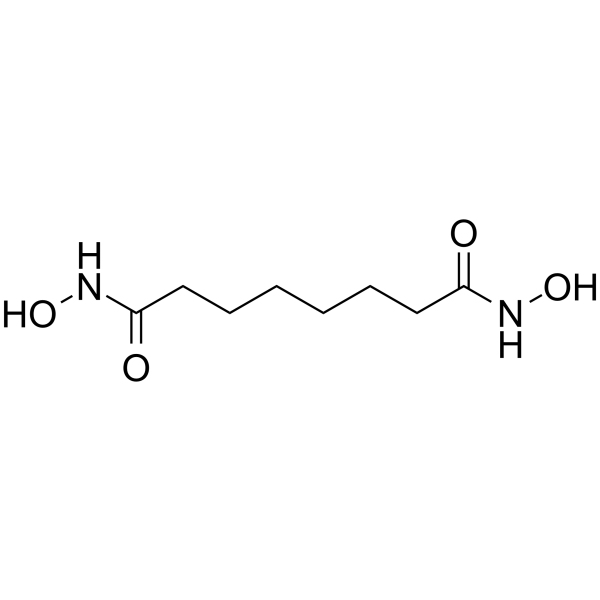
Suberoyl bis-hydroxamic acid (Suberohydroxamic acid; SBHA) is a competitive and cell-permeable HDAC1 and HDAC3 inhibitor with ID50 values of 0.25 μM and 0.30 μM, respectively .Suberoyl bis-hydroxamic acid renders MM cells susceptible to apoptosis and facilitates the mitochondrial apoptotic pathways .Suberoyl bis-hydroxamic acid can be used for the study of medullary thyroid carcinoma (MTC) .
loading...
    loading...
Cat. No.: HY-101246
CAS No.: 269730-03-2
Purity:  99.29%
Target:  

RET

Research Areas:  

Cancer

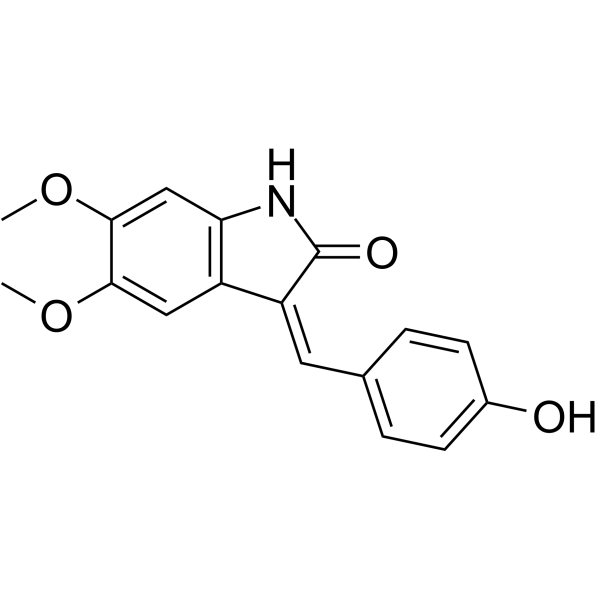
RPI-1 is a specific, orally available 2-indolinone Ret tyrosine kinase inhibitor. RPI-1 inhibits proliferation, Ret tyrosine phosphorylation, Ret protein expression, and the activation of PLCgamma, ERKs and AKT in human medullary thyroid carcinoma TT cells. Antitumor activity .
loading...
    loading...
Cat. No.: HY-148745
CAS No.: 2241517-83-7
Target:  

Drug Derivative HSP

Research Areas:  

Cancer

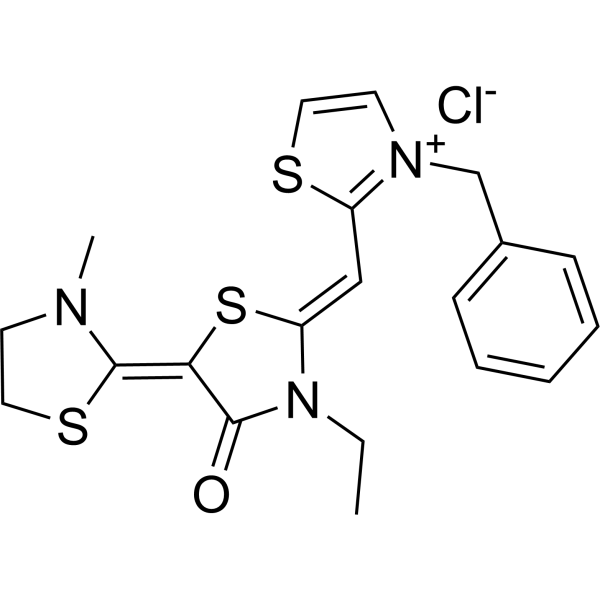
JG-258 is an inactive negative control for Hsp70 inhibitors. JG-258 is an inactive structural analog of JG-98 (HY-117282), an allosteric inhibitor of heat shock protein 70 (Hsp70) with demonstrated anticancer activity. JG-258 can be used in cancer-related research .
loading...
    loading...
Cat. No.: HY-164725
CAS No.: 3023869-94-2
Research Areas:  

Cancer

FAPI-mFS is a selective fibroblast activation protein (FAP) inhibitor with an IC50 of 0.0014 μM against human FAP. Through its covalent binding property with FAP, FAPI-mFS enhances its uptake and retention time in cancer cells. When radiolabeled with 68Ga, FAPI-mFS serves as a PET/CT imaging agent with superior tumor-to-background tissue contrast and lesion detection capability. When radiolabeled with 177Lu or 225Ac, FAPI-mFS induces tumor regression and inhibition in preclinical models. FAPI-mFS can be used in studies related to cancer and radionuclide-conjugated drugs (RDC) .
loading...
    loading...
Cat. No.: HY-170855A
Target:  

PROTACs RET

Research Areas:  

Endocrinology Cancer

YW-N-7 TFA is a PROTAC degrader targeting RET kinase, with an IC50 of 8.4 nM. YW-N-7 TFA inhibits RET kinase activity and induces proteasome-mediated degradation of RET fusion proteins, while enhancing the anti-tumor activity of Selpercatinib (LOXO-292) (HY-114370). YW-N-7 TFA can be used in the research of cancers associated with RET gene abnormalities, including medullary thyroid carcinoma, papillary thyroid carcinoma and non-small cell lung cancer .
loading...
    loading...
Cat. No.: HY-183783
Target:  

PROTACs RET STAT ERK Apoptosis

Research Areas:  

Endocrinology Cancer

PROTAC RET Degrader 2 is a RET degrader with a target IC50 of 0.36 nM. PROTAC RET Degrader 2 is mainly composed of RET-IN-34 (HY-183729) and Thalidomide (HY-14658). PROTAC RET Degrader 2 mediates RET degradation via the ubiquitin-proteasome system. PROTAC RET Degrader 2 induces apoptosis, inhibits colony-forming ability, and exhibits antiproliferative activity in cancer cells. PROTAC RET Degrader 2 suppresses tumor growth in xenograft models. PROTAC RET Degrader 2 can be used in research related to medullary thyroid carcinoma, papillary thyroid carcinoma, and RET fusion-positive lung adenocarcinoma .
loading...
    loading...
Cat. No.: HY-183684
Target:  

RET VEGFR PDGFR Akt ERK

Research Areas:  

Endocrinology Cancer

RET-IN-33 is a moderately selective inhibitor of RET mutants. RET-IN-33 potently inhibits G810 mutants, with IC50 values of 4.43 nM (G810R), 3.28 nM (G810C) and 0.51 nM (G810S), respectively. RET-IN-33 also inhibits other RET mutants: V804M (IC50 0.73 nM), V804L (IC50 0.36 nM), Y806H (IC50 0.74 nM) and M918T (IC50 0.55 nM). RET-IN-33 also inhibits other kinases, with an IC50 of 1.50 nM against VEGFR2 and 1.60 nM against PDGFRα. RET-IN-33 blocks the autophosphorylation of RET mutants and the downstream SHC/AKT/ERK signaling pathway. RET-IN-33 selectively inhibits the proliferation of RET-driven cell models without affecting non-RET-dependent or normal cells. RET-IN-33 exhibits dose-dependent antitumor efficacy in RET-driven xenograft models. RET-IN-33 can be used for the research of medullary thyroid carcinoma, papillary thyroid carcinoma and non-small cell lung cancer .
loading...
    loading...
Cat. No.: HY-183729
CAS No.: 2222758-09-8
RET-IN-34 is a RET inhibitor with an IC50 of 0.89 nM. RET-IN-34 serves as a target protein ligand for PROTAC synthesis (Ligand for Target Protein for PROTAC). RET-IN-34 is applicable for the synthesis of PROTAC RET Degrader 2 (HY-183783). RET-IN-34 exhibits anticancer activity against medullary thyroid carcinoma. RET-IN-34 can be used in studies related to medullary thyroid carcinoma .
loading...
    loading...
Cat. No.: HY-187253S
[U- 15N]-ProGRP is the 15N-labeled ProGRP. Pro-gastrin-releasing peptide (ProGRP) is a highly specific biomarker for small-cell lung cancer and is also highly expressed in tumors such as medullary thyroid carcinoma. This isotope can be used in NMR studies of disease mechanisms and in mass spectrometry analysis.
loading...
    loading...
Cat. No.: HY-189268
Target:  

RET

Research Areas:  

Endocrinology Cancer

RET-IN-36 is an orally active RET kinase inhibitor. RET-IN-36 overcomes gatekeeper and solvent front resistance mutations and inhibits the proliferation of cells expressing RET G810C and RET V804M mutants by suppressing RET phosphorylation and SHC downstream signaling. RET-IN-36 can be used for research on RET-mutant cancers, medullary thyroid cancer, papillary thyroid cancer, and non-small cell lung cancer .
loading...
    loading...

