10 Results for "

mitochondrial respiratory chain complex III

" in MedChemExpress (MCE) Product Catalog:
Products (10)

10 Results for "mitochondrial respiratory chain complex III" in MCE Product Catalog:

2
2 Cited Publications
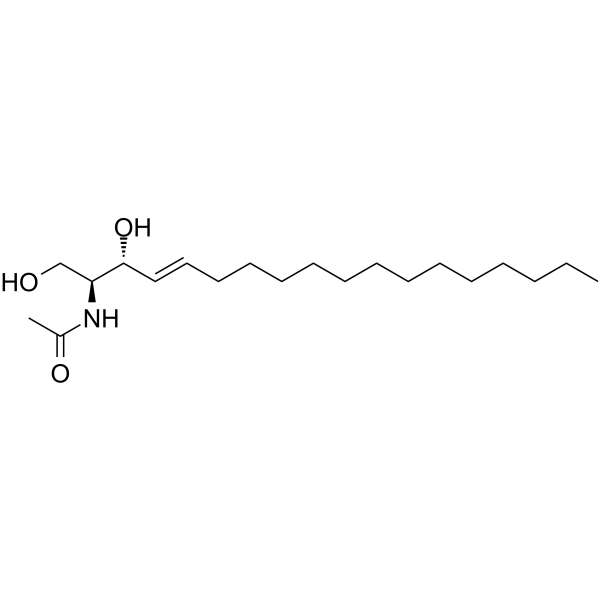
Cat. No.: HY-101180
CAS No.: 3102-57-6
Purity:  99.85%
Synonyms: Ceramide 2
C2 Ceramide (Ceramide 2) is the main lipid of the stratum corneum and a protein phosphatase 1 (PP1) activator. C2 Ceramide activates PP2A and ceramide-activated protein phosphatase (CAPP). C2 Ceramide induces cells differentiation, autophagy and apoptosis, inhibits mitochondrial respiratory chain complex III. C2 Ceramide is also a skin conditioning agent that protects the epidermal barrier from water loss .
loading...
    loading...
1
1 Cited Publications
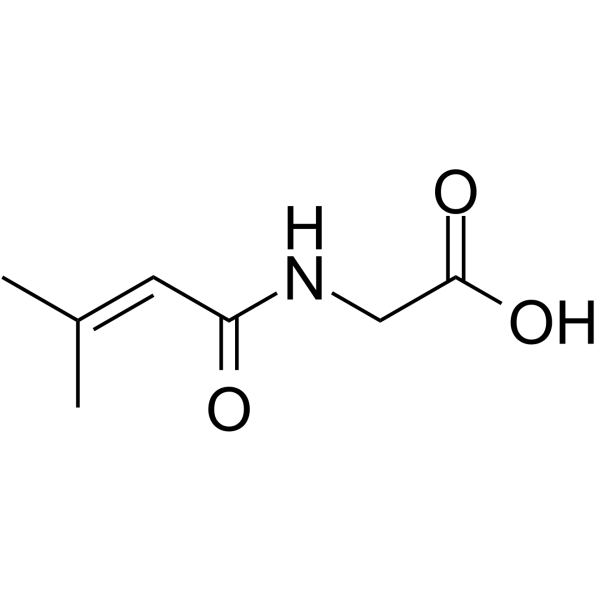
Cat. No.: HY-113232
CAS No.: 33008-07-0
Purity:  99.90%
3-Methylcrotonylglycine is an organic acid conjugate associated with leucine catabolism that inhibits respiratory chain complex II-III, mitochondrial creatine kinase, and synaptic membrane Na +, K +-ATPase. 3-Methylcrotonylglycine increases reactive oxygen species levels to mediate oxidative damage, while inhibiting mitochondrial electron transport, reducing tricarboxylic acid cycle flux, and interfering with intracellular energy transport and neuronal ion homeostasis. 3-Methylcrotonylglycine is a neurotoxic metabolite that accumulates in the metabolic pathway of 3-methylcrotonyl-CoA carboxylase deficiency. 3-Methylcrotonylglycine can be used in studies related to 3-methylcrotonyl-CoA carboxylase deficiency .
loading...
    loading...
1
1 Cited Publications
Cat. No.: HY-117897
CAS No.: 1361004-87-6
Purity:  98.91%
Target:  

Parasite

Research Areas:  

Infection

CK-2-68 is an inhibitor for complex III in protozoan mitochondrial respiratory chain, by targeting the alternative NADH dehydrogenase (NDH2) of the malarial parasite Plasmodium. CK-2-68 exhibits antimalaria efficacy, that inhibits Plasmodium falciparum infected erythrocytes with an IC50 of 40 nM .
loading...
    loading...
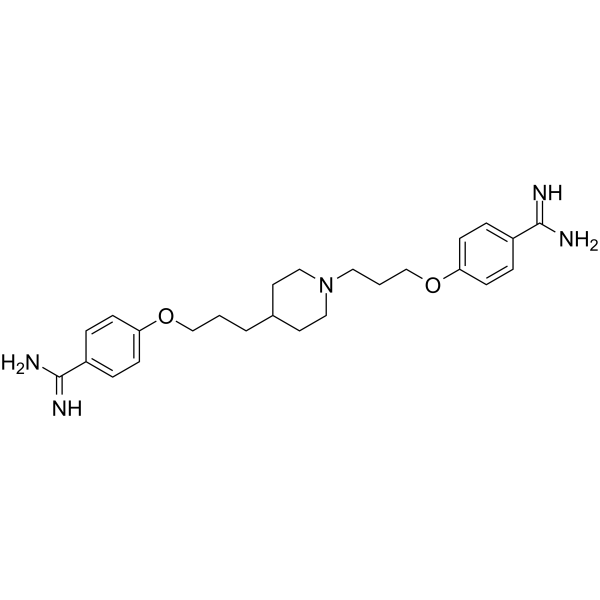
Cat. No.: HY-114220
CAS No.: 873546-31-7
Purity:  98.41%
Research Areas:  

Infection

T-2307 is an antifungal agent with blood-brain barrier penetration. T-2307 exhibits broad-spectrum antifungal activity against Candida species, including echinocandin-resistant strains, Cryptococcus neoformans, Cryptococcus gattii, and some Aspergillus species. T-2307 selectively targets fungal mitochondrial respiratory chain complexes III and IV, causing collapse of the fungal mitochondrial membrane potential and exerting fungicidal or fungistatic effects. T-2307 can be used in research related to fungal infections such as invasive candidiasis, cryptococcosis, and aspergillosis .
loading...
    loading...
Cat. No.: HY-112847B
CAS No.: 1212012-37-7
Synonyms: (E/Z)-Sulfo-N-succinimidyl oleate sodium
(E/Z)-Sulfosuccinimidyl oleate sodium is the racemate of (E)-Sulfosuccinimidyl oleate sodium and (Z)-Sulfosuccinimidyl oleate sodium. Sulfosuccinimidyl oleate sodium (Sulfo-N-succinimidyl oleate sodium) is a long-chain fatty acid that inhibits fatty acid transport into cells. Sulfosuccinimidyl oleate sodium is a potent and irreversible inhibitor of the mitochondrial respiratory chain. Sulfosuccinimidyl oleate sodium binds to the CD36 receptor on the surface of microglial cells. Sulfosuccinimidyl oleate sodium exhibits anti-inflammatory effects .
loading...
    loading...
Cat. No.: HY-189253
CAS No.: 3134062-94-2
Antimicrobial agent-57 is an agricultural antimicrobial agent that acts as a mitochondrial respiratory chain complex III inhibitor (IC50 = 8.82 mg/L). Antimicrobial agent-57 binds to the Qo site, disrupts the mitochondrial respiratory chain of P. capsici, and inhibits respiration. Antimicrobial agent-57 induces ultrastructural damage to hyphae, including cell wall thickening, mitochondrial degradation, vacuole enlargement, and lipid droplet reduction. Antimicrobial agent-57 inhibits hyphal respiratory metabolism. Antimicrobial agent-57 can be used for research on Phytophthora capsici infection .
loading...
    loading...
Cat. No.: HY-138439
CAS No.: 173662-97-0
Research Areas:  

Infection

Mandestrobin is a fungicide that exerts fungal killing activity by inhibiting mitochondrial respiratory chain complex III. Mandestrobin exhibits differential fungicidal activity between its enantiomers, and the R-enantiomer possesses stronger activity than the S-enantiomer. Mandestrobin is used in studies related to fungal infections and the agricultural field .
loading...
    loading...
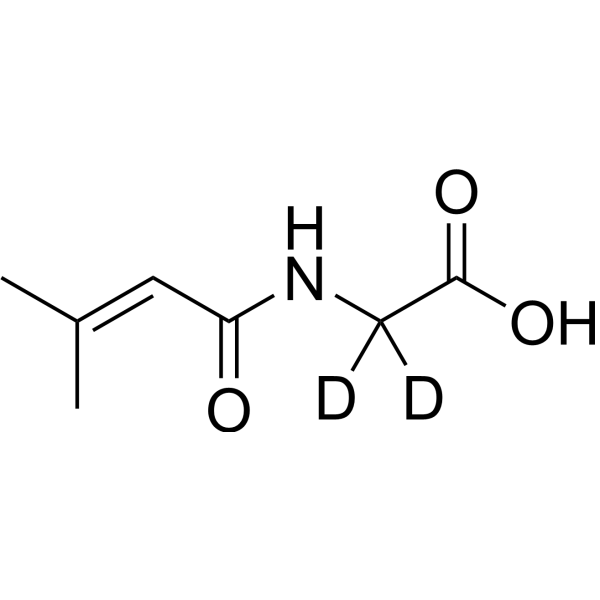
Cat. No.: HY-113232S
CAS No.: 1276197-31-9
3-Methylcrotonylglycine-d2 is the deuterated-labeled 3-Methylcrotonylglycine (HY-113232). 3-Methylcrotonylglycine is an organic acid conjugate associated with leucine catabolism that inhibits respiratory chain complex II-III, mitochondrial creatine kinase, and synaptic membrane Na +, K +-ATPase. 3-Methylcrotonylglycine increases reactive oxygen species levels to mediate oxidative damage, while inhibiting mitochondrial electron transport, reducing tricarboxylic acid cycle flux, and interfering with intracellular energy transport and neuronal ion homeostasis. 3-Methylcrotonylglycine is a neurotoxic metabolite that accumulates in the metabolic pathway of 3-methylcrotonyl-CoA carboxylase deficiency. 3-Methylcrotonylglycine can be used in studies related to 3-methylcrotonyl-CoA carboxylase deficiency .
loading...
    loading...
Cat. No.: HY-183705
CAS No.: 177776-73-7
Research Areas:  

Infection

Antimicrobial agent-50 is an anti-oomycete and Fungicidal agent. Antimicrobial agent-50 inhibits the activity of Mitochondrial respiratory chain complex III with an IC50 of 6.05 mg/L. Antimicrobial agent-50 inhibits ATP synthesis. Antimicrobial agent-50 exhibits protective activity against Phytophthora capsici in vivo. Antimicrobial agent-50 potently inhibits mycelial growth of Gaeumannomyces graminis, Rhizoctonia solani and Phytophthora capsici, with EC50 values of 2.97 mg/L, 1.86 mg/L and 0.74 mg/L, respectively .
loading...
    loading...
Cat. No.: HY-131453
CAS No.: 1352002-58-4
Mitochondrial respiration-IN-1 is a mitochondrial respiratory inhibitor. Mitochondrial respiration-IN-1 reduces platelet aggregation, adhesion, and platelet-induced coagulation responses. Mitochondrial respiration-IN-1 induces adaptive glycolysis, decreases mitochondrial membrane potential, selectively reduces ATP production derived from oxidative phosphorylation, and exerts bidirectional regulatory effects on cell proliferation. Mitochondrial respiration-IN-1 activates UPRmt and upregulates the expression of SDHA-1 and MT-CO1. Mitochondrial respiration-IN-1 restores metabolic homeostasis in type 2 diabetic mice. Mitochondrial respiration-IN-1 can be used to investigate diseases mediated by inappropriate platelet activation/aggregation and type 2 diabetes .
loading...
    loading...

