1. Search Result
Search Result
Results for "

paclitaxel-resistant

" in MedChemExpress (MCE) Product Catalog:

12

Inhibitors & Agonists

2

Natural
Products

Cat. No. Product Name Target Research Areas Chemical Structure
  • HY-127079

    Microtubule/Tubulin Cancer
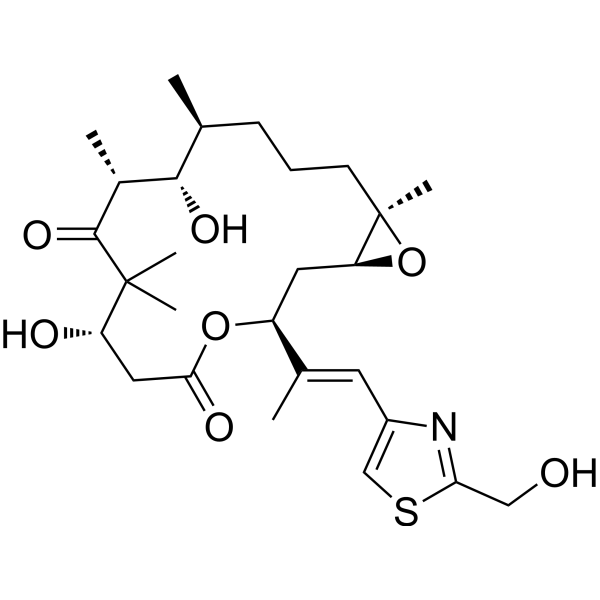
    Epothilone F is a 16-membered macrolide microtubule-targeting agent. Epothilone F exhibits significant anticancer activity, and it particularly exerts effective inhibitory effects on paclitaxel-resistant cancer cells. Epothilone F inhibits the proliferation of breast cancer cells, non-small cell lung cancer cells and drug-resistant ovarian cancer cells, and it has been widely used in cancer-related research .
    Epothilone F
  • HY-N2382
    Polyphyllin H
    1 Publications Verification

    Cytochrome P450 P-glycoprotein Metabolic Disease Cancer
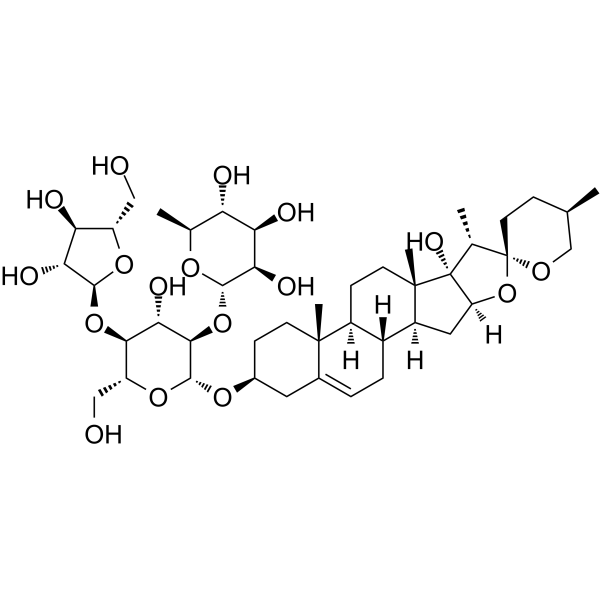
    Polyphyllin H is a steroidal saponin. Polyphyllin H is isolated from Paris polyphylla. Polyphyllin H potently inhibits the activities of CYP1A2 (IC50 = 6.44 μM, competitive), CYP2D6 (IC50 = 13.88 μM, competitive) and CYP3A4 (IC50 = 4.52 μM, non-competitive, time-dependent). Polyphyllin H downregulates the expression of ABCB1 and ABCC3. Polyphyllin H binds to membrane cholesterol and disrupts lipid raft structures. Polyphyllin H restores the sensitivity of paclitaxel-resistant breast cancer cells to paclitaxel .
    Polyphyllin H
  • HY-106219

    Microtubule/Tubulin P-glycoprotein Cancer
    BMS 275183 is a potent, orally active analogue of Paclitaxel (HY-B0015). BMS 275183 can stabilize microtubules and exhibits antitumor activity in in vivo tumor models. BMS 275183 is active in vitro against Paclitaxel-resistant tumors including those harboring tubulin mutations or overexpressing P-glycoprotein. BMS 275183 can be used for cancer research, such as non-small cell lung cancer (NSCLC) and prostate carcinoma .
    BMS 275183
  • HY-106265

    P-glycoprotein Cancer
    9,10-trans-Dehydroepothilone D shows an antiproliferative activity against a paclitaxel-resistant cell lines overexpressing P-glycoprotein. 9,10-trans-Dehydroepothilone D also shows tubulin polymerization activity. 9,10-trans-Dehydroepothilone D is given by lactonization of Seco acid, which is promising for research of cancers .
    9,10-trans-Dehydroepothilone D
  • HY-105409

    NVP-XAA-296; XAA 296

    Microtubule/Tubulin Apoptosis Cancer
    Discodermolide (NVP-XAA-296) is a potent microtubule-stabilizing agent with a Ki of 0.4 μM. Discodermolide stabilizes microtubules, induces G2 or M phase cell cycle arrest and apoptosis, leading to inhibition of cancer cell proliferation. Discodermolide competitively inhibits the binding of Paclitaxel (HY-B0015) to tubulin polymers, and inhibits the growth of Paclitaxel-resistant cells. Discodermolide can be used for breast and colon cancer research .
    Discodermolide
  • HY-161825

    Microtubule/Tubulin Apoptosis Cancer
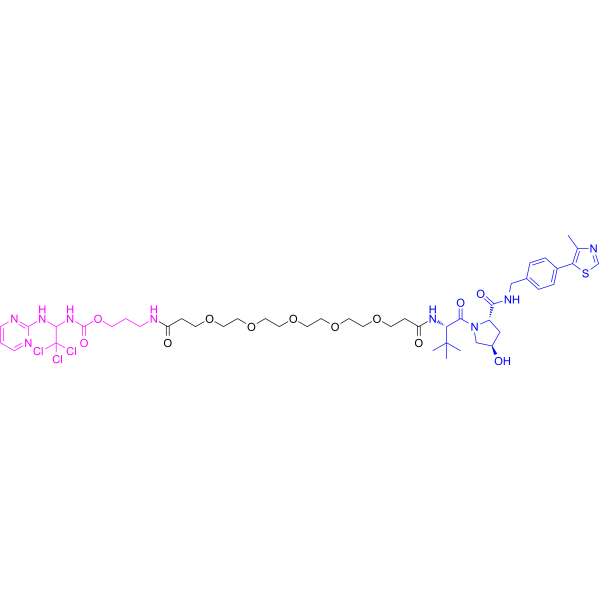
    Tubulin polymerization-IN-66 (Compound 13) inhibits colony formation and tubulin polymerization. Tubulin polymerization-IN-66 induces apoptosis. Tubulin polymerization-IN-66 inhibits cell viability of A549, A2780, SKOV3, HCC827 cells, with IC50s of 0.84, 0.38, 0.31, 0.34 nM respectively. Tubulin polymerization-IN-66 is also active against the Paclitaxel (HY-B0015)-resistant cancer cell line A2780/T and its parental cell line A2780 .
    Tubulin polymerization-IN-66
  • HY-183143

    Topoisomerase Apoptosis TNF Receptor PARP STAT P-glycoprotein Cancer
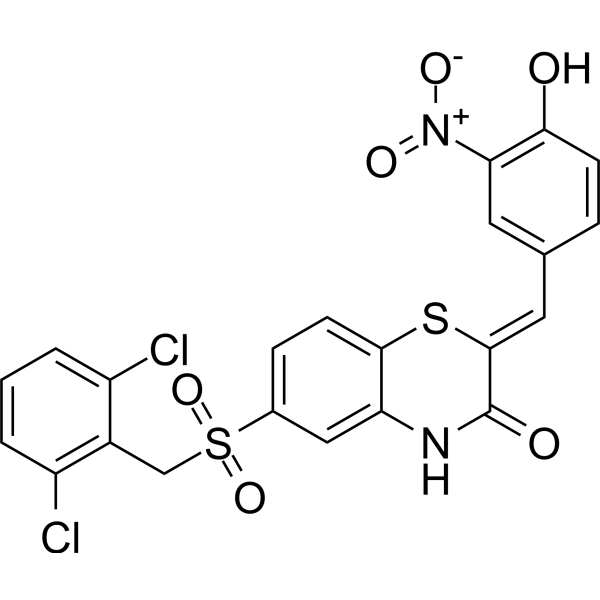
    Lss-11 is a topoisomerase inhibitor. LSS-11 enhances cell death in cancer cells by inducing apoptosis through increasing the DR5 protein level and PARP1 cleavage. LSS-11 dose-dependently reduces STAT3 phosphorylation, downregulates its target genes MDR1 and MRP1, reduces P-gp protein expressionwithout affecting P-gp transport function. Lss-11 is a chemosensitizer and shows synergistic anticancer effect with Paclitaxel (HY-B0015). Lss-11 can be used for the research of paclitaxel-resistant lung cancer .
    Lss-11
  • HY-181550A

    Cytochrome P450 P-glycoprotein Cancer
    CYP1B1-IN-14 TFA is a metabolically stable hCYP1B1 competitive inhibitor with an IC50 of 1.32 nM and a Ki of 0.72 μM. CYP1B1-IN-14 TFA reverses the resistance of cancer cells to Paclitaxel (HY-B0015). CYP1B1-IN-14 TFA acts synergistically with Paclitaxel (HY-B0015) to inhibit tumor growth in xenograft models without obvious toxicity. CYP1B1-IN-14 TFA can be used for the research of cancers such as paclitaxel-resistant lung cancer .
    CYP1B1-IN-14 TFA
  • HY-N10342

    Apoptosis Bcl-2 Family Caspase PARP Reactive Oxygen Species (ROS) Bacterial PI3K Akt NF-κB P-glycoprotein Infection Cancer
    Cajanol is an isoflavanone that can be isolated from the roots of Cajanus cajan (L.) Millsp. . Cajanol inhibits cancer cell proliferation and induces cancer cell apoptosis. Cajanol promotes the expression of Bax, inhibits the expression of Bcl-2, activates caspase-9 and caspase-3, induces PARP cleavage, arrests the cell cycle at the G2/M phase, generates ROS, disrupts mitochondrial membrane potential and triggers cytochrome c release. Cajanol induces bacterial DNA damage, disrupts bacterial cell membranes, and exerts antibacterial activity in vitro. Cajanol reduces the expression of PI3K, inhibits the phosphorylation of Akt and NF-κB, downregulates the expression and transport function of P-gp, restores the sensitivity of drug-resistant cancer cells to Paclitaxel, and inhibits the growth of Paclitaxel-resistant metastatic ovarian tumors. Cajanol is applicable to research related to breast cancer, ovarian cancer and bacterial infections .
    Cajanol
  • HY-164534

    Salt-inducible Kinase (SIK) PAK Cardiovascular Disease Cancer
    SIK2/3-IN-2 (compound 12, compound I-200) is a potent SIK2/3 inhibitor (SIK2 IC50 = 65 nM, SIK3 IC50 = 14 nM). SIK2/3-IN-2 is also a p21-activated protein kinase (PAK) 1 inhibitor with a Ki of 20.7 nM. SIK2/3-IN-2 can be used for hyperproliferative diseases and cancer research, such as Paclitaxel (HY-B0015)-resistant ovarian cancer .
    SIK2/3-IN-2
  • HY-183329

    Microtubule/Tubulin Apoptosis Cancer
    Tubulin polymerization-IN-92, an analog of KX-01 (HY-10340), is a potent orally active tubulin polymerization inhibitor that binds tubulin with a Ka of 1.29 μM. Tubulin polymerization-IN-92 simultaneously occupies the colchicine site in β-tubulin and a cavity in α-tubulin. Tubulin polymerization-IN-92 exerts antiproliferative activity, induces G2/M cell cycle arrest and apoptosis in cancer cells. Tubulin polymerization-IN-92 inhibits tumor growth in mouse xenograft models. Tubulin polymerization-IN-92 can be used for the research of colon cancer, cervical cancer, and Paclitaxel (HY-B0015)-resistant ovarian cancer .
    Tubulin polymerization-IN-92
  • HY-182253

    P-glycoprotein Cancer
    WS-691 is an orally active, selective ABCB1 modulator. WS-691 selectively stabilizes ABCB1 via direct binding to ABCB1. WS-691 inhibits the efflux function of ABCB1 and activates ABCB1 ATPase activity. WS-691 elevates intracellular Paclitaxel (HY-B0015) levels and reduces the required dose of Paclitaxel in cancer cells overexpressing ABCB1. WS-691 increases the sensitivity of colon cancer cells to Paclitaxel .
    WS-691

Inquiry Online

Your information is safe with us. * Required Fields.

Salutation


Country or Region *

Applicant Name *


Organization Name *

Department *


Email Address *


Product Name *

Cat. No.


Requested quantity *

Phone Number *


Remarks

Inquiry Online

Inquiry Information

Product Name:
Cat. No.:
Quantity:
MCE Japan Authorized Agent:

