
10 Results for "

plant senescence

" in MedChemExpress (MCE) Product Catalog:
Products (10)

10 Results for "plant senescence" in MCE Product Catalog:

Cat. No.: HY-126386
CAS No.: 9032-75-1
Synonyms: EC 3.2.1.15
Research Areas:  

Others

Pectinase (EC 3.2.1.15) is a mixed enzymes that hydrolyze pectic substances, it mostly presents in microorganisms and higher plants. Pectinase is involved in the metabolism of the cell wall as well as in the growth of the cell, senescence, ripening of fruits, pathogenesis and abscission process .
loading...
    loading...
Cat. No.: HY-131116
CAS No.: 3572-64-3
Purity:  99.26%
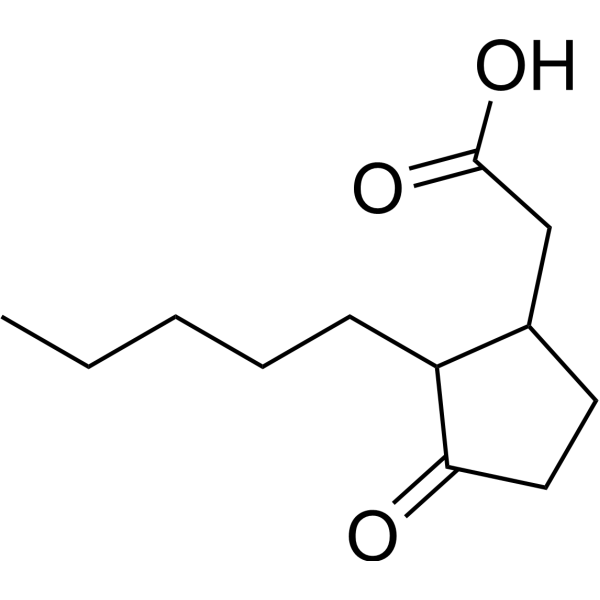
Dihydrojasmonic acid is a pentacyclic oxygen-containing lipid plant growth regulator related to Jasmonic acid (HY-122464), with activities including growth inhibition, promotion of leaf senescence, and induction of the accumulation of some plant secondary metabolites . Dihydrojasmonic acid serves as a substrate for metabolic modification and undergoes biotransformation via side-chain hydroxylation, glycosylation, and amino acid conjugation in the aerial parts and seedlings of barley (Hordeum vulgare). Dihydrojasmonic acid inhibits the growth of dwarf rice seedlings and can induce the synthesis of secondary metabolites in some plant cell culture species, with its activity being species-dependent. Dihydrojasmonic acid is involved in studies related to the regulation of plant growth and development .
loading...
    loading...
Cat. No.: HY-119698
CAS No.: 2312-73-4
Purity:  99.61%
Synonyms: SD 8339; N-Benzyl-9-(tetrahydro-2h-pyran-2-yl)adenine
Research Areas:  

Others

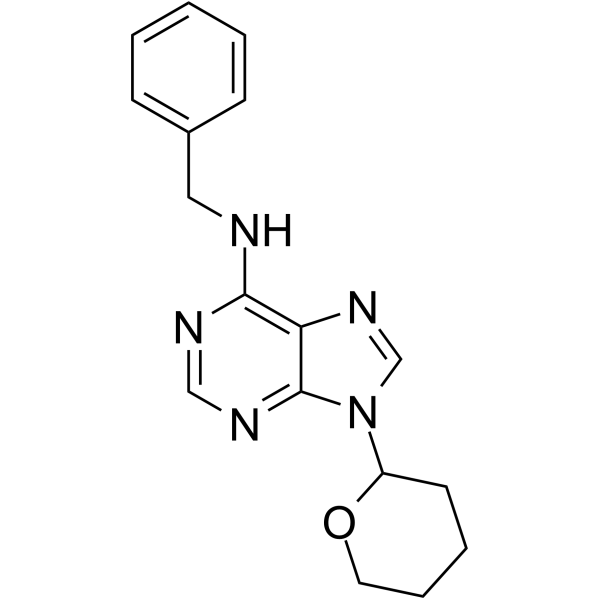
BAP9THP is a synthetic cytokinin derivative and a growth regulator. BAP9THP promotes chlorophyll retention (and senescence delay) in plant tissues exceptionally strongly, and growth of tobacco callus almost as strongly as 6-Benzylaminopurine (BAP). BAP9THP induces adventitious shoot formation ignificantly more strongly than N6-isopentenyladenine or Kinetin .
loading...
    loading...
Cat. No.: HY-162522
Target:  

Parasite

Research Areas:  

Others

SL-IN-1 (Compound C6) is an inhibitor for plant hormone steroid lactones receptor (SL receptor). SL-IN-1 promotes rice tillering, inhibits the germination of the root parasite P. aegyptiaca seeds (IC50 is 82.8 µM), delays dark-induced senescence of rice leaves, and protects the leaf membrane from lipid peroxidation .
loading...
    loading...
Cat. No.: HY-W681749
CAS No.: 2536-31-4
Synonyms: Morphactin
Morphactin Chlorflurenol methyl (Morphactin) is a plant growth regulator. Morphactin Chlorflurenol methyl preserves chlorophyll and suppresses senescence. Morphactin Chlorflurenol methyl regulates chlorophyll metabolic enzymes and alleviates heat-induced leaf senescence by enhancing chlorophyll content and reducing electrolyte leakage. Morphactin Chlorflurenol methyl promotes shoot redifferentiation and tracheary element development in tobacco calluses. Morphactin Chlorflurenol methyl can be applied to the investigation of heat-induced leaf senescence .
loading...
    loading...
Cat. No.: HY-W753416
CAS No.: 457603-63-3
14-Hydroxylated brassinosteroid is a plant growth regulator. 14-Hydroxylated brassinosteroid enhances winter wheat resistance to heat stress, delays heat-induced leaf senescence, maintains leaf water content, promotes grain filling, and mitigates yield loss. 14-Hydroxylated brassinosteroid shows antioxidant activity. 14-Hydroxylated brassinosteroid can be used for the research of plant growth .
loading...
    loading...
Cat. No.: HY-E70911
Research Areas:  

Others

Chlorophyllase (EC 3.1.1.14) is part of the chlorophyll degradation pathway and is believed to be involved in various plant chlorosis processes, such as fruit ripening, leaf senescence, and flowering, as well as chlorophyll turnover and homeostasis. Chlorophyllase (EC 3.1.1.14) preferentially acts on chlorophyll a, but can also use chlorophyll b and pheophytin as substrates.
loading...
    loading...
Cat. No.: HY-131116R
CAS No.: 3572-64-3
Dihydrojasmonic acid (Standard) is the analytical standard of Dihydrojasmonic acid (HY-131116). This product is intended for research and analytical applications. Dihydrojasmonic acid is a pentacyclic oxygen-containing lipid plant growth regulator related to Jasmonic acid (HY-122464), with activities including growth inhibition, promotion of leaf senescence, and induction of the accumulation of some plant secondary metabolites . Dihydrojasmonic acid serves as a substrate for metabolic modification and undergoes biotransformation via side-chain hydroxylation, glycosylation, and amino acid conjugation in the aerial parts and seedlings of barley (Hordeum vulgare). Dihydrojasmonic acid inhibits the growth of dwarf rice seedlings and can induce the synthesis of secondary metabolites in some plant cell culture species, with its activity being species-dependent. Dihydrojasmonic acid is involved in studies related to the regulation of plant growth and development .
loading...
    loading...
Cat. No.: HY-N9409
CAS No.: 229018-17-1
2-Hydroxymelatonin is a major hydroxylated metabolite of Melatonin (HY-B0075). It is enzymatically produced in plants by melatonin 2-hydroxylase (M2H/AsMT), while in animals, it is generated in trace amounts via CYP450 or spontaneous oxidation. 2-Hydroxymelatonin acts as a respiratory burst oxidase homolog (RBOH)-dependent ROS burst inducer, thereby regulating stress tolerance, seed germination and growth in plants. In animal cells, 2-Hydroxymelatonin synergizes with BMP-4 to promote osteogenesis, and exerts pro-apoptotic and anti-metastatic activities against colorectal cancer cells. 2-Hydroxymelatonin can be used in studies related to plant premature senescence, osteoporosis and colorectal cancer .
loading...
    loading...
Cat. No.: HY-119698R
CAS No.: 2312-73-4
Synonyms: SD 8339 (Standard); N-Benzyl-9-(tetrahydro-2h-pyran-2-yl)adenine (Standard)
Research Areas:  

Others

BAP9THP (Standard) is the analytical standard of BAP9THP. This product is intended for research and analytical applications. BAP9THP is a synthetic cytokinin derivative and a growth regulator. BAP9THP promotes chlorophyll retention (and senescence delay) in plant tissues exceptionally strongly, and growth of tobacco callus almost as strongly as 6-Benzylaminopurine (BAP). BAP9THP induces adventitious shoot formation ignificantly more strongly than N6-isopentenyladenine or Kinetin .
loading...
    loading...

