8 Results for "

rat embryo cells

" in MedChemExpress (MCE) Product Catalog:
Products (8)

8 Results for "rat embryo cells" in MCE Product Catalog:

4
4 Cited Publications
Cat. No.: HY-125913
CAS No.: 618-39-3
Target:  

Ser/Thr Protease

Research Areas:  

Inflammation/Immunology

Benzamidine is a competitive protease inhibitor that blocks the hydrolytic cleavage of glucagon by plasmin, trypsin and thrombin. Benzamidine effectively inhibits the degradation of glucagon by relevant proteases during the collection, storage and analysis of human plasma and blood samples. During in vivo metabolism, Benzamidine undergoes N-hydroxylation and produces multiple metabolites, exhibiting characteristics of delayed excretion or biphasic elimination. Benzamidine only induces slight single-strand DNA breaks at high concentrations and shows no significant genotoxic potential overall. Benzamidine may interfere with the detection of some glucagon antisera, but does not affect key antigen-antibody affinity at specific concentrations. Benzamidine can be used as a stabilizer in glucagon radioimmunoassays to ensure the accuracy and recovery rate of detection results .
loading...
    loading...
2
2 Cited Publications
Cat. No.: HY-B1099
CAS No.: 3105-97-3
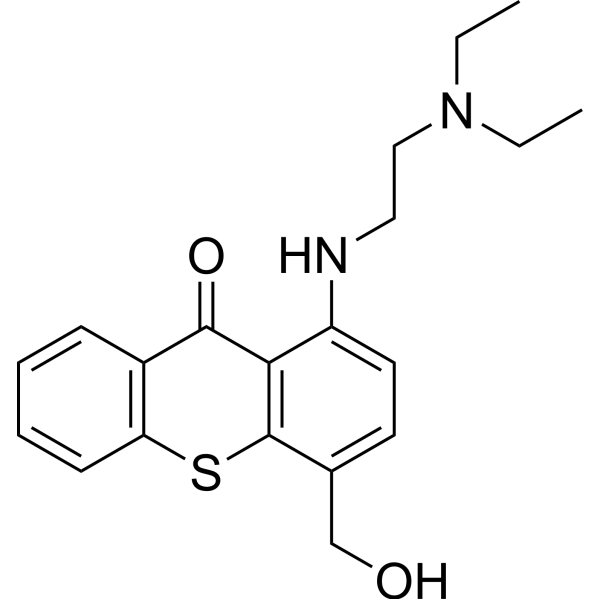
Hycanthone is an apurinic/apyrimidinic endonuclease 1 (APE1) inhibitor, DNA intercalator and Antischistosomal agent, with an IC50 of 80 nM against APE1. Hycanthone irreversibly inhibits thymidine incorporation into DNA in adult sensitive *Schistosoma mansoni*, while exerts weak inhibitory effects on uridine and leucine incorporation. Hycanthone reduces influenza virus-induced interferon production. Hycanthone exhibits mutagenic effects in various organisms, shows teratogenicity in mice and rabbits, and induces neoplastic liver lesions in partially hepatectomized mice. Hycanthone can be used in research related to schistosomiasis and cancer .
loading...
    loading...
Cat. No.: HY-100536
CAS No.: 687561-60-0
Purity:  99.27%
Research Areas:  

Cancer

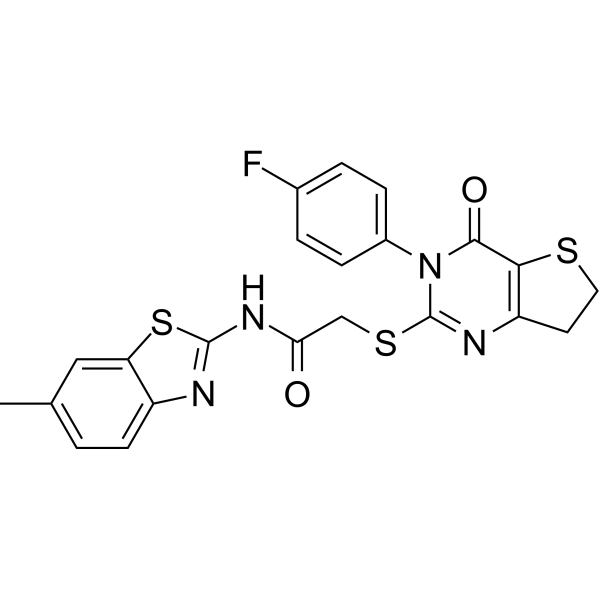
IWP-3 is a Wnt production inhibitor with an IC50 of 40 nM. IWP-3 also acts as a CK1δ inhibitor, with an IC50 of 1.89 μM against rat full-length CK1δ. IWP-3 inhibits the function of Porcupine (Porcn), thereby blocking the palmitoylation of Wnt proteins, suppressing the canonical Wnt signaling pathway, reducing the proliferative capacity of cancer cells, promoting the differentiation of mesoderm into cardiomyocytes and increasing cardiomyocyte yield. IWP-3 reduces embryonic cell division, alters the cell movement along the anterior-posterior axis of embryos, and causes embryonic shortening. IWP-3 can be used in studies related to cancers such as pancreatic cancer .
loading...
    loading...
Cat. No.: HY-B1099R
CAS No.: 3105-97-3
Hycanthone (Standard) is the analytical standard of Hycanthone (HY-B1099). This product is intended for research and analytical applications. Hycanthone is an apurinic/apyrimidinic endonuclease 1 (APE1) inhibitor, DNA intercalator and Antischistosomal agent, with an IC50 of 80 nM against APE1. Hycanthone irreversibly inhibits thymidine incorporation into DNA in adult sensitive *Schistosoma mansoni*, while exerts weak inhibitory effects on uridine and leucine incorporation. Hycanthone reduces influenza virus-induced interferon production. Hycanthone exhibits mutagenic effects in various organisms, shows teratogenicity in mice and rabbits, and induces neoplastic liver lesions in partially hepatectomized mice. Hycanthone can be used in research related to schistosomiasis and cancer .
loading...
    loading...
Cat. No.: HY-B1099A
CAS No.: 23255-93-8
Hycanthone mesylate is an apurinic/apyrimidinic endonuclease 1 (APE1) inhibitor, DNA intercalator and Antischistosomal agent, with an IC50 of 80 nM against APE1. Hycanthone mesylate irreversibly inhibits thymidine incorporation into DNA in adult sensitive *Schistosoma mansoni*, while exerts weak inhibitory effects on uridine and leucine incorporation. Hycanthone mesylate reduces influenza virus-induced interferon production. Hycanthone mesylate exhibits mutagenic effects in various organisms, shows teratogenicity in mice and rabbits, and induces neoplastic liver lesions in partially hepatectomized mice. Hycanthone mesylate can be used in research related to schistosomiasis and cancer .
loading...
    loading...
Cat. No.: HY-B1099B
CAS No.: 64265-18-5
Hycanthone ethansulfonate is an apurinic/apyrimidinic endonuclease 1 (APE1) inhibitor, DNA intercalator and Antischistosomal agent, with an IC50 of 80 nM against APE1. Hycanthone ethansulfonate irreversibly inhibits thymidine incorporation into DNA in adult sensitive *Schistosoma mansoni*, while exerts weak inhibitory effects on uridine and leucine incorporation. Hycanthone ethansulfonate reduces influenza virus-induced interferon production. Hycanthone ethansulfonate exhibits mutagenic effects in various organisms, shows teratogenicity in mice and rabbits, and induces neoplastic liver lesions in partially hepatectomized mice. Hycanthone ethansulfonate can be used in research related to schistosomiasis and cancer .
loading...
    loading...
Cat. No.: HY-15080
CAS No.: 143691-37-6
Synonyms: LY 293606
Target:  

iGluR

GYKI 53405 (LY 293606) is a non-competitive, orally active AMPA receptor antagonist. GYKI 53405 shows no significant binding affinity for GABAA, GABAB or benzodiazepine receptors. GYKI 53405 increases self-grooming behavior, induces wet dog-like shakes, reduces spontaneous activity, produces anxiolytic-like behavior, reverses the anxiogenic effect induced by mCPP, inhibits locomotor activity, suppresses sound-induced and maximal electroshock-induced seizures, prolongs survival in global cerebral ischemia models, and exhibits sustained anticonvulsant effects at doses below the sedation threshold. GYKI 53405 can be used in research related to absence epilepsy, anxiety disorders and global cerebral ischemia .
loading...
    loading...
Cat. No.: HY-119590
CAS No.: 31501-55-0
Synonyms: Lonchocarpine
Lonchocarpin (Lonchocarpine) is a Wnt/β-catenin signaling pathway inhibitor. The IC50 of Lonchocarpin in SW480 pBAR/Renilla cells is 4 μM. Acting downstream of β-catenin stabilization, Lonchocarpin inhibits β-catenin nuclear localization and TCF-mediated transcription, as well as the proliferation and migration of colorectal cancer cells. Lonchocarpin enhances Nrf2/ARE-mediated antioxidant responses in primary astrocytes via AMPK and JNK-related signaling, reduces H2O2-induced ROS production, and increases the expression of HO-1, NQO1 and MnSOD. Lonchocarpin can be used in research on colorectal cancer and oxidative stress .
loading...
    loading...

