1. Search Result
Search Result
Results for "

rhodium

" in MedChemExpress (MCE) Product Catalog:

9

Inhibitors & Agonists

2

Biochemical Assay Reagents

Cat. No. Product Name Target Research Areas Chemical Structure
  • HY-W001951

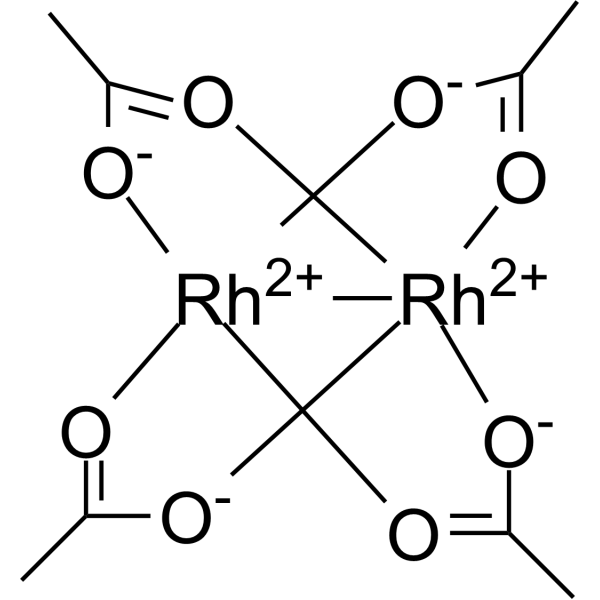
    Tetrakis(acetato)dirhodium(II); rhodium(II) acetate dimer

    DNA/RNA Synthesis Cancer
    Dirhodium tetraacetate (Tetrakis (acetato) dirhodium (II)) is an anticancer agent. Dirhodium tetraacetate functionally inhibits the activities of DNA polymerase I and RNA polymerase. It also acts as a catalyst and can be used to construct rhodium-based artificial metalloenzymes .
    Dirhodium tetraacetate
  • HY-W021016

    (S,S)-Ph-BPE

    Biochemical Assay Reagents Others
    (+)-1,2-Bis ((2S,5S)-2,5-diphenylphospholano)ethane ((S,S)-Ph-BPE) is a chiral bisphosphine ligand and catalyst. (+)-1,2-Bis ((2S,5S)-2,5-diphenylphospholano)ethane acts as a chiral ligand in rhodium-catalyzed reductive hydroformylation of alkenyl boronic esters, enabling enantiodivergent synthesis of chiral γ-boryl alcohols. (+)-1,2-Bis ((2S,5S)-2,5-diphenylphospholano)ethane forms chiral nickel-phosphine complexes to mediate asymmetric hydrogenation of aliphatic γ- and δ-keto acids; protons promote substrate C=O bond activation and stereoselectivity control via hydrogen bonding. (+)-1,2-Bis ((2S,5S)-2,5-diphenylphospholano)ethane forms a monodentate nickel complex, which serves as the active species for asymmetric hydrogenation of aliphatic keto acids .
    (+)-1,2-Bis((2S,5S)-2,5-diphenylphospholano)ethane
  • HY-W033823

    Biochemical Assay Reagents Endogenous Metabolite
    Rhodium(III) oxide is an inorganic compound with catalytic activity. Rhodium(III) oxide can be used as an efficient catalyst in catalytic reactions and is often used to promote chemical reactions. Rhodium(III) oxide is also widely used in energy materials, especially in fuel cells and other renewable energy technologies. Rhodium(III) oxide is studied in the field of materials science for the development of new functional materials.
    Rhodium(III) oxide
  • HY-W033831

    Rh2(TPA)4

    Endogenous Metabolite Biochemical Assay Reagents
    Rhodium(II) triphenylacetate dimer (Rh2(TPA)4) is an important catalyst with high C–H activation reaction activity. Rhodium(II) triphenylacetate dimer is widely used in organic synthesis to achieve the construction of complex molecules. Rhodium(II) triphenylacetate dimer can also be used to catalyze the synthesis of certain biologically active molecules and improve the preparation efficiency of compounds. Rhodium(II) triphenylacetate dimer exhibits excellent selectivity and reaction rate in catalytic reactions.
    Rhodium(II) triphenylacetate dimer
  • HY-Y1094

    Chloro(1,5-cyclooctadiene)rhodium(I) dimer

    Biochemical Assay Reagents Cardiovascular Disease
    [Rh(cod)Cl]2 (Chloro(1,5-cyclooctadiene)rhodium(I) dimer) is a rhodium (I) organometallic dimer complex. [Rh(cod)Cl]2 can inhibit platelet-activating factor-mediated platelet aggregation with IC50 values of 5.2 and 43.3 μM in washed rabbit platelets and human platelet-rich plasmas. [Rh(cod)Cl]2 also can inhibit thrombin-, ADP (HY-W010918)- and collagen-induced aggregation with IC50 values of 16.7, 162 and 69.8 μM. [Rh(cod)Cl]2 can be used for the research of cardiovascular disease, such as thrombosis .
    [Rh(cod)Cl]2
  • HY-W013598

    Biochemical Assay Reagents Others
    Sodium benzenesulfinate is a reagent used in organic synthesis to create other compounds, such as sulfones. Sodium benzenesulfinate undergoes rhodium-catalyzed desulfinative coupling with aldehydes to yield ketones .
    Sodium benzenesulfinate
  • HY-W008658

    Biochemical Assay Reagents Endogenous Metabolite
    [1,4-Bis(diphenylphosphino)butane](norbornadiene)rhodium tetrafluoroborate is a highly efficient and selective transition metal catalyst that can catalyze a variety of reactions, including cross-coupling reactions and hydrogenation reactions. This compound is widely used in organic synthesis and helps to promote the development of new compounds and materials. Through its catalytic activity, [1,4-Bis(diphenylphosphino)butane](norbornadiene)rhodium tetrafluoroborate offers the potential to optimize reaction conditions and improve yields.
    [1,4-Bis(diphenylphosphino)butane](norbornadiene)rhodium tetrafluoroborate
  • HY-W010685

    [Rh(dppb)(COD)]BF4

    Biochemical Assay Reagents Endogenous Metabolite Others
    [1,4-Bis(diphenylphosphino)butane](1,5-cyclooctadiene)rhodium(I) tetrafluoroborate ([Rh(dppb)(COD)]BF4) serves as a rhodium-based catalyst that facilitates regioselective hydrogenation and enantioselective reductive amination reactions.
    [1,4-BIs(diphenylphosphino)butane](1,5-cyclooctadiene)rhodium(I) tetrafluoroborate
  • HY-W074081

    Biochemical Assay Reagents Endogenous Metabolite
    (CAAC-Cy)Rh(COD)Cl is a rhodium-based catalyst with significant hydrogenation activity. (CAAC-Cy)Rh(COD)Cl is widely used in organic synthesis to catalyze different types of reactions. (CAAC-Cy)Rh(COD)Cl is highly efficient in promoting hydrogenation reactions. (CAAC-Cy)Rh(COD)Cl can effectively catalyze the conversion of certain unsaturated compounds.
    (CAAC-Cy)Rh(COD)Cl

Inquiry Online

Your information is safe with us. * Required Fields.

Salutation


Country or Region *

Applicant Name *


Organization Name *

Department *


Email Address *


Product Name *

Cat. No.


Requested quantity *

Phone Number *


Remarks

Inquiry Online

Inquiry Information

Product Name:
Cat. No.:
Quantity:
MCE Japan Authorized Agent:

