5 Results for "

xenobiotic metabolizing enzyme

" in MedChemExpress (MCE) Product Catalog:
Products (5)

5 Results for "xenobiotic metabolizing enzyme" in MCE Product Catalog:

Cat. No.: HY-N9348A
CAS No.: 108844-81-1
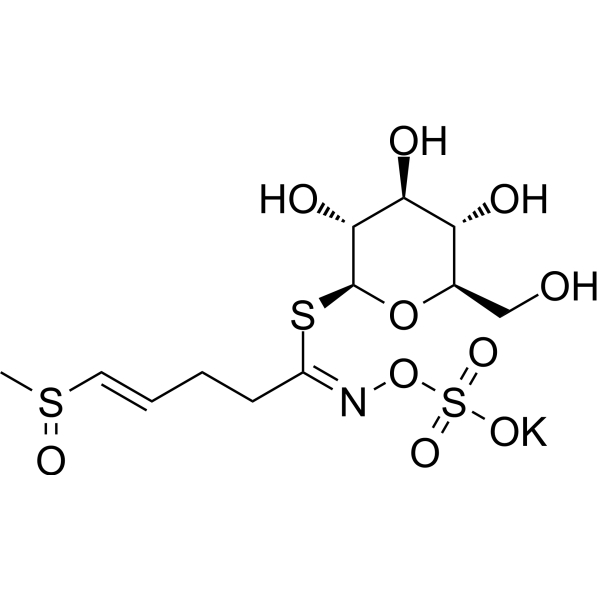
Glucoraphenin potassium is an orally effective glucosinolate. Glucoraphenin potassium can be isolated from radish sprouts. Glucoraphenin potassium enhances the enzymatic activity of Glutathione S-transferase. Glucoraphenin potassium enhances the activity of cytochrome P450-related monooxygenase .
loading...
    loading...
Cat. No.: HY-133078
CAS No.: 288323-41-1
Target:  

Cytochrome P450

Research Areas:  

Cancer

Thienyldecyl isothiocyanate is an analog of thienylbutyl isothiocyanate that, like many isothiocyanates, demonstrates antiproliferative activity against cancer cells presumably by modulation of xenobiotic-metabolizing enzymes, such as by inhibition of cytochrome P450, and/or by induction of phase II detoxifying enzymes.
loading...
    loading...
Cat. No.: HY-E72096
Target:  

Cytochrome P450

Research Areas:  

Others

Human CYP2B6, Reductase+b5 refers to a near-physiological recombinant microsomal system co-expressed in insect cells, consisting of human cytochrome P450 2B6, NADPH-P450 oxidoreductase (CPR) and cytochrome b5. Human CYP2B6 is a human cytochrome P450 subtype belonging to the CYP2 family, and also serves as a minor but highly polymorphic hepatic metabolic enzyme that metabolizes various prodrugs or xenobiotics .
loading...
    loading...
Cat. No.: HY-N9348
CAS No.: 28463-24-3
Glucoraphenin is an orally effective glucosinolate. Glucoraphenin can be isolated from radish sprouts. Glucoraphenin enhances the enzymatic activity of Glutathione S-transferase. Glucoraphenin enhances the activity of cytochrome P450-related monooxygenase .
loading...
    loading...
Cat. No.: HY-W275882
CAS No.: 13179-98-1
Research Areas:  

Endocrinology

1,6-Dimethoxyhexane is an aliphatic ether that serves as a PROTAC linker and fuel additive. 1,6-Dimethoxyhexane is an orally active testicular toxicant. It has no direct toxicity on its own, but exerts toxicity after oxidative metabolism by liver/testicular microsomes to produce 2-Methoxyacetic Acid (MAA). 1,6-Dimethoxyhexane induces apoptosis/necrosis of pachytene spermatocytes, downregulates the expression of HSP70.2, HSP60 and ERp60/PDI A3, and causes spermatogenic tubule degeneration, testicular/thymic atrophy, a sharp decline in epididymal sperm density, and other effects. 1,6-Dimethoxyhexane can be used in studies related to testicular toxicity .
loading...
    loading...

