7 Results for "

yeast mitochondrial membranes

" in MedChemExpress (MCE) Product Catalog:
Products (7)

7 Results for "yeast mitochondrial membranes" in MCE Product Catalog:

4
4 Cited Publications
Cat. No.: HY-131442
CAS No.: 1694495-59-4
Purity:  99.72%
Synonyms: Alkyne tyramide; Alk-Ph
Research Areas:  

Others

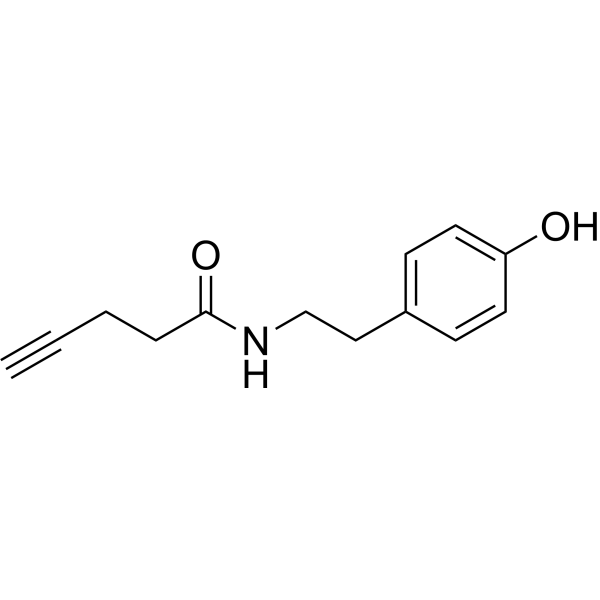
Alkyne-phenol (Alk-Ph) is a clickable ascorbate peroxidase 2 (APEX2) probe. Alkyne-phenol substantially improves APEX-labeling efficiency in intact yeast cells, as it is more cell wall-permeant than APEX2 substrate biotin-phenol (BP). Alkyne-phenol also facilitates the identification of APEX-labeling sites, allowing the unambiguous assignment of membrane topology of mitochondrial proteins . Alkyne-phenol is a click chemistry reagent, it contains an Alkyne group and can undergo copper-catalyzed azide-alkyne cycloaddition (CuAAc) with molecules containing Azide groups.
loading...
    loading...
Cat. No.: HY-112747
CAS No.: 97281-51-1
Synonyms: LPI; PE (soy)
Target:  

Phospholipase

Research Areas:  

Infection

Soy PE (LPI) is the most abundant phospholipid in prokaryotes and the second most abundant found in the membrane of mammalian, plant, and yeast cells, comprising approximately 25% of total mammalian phospholipids. In the brain, phosphatidylethanolamine comprises almost half of the total phospholipids. It is synthesized mainly through the cytidine diphosphate-ethanolamine and phosphatidylserine decarboxylation pathways, which occur in the endoplasmic reticulum (ER) and mitochondrial membranes, respectively. It is a precursor in the synthesis of phosphatidylcholine and arachidonoyl ethanolamide and is a source of ethanolamine used in various cellular functions. In E.coli, phosphatidylethanolamine deficiency prevents proper assembly of lactose permease, suggesting a role as a lipid chaperone. It is a cofactor in the propagation of prions in vitro and can convert recombinant mammalian proteins into infectious molecules even in the absence of RNA. This product contains phosphatidylethanolamine molecular species with variable fatty acyl chain lengths at the sn-1 and sn-2 positions .
loading...
    loading...
Cat. No.: HY-W020784
CAS No.: 102849-12-7
Research Areas:  

Others

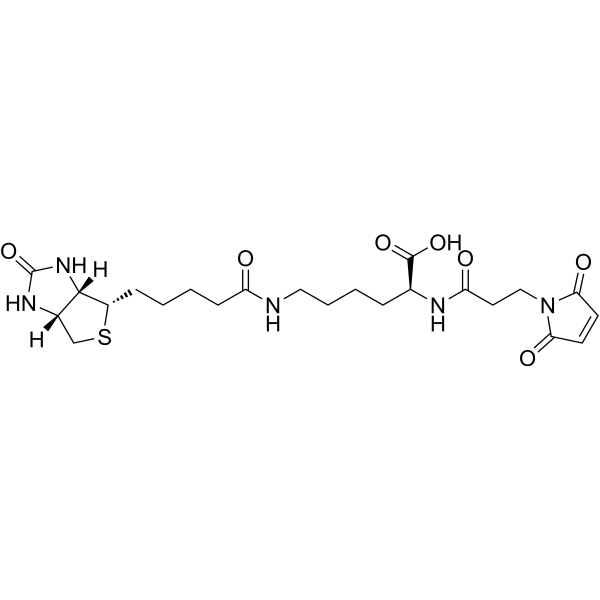
3-(N-Maleimidopropionyl)biocytin is a cysteine-specific labeling reagent and non-membrane-permeable probe. 3-(N-Maleimidopropionyl)biocytin covalently modifies the exposed cysteine residues of yeast Tim44, conjugating the biotin moiety to the polypeptide chain. 3-(N-Maleimidopropionyl)biocytin determines the topology of membrane proteins by modifying the exposed cysteine residues on the outer side of the inner mitochondrial membrane .
loading...
    loading...
Cat. No.: HY-175412
CAS No.: 142473-18-5
Synonyms: Dodecylmercapto-S-(poly(tris(hydroxymethyl)acrylamidomethane); H12-TAC
Research Areas:  

Others

DDTAC (H12-TAC) is a detergent that can extract and solubilize membrane proteins. DDTAC has a thio dodecanoyl chain linked to a polar group made of Tris polyalcoholic moieties and can be utilized in extracting yeast ATP synthase from mitochondrial membranes .
loading...
    loading...
Cat. No.: HY-183416
CAS No.: 111234-77-6
Research Areas:  

Others

M&B 39279 is an inhibitor of protoporphyrinogen oxidase (Protoporphyrinogen Oxidase). M&B 39279 induces protoporphyrin IX accumulation, light-dependent lipid peroxidation, degradation of membranes and organelles, and reduction of photosynthesis. M&B 39279 functions through the mechanism of action of diphenyl ether herbicides, and can be used for studies on PPO inhibition and herbicide mechanisms of action .
loading...
    loading...
Cat. No.: HY-111989
CAS No.: 103923-27-9
Target:  

Bacterial Fungal

Research Areas:  

Infection Inflammation/Immunology

Pirtenidine free base is a broad-spectrum antibacterial and anti-plaque agent. Pirtenidine free base exhibits bactericidal activity against oral plaque bacteria in vitro and inhibits plaque formation. Pirtenidine free base inhibits the growth, budding, germ tube formation and buccal epithelial cell adhesion of Candida albicans and Saccharomyces cerevisiae, reduces the oxygen uptake rate of yeast, and impairs mitochondrial respiratory function. Pirtenidine free base disrupts the integrity of fungal cell wall and membrane, leading to cytoplasmic leakage, cell shrinkage, and lysis. Pirtenidine free base binds tightly to mucosal surfaces in vivo with low systemic exposure. Pirtenidine free base can be used in studies related to dental plaque, fungal infections and oral candidiasis .
loading...
    loading...
Cat. No.: HY-184587
Antibacterial agent 356 is an orally active antibacterial agent. Antibacterial agent 356 binds to the Mrr1 transcription factor, inhibits the expression of the MDR1 efflux pump gene, reduces the efflux of Rhodamine 123, and increases the accumulation of intracellular substrates in drug-resistant Candida albicans cells. Antibacterial agent 356 induces mitochondrial membrane potential reduction and ROS accumulation in Candida albicans, inhibits the yeast-hypha transition process, and suppresses its biofilm formation. Antibacterial agent 356 reverses efflux pump-mediated drug resistance in azole-resistant Candida albicans with overexpressed Mdr1. Antibacterial agent 356 improves the survival rate of Galleria mellonella larvae infected with azole-resistant Candida albicans*CA632, and reduces the renal fungal load and renal tissue damage in infected BALB/c mice. Antibacterial agent 356 can be used for the research of Candida albicans infection .
loading...
    loading...

