



SUN13837

Based on 1 Customer Validation
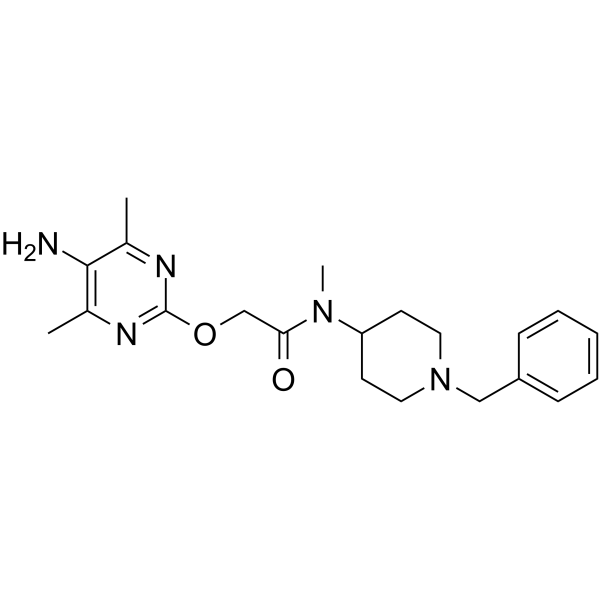
SUN13837 is an orally active, blood-brain barrier permeable FGFR modulator and neuroprotective agent. SUN13837 mimics the activity of basic fibroblast growth factor, stimulates intracellular tyrosine phosphorylation of FGFR and signal transduction in neuronal cells, induces neurite outgrowth, and inhibits glutamate-induced neuronal death. SUN13837 can be used in research related to acute cervical spinal cord injury and severe spinal cord injury.
商品は「研究用試薬」です。人や動物の医療用・臨床診断用・食品用の製品ではありません。
研究用途以外に使用した場合、当社は一切の責任を負いかねます。
- 純度 : 99.18%
- CAS 番号: 1080650-67-4
- 分子式: C21H29N5O2
- 分子量:383.49
-
保管条件:Powder -20°C, 3 years , 4°C, 2 years ; In solvent -80°C, 6 months , -20°C, 1 month

To place orders, for customer services and technical support, please contact: MedChemExpress USA
Tel: 609-228-6898 E-mail: [email protected] [email protected]


-
 生物活性
生物活性
-
化学情報
-
溶剤 & 溶解度
- プロトコル
- 純度とドキュメンテーション
- 参考文献
-
 Help & FAQs




生物活性
製品説明
体外実験
SUN13837 (10 μM; 24 h pre-incubation before glutamate exposure) exhibits 100% neuroprotective activity against glutamate-induced cell death in rat embryonic cerebral cortex and hippocampal neurons[2].
SUN13837 (10 μM; 30 min pre-incubation) inactivates CYP3A4 in a mechanism-based manner in liver microsomes, with residual activity of 60%[2].
SUN13837 (10 μM; 120 min) is a substrate of P-gp, with an efflux ratio of 6.3 in Caco-2 cell monolayers[2].
SUN13837 (100 μM; 60 min) undergoes hydrolysis by liver microsomes at a rate of 7.2 pmol/min/mg protein[2].
SUN13837 (0.3-3 μM) potently induces axonal growth in primary hippocampal neurons from E18 Wistar rats. The effect produced by 3 μM SUN13837 is comparable to that of 3 ng/mL bFGF, and significant increases in axon length are observed at concentrations of 0.3 μM and 3 μM[3].
SUN13837 (0.1-1 μM) protects primary hippocampal neurons from E18 Wistar rats against glutamate-induced cell death by activating FGFR-1, with significant neuroprotective effects observed at concentrations of 0.1 μM, 0.3 μM and 1 μM[3].
SUN13837 (0.3-3 μM; 40 minutes) activates intracellular tyrosine phosphorylation via human FGFR-1 in transfected L6 rat skeletal muscle cells, with significant elevations observed at concentrations of 0.3 μM, 1 μM and 3 μM[3].
SUN13837 (0.1-30 μM; 22-23 h) does not induce proliferation in SW1353 chondrosarcoma cells or Swiss 3T3 mouse embryonic fibroblasts, even at concentrations as high as 30 μM[3].
MedChemExpress (MCE) has not independently confirmed the accuracy of these methods. They are for reference only. Further protocols information, click here.
-
Cell Line:SW1353 human chondrosarcoma cells, Swiss 3T3 mouse embryo fibroblast cells
-
Concentration:0.1 μM, 0.3 μM, 1 μM, 3 μM, 10 μM, 30 μM
-
Incubation Time:22-23 h
-
Result:Did not produce a significant increase in BrdU uptake in either SW1353 or Swiss 3T3 cells, with absorbance values remaining comparable to vehicle control levels.
Contrasted with bFGF, which significantly increased BrdU uptake in both cell lines.
-
Cell Line:Swiss 3T3 mouse embryo fibroblast cells
-
Concentration:10 μM
-
Incubation Time:16 h
-
Result:Had no significant effect on cyclin D1 expression.
Had no significant effect on p27(kip1) expression.
Contrasted with bFGF, which increased cyclin D1 expression by 4.6-fold and decreased p27(kip1) expression to 5% of control levels.
Parmacokinetics
体内実験
Systemic administration of SUN13837 (0.3-1 mg/kg; i.v.; daily; 10 days) starting up to 12 hours post-spinal cord injury significantly enhances hind limb motor function recovery (BBB score >12 at 8 weeks) and axon regeneration in rats without adverse events[3].
MedChemExpress (MCE) has not independently confirmed the accuracy of these methods. They are for reference only.
-
Animal Model:Slc: SD (female, 180-250 g, T9 spinal cord contusion injury model)[3]
-
Dosage:0.3 mg/kg (first dose 90 mins post-injury); 1 mg/kg (first dose 90 mins post-injury); 1 mg/kg (first dose 12 hours post-injury)
-
Administration:i.v.; daily; 10 days
-
Result:Showed significantly enhanced hind limb motor function from 2 weeks post-injury onward, reaching a BBB score >12 at 8 weeks (p = 0.017), compared to vehicle group's score of 8.
Shortened MEP latency significantly (p = 0.0146) and increased MEP amplitude relative to vehicle.
Had higher BBB scores than vehicle at all time points, but the difference did not reach statistical significance (p = 0.118).
Showed significantly enhanced motor function recovery from 5 weeks post-injury onward, with a significant difference at 8 weeks (p = 0.025).
Increased 5-HT-positive area 4 mm caudal to the contusion epicenter significantly (p = 0.0043 for 90-minute group, p = 0.027 for 12-hour group) relative to vehicle.
Induced extensive caudal extension of corticospinal tract axons through the contusion site into lumbo-sacral spinal segments, whereas axon extension was limited to distal stumps in vehicle-treated rats.
臨床実験
| NCT Number | Sponsor | Condition | Start Date |
Phase

|
|---|---|---|---|---|
| NCT01329991 | Plexxikon| | 2011-05 | PHASE1 |


化学情報
-
CAS 番号 1080650-67-4
-
性状 Solid
-
分子量 383.49
-
分子式 C21H29N5O2
-
Color White to off-white
-
SMILES
CC1=NC(OCC(N(C2CCN(CC2)CC3=CC=CC=C3)C)=O)=NC(C)=C1N
-
輸送条件
Room temperature in continental US; may vary elsewhere.
-
保管条件
Powder -20°C 3 years 4°C 2 years In solvent -80°C 6 months -20°C 1 month


溶剤 & 溶解度
体外:
DMSO : 50 mg/mL (130.38 mM; Need ultrasonic; Hygroscopic DMSO has a significant impact on the solubility of product, please use newly opened DMSO)
Please refer to the solubility information to select the appropriate solvent. Once prepared, please aliquot and store the solution to prevent product inactivation from repeated freeze-thaw cycles.
Storage method and period of stock solution: -80°C, 6 months; -20°C, 1 month. When stored at -80°C, please use it within 6 months. When stored at -20°C, please use it within 1 month.
Please refer to the solubility information to select the appropriate solvent. Once prepared, please aliquot and store the solution to prevent product inactivation from repeated freeze-thaw cycles.
Storage method and period of stock solution: -80°C, 6 months; -20°C, 1 month. When stored at -80°C, please use it within 6 months. When stored at -20°C, please use it within 1 month.
濃度 (開始) × 体積 (開始) = 濃度 (終了) × 体積 (終了)
体内:
Select the appropriate dissolution method based on your experimental animal and administration route.
- For the following dissolution methods, please ensure to first prepare a clear stock solution using an In Vitro approach and then sequentially add co-solvents:
- To ensure reliable experimental results, the clarified stock solution can be appropriately stored based on storage conditions. As for the working solution for In Vivo experiments, it is recommended to prepare freshly and use it on the same day.
- The percentages shown for the solvents indicate their volumetric ratio in the final prepared solution. If precipitation or phase separation occurs during preparation, heat and/or sonication can be used to aid dissolution.
Add each solvent one by one: 10% DMSO 40% PEG300 5% Tween-80 45% Saline
Solubility: ≥ 2.5 mg/mL (6.52 mM); Clear solution
This protocol yields a clear solution of ≥ 2.5 mg/mL (saturation unknown).
Taking 1 mL working solution as an example, add 100 μL DMSO stock solution (25.0 mg/mL) to 400 μL PEG300, and mix evenly; then add 50 μL Tween-80 and mix evenly; then add 450 μL Saline to adjust the volume to 1 mL.
Preparation of Saline: Dissolve 0.9 g sodium chloride in ddH₂O and dilute to 100 mL to obtain a clear Saline solution.
Add each solvent one by one: 10% DMSO 90% (20% SBE-β-CD in Saline)
Solubility: ≥ 2.5 mg/mL (6.52 mM); Clear solution
This protocol yields a clear solution of ≥ 2.5 mg/mL (saturation unknown).
Taking 1 mL working solution as an example, add 100 μL DMSO stock solution (25.0 mg/mL) to 900 μL 20% SBE-β-CD in Saline, and mix evenly.
Preparation of 20% SBE-β-CD in Saline (4°C, storage for one week): 2 g SBE-β-CD powder is dissolved in 10 mL Saline, completely dissolve until clear.
In Vivo Dissolution Calculator
Please enter the basic information of animal experiments:
-
-
-
-
Recommended: Prepare an additional quantity of animals to account for potential losses during experiments.
Please enter your animal formula composition:
-
%DMSO +
Recommended: Keep the proportion of DMSO in working solution below 2% if your animal is weak.
-
%+
-
+%Tween-80 + +
-
%Saline +
The co-solvents required include: DMSO, . All of co-solvents are available by MedChemExpress (MCE). , Tween 80. All of co-solvents are available by MedChemExpress (MCE).
Working solution concentration: 0.22 mg/mL
Method for preparing stock solution: mg drug dissolved in μL DMSO. Stock solution concentration: mg/mL.
1. Take μL DMSO stock solution;
2. Add μL .
μL , mix evenly;
3. Then add μL Tween 80, mix evenly;
4. Then add μL
Please ensure that the stock solution in the first step is dissolved to a clear state, and add co-solvents in sequence. You can use ultrasonic heating (ultrasonic cleaner, recommended frequency 20-40 kHz), vortexing, etc. to assist dissolution.

プロトコル
-
Kinase activity and phosphorylation assays
Kinase activity assays measure the ability of kinases to transfer phosphate groups from ATP to specific substrates, while phosphorylation assays detect the presence and levels of phosphorylated proteins. Common methods include radiolabeled ATP incorporation (e. g. ,), ADP release detection via bioluminescence (e. g. ,[3]), enzyme-linked immunosorbent assays (ELISA) for phospho-specific epitopes (e. g. ,[6]), and microtiter-based formats for high-throughput screening (e. g. ,[8]). The ADP-Glo assay quantifies kinase activity by measuring ADP produced during phosphorylation using a luciferase-based system. Radiometric assays involve autoradiography or scintillation counting after incorporation of 32P-labeled ATP into substrate proteins. ELISA-based approaches rely on phospho-specific antibodies to detect activated kinases in cell lysates or purified samples.
-
PC12 NGF-Induced Neuronal Differentiation Culture
PC12 cells are a rat adrenal pheochromocytoma clonal line that responds to NGF by stopping proliferation and extending branching neurite-like processes; after longer NGF exposure, cells develop long processes and neuronal-like ultrastructural and functional features. NGF-induced differentiation is read out mainly by neurite outgrowth, reduced proliferation, microtubule assembly, and neuronal differentiation-associated proteins such as MAPs, tau, GAP-43, and synapsin-1.
-
Western Blot
Western blotting (WB) is a commonly used experimental method in molecular biology, biochemistry, and immunogenetics for identifying and quantifying target proteins. It combines gel electrophoresis with immunoassay, enabling researchers to analyze protein expression, post-translational modifications, and molecular weight.
-
SH-SY5Y Neuronal Differentiation Culture
SH-SY5Y neuronal differentiation culture uses sequential exposure to retinoic acid and neurotrophic factors to reduce proliferative neuroblastoma-like behavior and induce neuron-like morphology, including neurite extension, neuronal marker expression, and, in RA/BDNF protocols, greater synaptic-marker expression than undifferentiated culture. Retinoic acid is commonly used as the initiating differentiation cue, while BDNF in serum-reduced or serum-free medium supports later maturation and neurotrophic-factor-dependent neuron-like survival.
-
SH-SY5Y neuronal-like differentiation
SH-SY5Y neuronal-like differentiation uses defined culture conditions to shift proliferative human neuroblastoma cells toward a neuron-like state, mainly assessed by reduced proliferation, neurite extension, neuronal-marker expression, and, in some protocols, increased dependence on neurotrophic support. Retinoic acid (RA) is commonly used for the first differentiation phase, and sequential RA followed by brain-derived neurotrophic factor (BDNF) in serum-free medium is a well-characterized approach for generating neuron-like SH-SY5Y cultures with extensive neurite outgrowth. The primary readouts are morphology-based neurite outgrowth and marker-based confirmation using proteins such as βIII-tubulin, MAP2, GAP43, synaptophysin, NeuN, NSE, TH, or related neuronal/synaptic markers, depending on the study endpoint.
-
Cell differentiation
Cell differentiation refers to the process in which cells of the same origin gradually produce cell groups with different morphological structure and functional characteristics.
-
Protocol for Kinase activity and phosphorylation assays
Kinase activity assays measure transfer of phosphate from ATP to a protein or peptide substrate, generating phosphorylated substrate, ADP, or incorporated radiolabeled phosphate as the readout; phosphorylation assays measure site-specific phosphorylation in cells or tissues as a proxy for kinase-pathway activation, inhibition, or substrate regulation. Phosphorylation can be detected by phospho-specific Western blot, immunoprecipitation kinase assay, phospho-immunofluorescence, phospho-flow cytometry, luminescent ADP detection, radiolabeled ATP incorporation, or reporter-based pathway assays, and these readouts can be applied to cancer cells, primary neurons, mouse tumors, organoids, inflammatory macrophages, ferroptosis studies, and mitophagy studies when the kinase target is biologically relevant.
-
PC12 NGF-induced neuronal-like differentiation
PC12 cells are a rat adrenal pheochromocytoma-derived clonal cell line that responds to nerve growth factor by stopping proliferation and extending neurites, producing a sympathetic neuron-like phenotype used to study neuronal differentiation and neurite outgrowth. NGF acts through TrkA-dependent signaling, and neurite outgrowth is associated with ERK/Akt signaling, microtubule organization, neuronal-marker expression, and increased electrophysiological neuronal features such as sodium-channel density. The main assay readout is morphological differentiation, usually measured as the percentage of neurite-bearing cells, neurite length, neurite number, or total neurite length per cell. Additional readouts include GAP-43, tyrosine hydroxylase, βIII-tubulin, neurofilament, synapsin I, synaptophysin, ERK phosphorylation, Akt phosphorylation, and sodium-channel current density.


純度とドキュメンテーション
-
データシート (277 KB)
-
SDS (252 KB)
- English - EN (252 KB)
- Français - FR (252 KB)
- Deutsch - DE (252 KB)
- Norwegian - NO (252 KB)
- Español - ES (252 KB)
- Swedish - SV (252 KB)
- Italian - IT (252 KB)
- Korean - KR (252 KB)
- Portuguese - PT (252 KB)
-
取扱説明書 (2659 KB)
参考文献
[2]. Sakai H, et al. Fibroblast growth factor receptor modulators employing diamines with reduced phospholipidosis-inducing potential. Bioorg Med Chem. 2020;28(14):115562. [Content Brief]
[3]. Imagama S, et al. Systemic treatment with a novel basic fibroblast growth factor mimic small-molecule compound boosts functional recovery after spinal cord injury. PLoS One. 2020;15(7):e0236050. Published 2020 Jul 17. [Content Brief]


Complete Stock Solution Preparation Table
Please refer to the solubility information to select the appropriate solvent. Once prepared, please aliquot and store the solution to prevent product inactivation from repeated freeze-thaw cycles.
Storage method and period of stock solution: -80°C, 6 months; -20°C, 1 month. When stored at -80°C, please use it within 6 months. When stored at -20°C, please use it within 1 month.
| Optional Solvent | Concentration Solvent Mass | 1 mg | 5 mg | 10 mg | 25 mg |
|---|---|---|---|---|---|
| DMSO | 1 mM | 2.6076 mL | 13.0381 mL | 26.0763 mL | 65.1907 mL |
| 5 mM | 0.5215 mL | 2.6076 mL | 5.2153 mL | 13.0381 mL | |
| 10 mM | 0.2608 mL | 1.3038 mL | 2.6076 mL | 6.5191 mL | |
| 15 mM | 0.1738 mL | 0.8692 mL | 1.7384 mL | 4.3460 mL | |
| 20 mM | 0.1304 mL | 0.6519 mL | 1.3038 mL | 3.2595 mL | |
| 25 mM | 0.1043 mL | 0.5215 mL | 1.0431 mL | 2.6076 mL | |
| 30 mM | 0.0869 mL | 0.4346 mL | 0.8692 mL | 2.1730 mL | |
| 40 mM | 0.0652 mL | 0.3260 mL | 0.6519 mL | 1.6298 mL | |
| 50 mM | 0.0522 mL | 0.2608 mL | 0.5215 mL | 1.3038 mL | |
| 60 mM | 0.0435 mL | 0.2173 mL | 0.4346 mL | 1.0865 mL | |
| 80 mM | 0.0326 mL | 0.1630 mL | 0.3260 mL | 0.8149 mL | |
| 100 mM | 0.0261 mL | 0.1304 mL | 0.2608 mL | 0.6519 mL |


SUN13837 関連分類
HY-147681 関連分類
 Powered by Bioz
Keywords
- SUN13837
- 1080650-67-4
- SUN 13837
- SUN-13837
- FGFR
- glutamate-induced neuronal cell death
- embryonic rat cerebrocortical neurons
- basic fibroblast growth factor
- fibroblast growth factor receptor
- acute cervical spinal cord injury
- embryonic rat hippocampal neurons
- Caco-2 cell monolayers
- spinal cord injury
- severe spinal cord injury
- CYP3A4
- Inhibitor
- inhibitor
- inhibit