



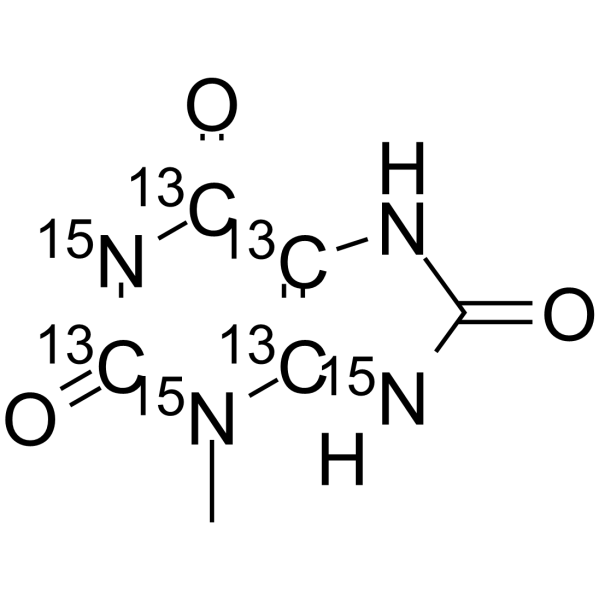
1,3-Dimethyluric acid-13C4,15N3
1,3-Dimethyluric acid-13C4,15N3 is the 15N and 13C-labeled 1,3-Dimethyluric acid (HY-W014993). 1,3-Dimethyluric acid is a major metabolite of Theophylline (HY-B0809) in vivo. 1,3-Dimethyluric acid is an inhibitor of human organic anion transporter 1 (hOAT1) with an IC50 of 9.2 μM. 1,3-Dimethyluric acid inhibits hOAT1-mediated substrate uptake and transport through competitive binding. 1,3-Dimethyluric acid is also a component of urinary calculi. 1,3-Dimethyluric acid can be used in research on urolithiasis.
Nur für Forschungszwecke. Wir verkaufen nicht an Patienten.
- CAS. Nr.: 1173019-16-3
- Formel: C313C4H8N15N3O3
- Molecular Weight:203.11
-
Speicherung:
Please store the product under the recommended conditions in the Certificate of Analysis.

To place orders, for customer services and technical support, please contact: MedChemExpress USA
Tel: 609-228-6898 E-mail: [email protected] [email protected]


-
 Biologische Aktivität
-
Chemical Information
- Reinheit & Dokumentation
- Verweise
-
 Help & FAQs


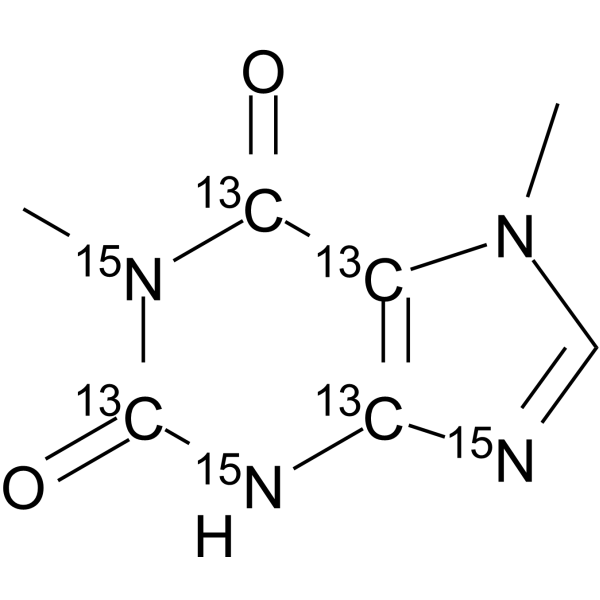
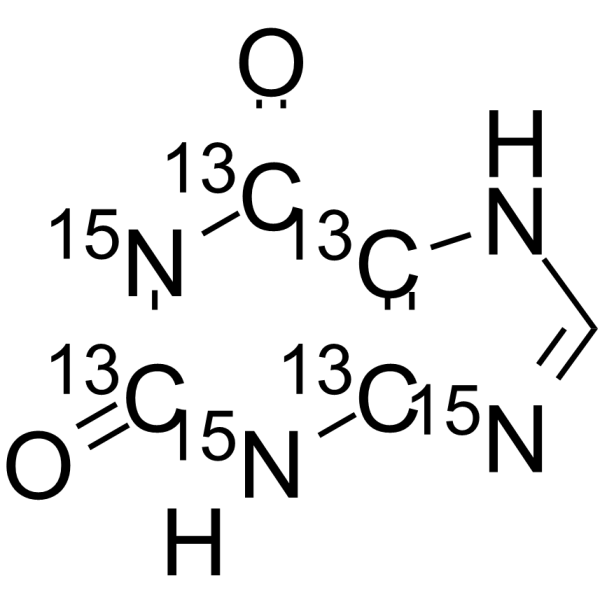

Alle Endogenous Metabolite Isoform-spezifische Produkte anzeigen
More

Biologische Aktivität
Beschreibung
|
Human Endogenous Metabolite |
hOAT1 9.2 μM (IC50) |
Anwendung
1. This compound can be used as a tracer
2. This compound can be used as an internal standard for quantitative analysis by NMR, GC-MS, or LC-MS.


Chemical Information
-
CAS. Nr. 1173019-16-3
-
Molecular Weight 203.11
-
Formel C313C4H8N15N3O3
-
SMILES
O=[13C]1[13C]2=[13C]([15NH]C(N2)=O)[15N]([13C]([15N]1C)=O)C
-
Versand
Room temperature in continental US; may vary elsewhere.
-
Speicherung
Please store the product under the recommended conditions in the Certificate of Analysis.


Reinheit & Dokumentation
Verweise
[5]. Kuroda Y, et al. Age-Associated Theophylline Metabolic Activity Corresponds to the Ratio of 1,3-Dimethyluric Acid to Theophylline in Mice. Biological & pharmaceutical bulletin. 2019;42(8):1423-1427. [Content Brief]
[7]. Tang-Liu DD, et al. Nonlinear theophylline elimination. Clin Pharmacol Ther. 1982 Mar;31(3):358-69.
[8]. Kuh HJ, et al. Nonlinear renal excretion of theophylline and its metabolites, 1-methyluric acid and 1,3-dimethyluric acid, in rats. Archives of pharmacal research. 1994 Apr;17(2):124-30. [Content Brief]

Calculators
Konzentration (Stammlösung) × Volumen (Stammlösung) = Konzentration (Ziellösung) × Volumen (Ziellösung)


1,3-Dimethyluric acid-13C4,15N3 Related Classifications
HY-W014993S Related Classifications
 Powered by Bioz