



1-Dodecylimidazole
Based on 3 publication(s) in Google Scholar
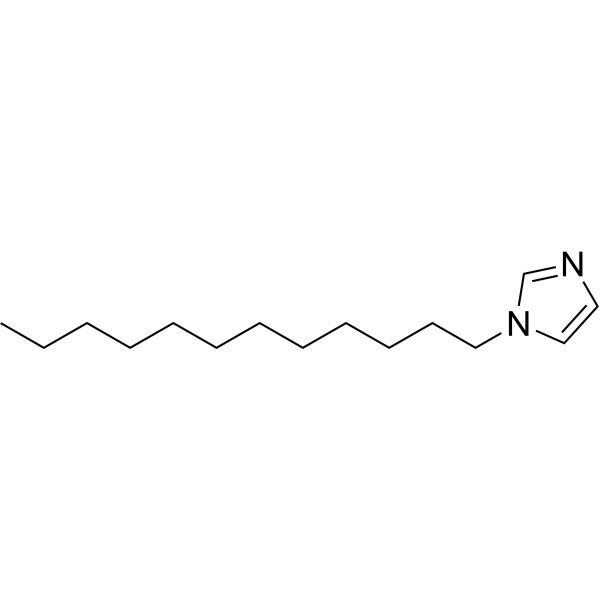
1-Dodecylimidazole (N-Dodecylimidazole) is a lysosomotropic detergent and a cytotoxic agent. 1-Dodecylimidazole causes cell death by its acid-dependent accumulation in lysosomes, disruption of the lysosomal membrane, and releaseof cysteine proteases into the cytoplasm. 1-Dodecylimidazole has hypocholesterolaemic activity and broad-spectrum antifungal activity.
Nur für Forschungszwecke. Wir verkaufen nicht an Patienten.
- Reinheit : 98.0%
- CAS. Nr.: 4303-67-7
- Formel: C15H28N2
- Molecular Weight:236.40
-
Speicherung:Pure form -20°C, 3 years , 4°C, 2 years ; In solvent -80°C, 6 months , -20°C, 1 month

To place orders, for customer services and technical support, please contact: MedChemExpress USA
Tel: 609-228-6898 E-mail: [email protected] [email protected]


-
 Biologische Aktivität
-
Chemical Information
-
Lösungsmittel & Löslichkeit
- Protokoll
- Reinheit & Dokumentation
- Verweise
-
 Help & FAQs


Publications Citing Use of MedChemExpress (MCE) 1-Dodecylimidazole
More

Biologische Aktivität
Beschreibung
In Vitro
N-dodecylimidazole, an acid activated detergent with a pKa of 6.3, has been shown to be cytotoxic to cells in culture. N-dodecylimidazole displayed extracellular pH (pHe)-dependent cytotoxicity against EMT-6 and MGH U1 cells. cell killing was dose dependent and was 100-fold greater at pHe 6.0 than pHe 7.0[4].
MedChemExpress (MCE) has not independently confirmed the accuracy of these methods. They are for reference only.
In Vivo
1-dodecylimidazole (150 mg/kg body wt; by stomach tube; daily for 10 days) has lower serum cholesterol concentrations than control rats[2].
MedChemExpress (MCE) has not independently confirmed the accuracy of these methods. They are for reference only.
-
Animal Model:Male rats[2]
-
Dosage:150 mg/kg body wt
-
Administration:By stomach tube; daily for 10 days
-
Result:Had significantly lower serum cholesterol concentrations than untreated animals.


Chemical Information
-
CAS. Nr. 4303-67-7
-
Appearance Liquid (Density: 0.9624 g/cm3)
-
Molecular Weight 236.40
-
Formel C15H28N2
-
Color Colorless to light yellow
-
SMILES
CCCCCCCCCCCCN1C=CN=C1
-
Synonyms
N-Dodecylimidazole
-
Versand
Room temperature in continental US; may vary elsewhere.
-
Speicherung
Pure form -20°C 3 years 4°C 2 years In solvent -80°C 6 months -20°C 1 month


Publications (3)
-
Journal Impact Factor
-
Most Recent
-
Mater Today Bio
Cadherin-responsive hydrogel combined with dental pulp stem cells and fibroblast growth factor 21 promotes diabetic scald repair via regulating epithelial-mesenchymal transition and necroptosis. [Abstract]2023 Dec 22:24:100919. PMID: 38298888 -
Cell Prolif
TREM2 Impedes Recovery After Spinal Cord Injury by Regulating Microglial Lysosomal Membrane Permeabilization-Mediated Autophagy. [Abstract]2025 Oct;58(10):e70047. PMID: 40320759 -
Br J Pharmacol
Semax peptide targets the μ opioid receptor gene Oprm1 to promote deubiquitination and functional recovery after spinal cord injury in female mice. [Abstract]2025 Jul 21. PMID: 40692165


Lösungsmittel & Löslichkeit
In Vitro:
DMSO : 100 mg/mL (423.01 mM; Need ultrasonic; Hygroscopic DMSO has a significant impact on the solubility of product, please use newly opened DMSO)
Please refer to the solubility information to select the appropriate solvent. Once prepared, please aliquot and store the solution to prevent product inactivation from repeated freeze-thaw cycles.
Storage method and period of stock solution: -80°C, 6 months; -20°C, 1 month. When stored at -80°C, please use it within 6 months. When stored at -20°C, please use it within 1 month.
Please refer to the solubility information to select the appropriate solvent. Once prepared, please aliquot and store the solution to prevent product inactivation from repeated freeze-thaw cycles.
Storage method and period of stock solution: -80°C, 6 months; -20°C, 1 month. When stored at -80°C, please use it within 6 months. When stored at -20°C, please use it within 1 month.
Konzentration (Stammlösung) × Volumen (Stammlösung) = Konzentration (Ziellösung) × Volumen (Ziellösung)
In Vivo:
Select the appropriate dissolution method based on your experimental animal and administration route.
- For the following dissolution methods, please ensure to first prepare a clear stock solution using an In Vitro approach and then sequentially add co-solvents:
- To ensure reliable experimental results, the clarified stock solution can be appropriately stored based on storage conditions. As for the working solution for In Vivo experiments, it is recommended to prepare freshly and use it on the same day.
- The percentages shown for the solvents indicate their volumetric ratio in the final prepared solution. If precipitation or phase separation occurs during preparation, heat and/or sonication can be used to aid dissolution.
Add each solvent one by one: 10% DMSO 40% PEG300 5% Tween-80 45% Saline
Solubility: ≥ 2.5 mg/mL (10.58 mM); Clear solution
This protocol yields a clear solution of ≥ 2.5 mg/mL (saturation unknown).
Taking 1 mL working solution as an example, add 100 μL DMSO stock solution (25.0 mg/mL) to 400 μL PEG300, and mix evenly; then add 50 μL Tween-80 and mix evenly; then add 450 μL Saline to adjust the volume to 1 mL.
Preparation of Saline: Dissolve 0.9 g sodium chloride in ddH₂O and dilute to 100 mL to obtain a clear Saline solution.
Add each solvent one by one: 10% DMSO 90% (20% SBE-β-CD in Saline)
Solubility: ≥ 2.5 mg/mL (10.58 mM); Clear solution
This protocol yields a clear solution of ≥ 2.5 mg/mL (saturation unknown).
Taking 1 mL working solution as an example, add 100 μL DMSO stock solution (25.0 mg/mL) to 900 μL 20% SBE-β-CD in Saline, and mix evenly.
Preparation of 20% SBE-β-CD in Saline (4°C, storage for one week): 2 g SBE-β-CD powder is dissolved in 10 mL Saline, completely dissolve until clear.
In Vivo Dissolution Calculator
Please enter the basic information of animal experiments:
-
-
-
-
Recommended: Prepare an additional quantity of animals to account for potential losses during experiments.
Please enter your animal formula composition:
-
%DMSO +
Recommended: Keep the proportion of DMSO in working solution below 2% if your animal is weak.
-
%+
-
+%Tween-80 + +
-
%Saline +
The co-solvents required include: DMSO, . All of co-solvents are available by MedChemExpress (MCE). , Tween 80. All of co-solvents are available by MedChemExpress (MCE).
Working solution concentration: 0.22 mg/mL
Method for preparing stock solution: mg drug dissolved in μL DMSO. Stock solution concentration: mg/mL.
1. Take μL DMSO stock solution;
2. Add μL .
μL , mix evenly;
3. Then add μL Tween 80, mix evenly;
4. Then add μL
Please ensure that the stock solution in the first step is dissolved to a clear state, and add co-solvents in sequence. You can use ultrasonic heating (ultrasonic cleaner, recommended frequency 20-40 kHz), vortexing, etc. to assist dissolution.


Reinheit & Dokumentation
-
Data Sheet (270 KB)
-
SDS (393 KB)
- English - EN (393 KB)
- Français - FR (393 KB)
- Deutsch - DE (393 KB)
- Norwegian - NO (393 KB)
- Español - ES (393 KB)
- Swedish - SV (393 KB)
- Italian - IT (393 KB)
- Korean - KR (393 KB)
- Portuguese - PT (393 KB)
-
Handling Instructions (2659 KB)
Verweise
[1]. Wilson PD, et al. A relationship between multidrug resistance and growth-state dependent cytotoxicity of the lysosomotropic detergent N-dodecylimidazole. Biochem Biophys Res Commun. 1991;176(3):1377-1382. [Content Brief]
[2]. Atkin SD, et al. The isolation of 2,3-oxidosqualene from the liver of rats treated with 1-dodecylimidazole, a novel hypocholesterolaemic agent. Biochem J. 1972;130(1):153-157. [Content Brief]
[3]. Firestone RA, et al. Lysosomotropic agents. 7. Broad-spectrum antifungal activity of lysosomotropic detergents. J Med Chem. 1987;30(8):1519-1521. [Content Brief]
[4]. Boyer MJ, et al. pH dependent cytotoxicity of N-dodecylimidazole: a compound that acquires detergent properties under acidic conditions. Br J Cancer. 1993;67(1):81-87. [Content Brief]


Complete Stock Solution Preparation Table
Please refer to the solubility information to select the appropriate solvent. Once prepared, please aliquot and store the solution to prevent product inactivation from repeated freeze-thaw cycles.
Storage method and period of stock solution: -80°C, 6 months; -20°C, 1 month. When stored at -80°C, please use it within 6 months. When stored at -20°C, please use it within 1 month.
| Optional Solvent | Concentration Solvent Mass | 1 mg | 5 mg | 10 mg | 25 mg |
|---|---|---|---|---|---|
| DMSO | 1 mM | 4.2301 mL | 21.1506 mL | 42.3012 mL | 105.7530 mL |
| 5 mM | 0.8460 mL | 4.2301 mL | 8.4602 mL | 21.1506 mL | |
| 10 mM | 0.4230 mL | 2.1151 mL | 4.2301 mL | 10.5753 mL | |
| 15 mM | 0.2820 mL | 1.4100 mL | 2.8201 mL | 7.0502 mL | |
| 20 mM | 0.2115 mL | 1.0575 mL | 2.1151 mL | 5.2876 mL | |
| 25 mM | 0.1692 mL | 0.8460 mL | 1.6920 mL | 4.2301 mL | |
| 30 mM | 0.1410 mL | 0.7050 mL | 1.4100 mL | 3.5251 mL | |
| 40 mM | 0.1058 mL | 0.5288 mL | 1.0575 mL | 2.6438 mL | |
| 50 mM | 0.0846 mL | 0.4230 mL | 0.8460 mL | 2.1151 mL | |
| 60 mM | 0.0705 mL | 0.3525 mL | 0.7050 mL | 1.7625 mL | |
| 80 mM | 0.0529 mL | 0.2644 mL | 0.5288 mL | 1.3219 mL | |
| 100 mM | 0.0423 mL | 0.2115 mL | 0.4230 mL | 1.0575 mL |


1-Dodecylimidazole Related Classifications
HY-138540 Related Classifications
 Powered by Bioz