



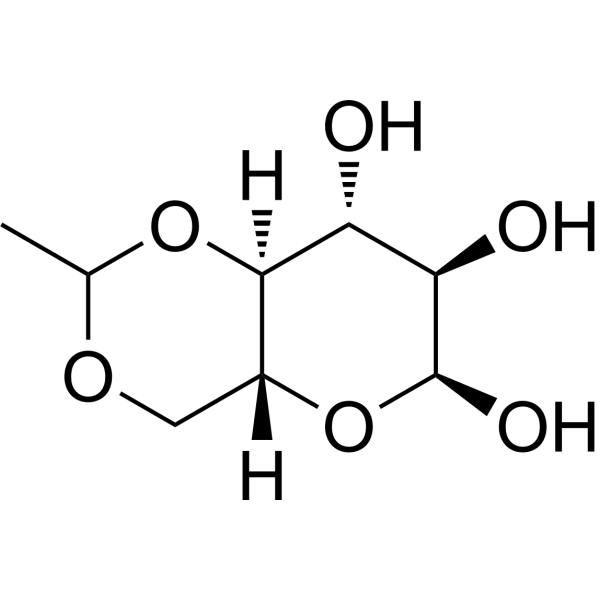
4,6-O-Ethylidene-α-D-glucose

Based on 1 Customer Validation
4,6-O-ethylidene-α-D-glucose (Ethylidene-glucose), a glucose derivative, is a competitive exofacial binding-site inhibitor on glucose transporter 1 (GLUT1) with a Ki of 12 mM for wild-type 2-deoxy-D-glucose transport.
For research use only. We do not sell to patients.
- Purity : 98.0%
- CAS No.: 13224-99-2
- Formula: C8H14O6
- Molecular Weight:206.19
-
Storage:Powder -20°C, 3 years , 4°C, 2 years ; In solvent -80°C, 6 months , -20°C, 1 month

To place orders, for customer services and technical support, please contact: MedChemExpress USA
Tel: 609-228-6898 E-mail: [email protected] [email protected]


-
 Biological Activity
-
Chemical Information
-
Solvent & Solubility
- Purity & Documentation
- References
-
 Help & FAQs



All Endogenous Metabolite Isoforms
More

Biological Activity
Description
IC50 & Target
[1]|
GLUT1 |
Human Endogenous Metabolite |
In Vitro
4,6-O-ethylidene-α-D-glucose (Ethylidene-glucose) shows poor affinity for malarial hexose transporter (PfHT1; Ki>50 mM). 4,6-O-ethylidene-α-D-glucose inhibits wild-type transport with a Ki of approximately 12 mM, but this is increased to greater than 120 mM in the Gln282-Leu mutant[1].
4,6-O-ethylidene-α-D-glucose inhibits glucose exit competitively but its penetration into human red cells is unaffected by glucose in the medium. The potentiation of the development of FDNB inhibition by sugars in the incubating medium is absent when 4,6-O-ethylidene-α-D-glucose is used and there is a slight protective action. 4,6-O-ethylidene-α-D-glucose penetrates human red cells by simple diffusion supported by its penetration of guinea-pig red cells at similar rates, by the occurrence of osmotic haemolysis in isosmotic solutions which is unaffected by copper ions and by the relatively high ether/water partition of the compound[3].
MedChemExpress (MCE) has not independently confirmed the accuracy of these methods. They are for reference only.


Chemical Information
-
CAS No. 13224-99-2
-
Appearance Solid
-
Molecular Weight 206.19
-
Formula C8H14O6
-
Color White to off-white
-
SMILES
[H][C@]12[C@@](O[C@H](O)[C@H](O)[C@H]2O)([H])COC(C)O1
-
Synonyms
Ethylidene-glucose
-
Structure Classification
-
Initial Source
-
Shipping
Room temperature in continental US; may vary elsewhere.
-
Storage
Powder -20°C 3 years 4°C 2 years In solvent -80°C 6 months -20°C 1 month


Solvent & Solubility
In Vitro:
H2O : 125 mg/mL (606.24 mM; Need ultrasonic)
DMSO : 100 mg/mL (484.99 mM; Need ultrasonic; Hygroscopic DMSO has a significant impact on the solubility of product, please use newly opened DMSO)
Please refer to the solubility information to select the appropriate solvent. Once prepared, please aliquot and store the solution to prevent product inactivation from repeated freeze-thaw cycles.
Storage method and period of stock solution: -80°C, 6 months; -20°C, 1 month. When stored at -80°C, please use it within 6 months. When stored at -20°C, please use it within 1 month.
* Note: If you choose water as the stock solution, please dilute it to the working solution, then filter and sterilize it with a 0.22 μm filter before use.
Please refer to the solubility information to select the appropriate solvent. Once prepared, please aliquot and store the solution to prevent product inactivation from repeated freeze-thaw cycles.
Storage method and period of stock solution: -80°C, 6 months; -20°C, 1 month. When stored at -80°C, please use it within 6 months. When stored at -20°C, please use it within 1 month.
* Note: If you choose water as the stock solution, please dilute it to the working solution, then filter and sterilize it with a 0.22 μm filter before use.
Concentration (start) × Volume (start) = Concentration (final) × Volume (final)
In Vivo:
Select the appropriate dissolution method based on your experimental animal and administration route.
- For the following dissolution methods, please ensure to first prepare a clear stock solution using an In Vitro approach and then sequentially add co-solvents:
- To ensure reliable experimental results, the clarified stock solution can be appropriately stored based on storage conditions. As for the working solution for In Vivo experiments, it is recommended to prepare freshly and use it on the same day.
- The percentages shown for the solvents indicate their volumetric ratio in the final prepared solution. If precipitation or phase separation occurs during preparation, heat and/or sonication can be used to aid dissolution.
Add each solvent one by one: 10% DMSO 40% PEG300 5% Tween-80 45% Saline
Solubility: ≥ 2.5 mg/mL (12.12 mM); Clear solution
This protocol yields a clear solution of ≥ 2.5 mg/mL (saturation unknown).
Taking 1 mL working solution as an example, add 100 μL DMSO stock solution (25.0 mg/mL) to 400 μL PEG300, and mix evenly; then add 50 μL Tween-80 and mix evenly; then add 450 μL Saline to adjust the volume to 1 mL.
Preparation of Saline: Dissolve 0.9 g sodium chloride in ddH₂O and dilute to 100 mL to obtain a clear Saline solution.
Add each solvent one by one: 10% DMSO 90% (20% SBE-β-CD in Saline)
Solubility: ≥ 2.5 mg/mL (12.12 mM); Clear solution
This protocol yields a clear solution of ≥ 2.5 mg/mL (saturation unknown).
Taking 1 mL working solution as an example, add 100 μL DMSO stock solution (25.0 mg/mL) to 900 μL 20% SBE-β-CD in Saline, and mix evenly.
Preparation of 20% SBE-β-CD in Saline (4°C, storage for one week): 2 g SBE-β-CD powder is dissolved in 10 mL Saline, completely dissolve until clear.
For the following dissolution methods, please prepare the working solution directly:
It is recommended to prepare fresh solutions and use them promptly within a short period of time.
The percentages shown for the solvents indicate their volumetric ratio in the final prepared solution. If precipitation or phase separation occurs during preparation, heat and/or sonication can be used to aid dissolution.
Add each solvent one by one: PBS
Solubility: 100 mg/mL (484.99 mM); Clear solution; Need ultrasonic
In Vivo Dissolution Calculator
Please enter the basic information of animal experiments:
-
-
-
-
Recommended: Prepare an additional quantity of animals to account for potential losses during experiments.
Working solution concentration: 0.22 mg/mL
This product has good water solubility, please refer to the measured solubility data in water/PBS/Saline for details.


Purity & Documentation
-
Data Sheet (278 KB)
-
SDS (393 KB)
- English - EN (393 KB)
- Français - FR (393 KB)
- Deutsch - DE (393 KB)
- Norwegian - NO (393 KB)
- Español - ES (393 KB)
- Swedish - SV (393 KB)
- Italian - IT (393 KB)
- Korean - KR (393 KB)
- Portuguese - PT (393 KB)
-
Handling Instructions (2659 KB)
References
[1]. M Hashiramoto, et al. Site-directed Mutagenesis of GLUT1 in Helix 7 Residue 282 Results in Perturbation of Exofacial Ligand Binding. J Biol Chem. 1992 Sep 5;267(25):17502-7. [Content Brief]
[2]. Malay Patra, et al. A Potent Glucose-Platinum Conjugate Exploits Glucose Transporters and Preferentially Accumulates in Cancer Cells. Angew Chem Int Ed Engl. 2016 Feb 12;55(7):2550-4. [Content Brief]
[3]. G F Baker, et al. The Permeation of Human Red Cells by 4,6-O-ethylidene- -D-glucopyranose (Ethylidene Glucose). J Physiol. 1973 May;231(1):129-42. [Content Brief]


Complete Stock Solution Preparation Table
Please refer to the solubility information to select the appropriate solvent. Once prepared, please aliquot and store the solution to prevent product inactivation from repeated freeze-thaw cycles.
Storage method and period of stock solution: -80°C, 6 months; -20°C, 1 month. When stored at -80°C, please use it within 6 months. When stored at -20°C, please use it within 1 month.
| Optional Solvent | Concentration Solvent Mass | 1 mg | 5 mg | 10 mg | 25 mg |
|---|---|---|---|---|---|
| DMSO / H2O | 1 mM | 4.8499 mL | 24.2495 mL | 48.4990 mL | 121.2474 mL |
| 5 mM | 0.9700 mL | 4.8499 mL | 9.6998 mL | 24.2495 mL | |
| 10 mM | 0.4850 mL | 2.4249 mL | 4.8499 mL | 12.1247 mL | |
| 15 mM | 0.3233 mL | 1.6166 mL | 3.2333 mL | 8.0832 mL | |
| 20 mM | 0.2425 mL | 1.2125 mL | 2.4249 mL | 6.0624 mL | |
| 25 mM | 0.1940 mL | 0.9700 mL | 1.9400 mL | 4.8499 mL | |
| 30 mM | 0.1617 mL | 0.8083 mL | 1.6166 mL | 4.0416 mL | |
| 40 mM | 0.1212 mL | 0.6062 mL | 1.2125 mL | 3.0312 mL | |
| 50 mM | 0.0970 mL | 0.4850 mL | 0.9700 mL | 2.4249 mL | |
| 60 mM | 0.0808 mL | 0.4042 mL | 0.8083 mL | 2.0208 mL | |
| 80 mM | 0.0606 mL | 0.3031 mL | 0.6062 mL | 1.5156 mL | |
| 100 mM | 0.0485 mL | 0.2425 mL | 0.4850 mL | 1.2125 mL |
* Note: If you choose water as the stock solution, please dilute it to the working solution, then filter and sterilize it with a 0.22 μm filter before use.


4,6-O-Ethylidene-α-D-glucose Related Classifications
HY-N7433 Related Classifications
 Powered by Bioz