



Oleandomycin
Based on 1 publication(s) in Google Scholar
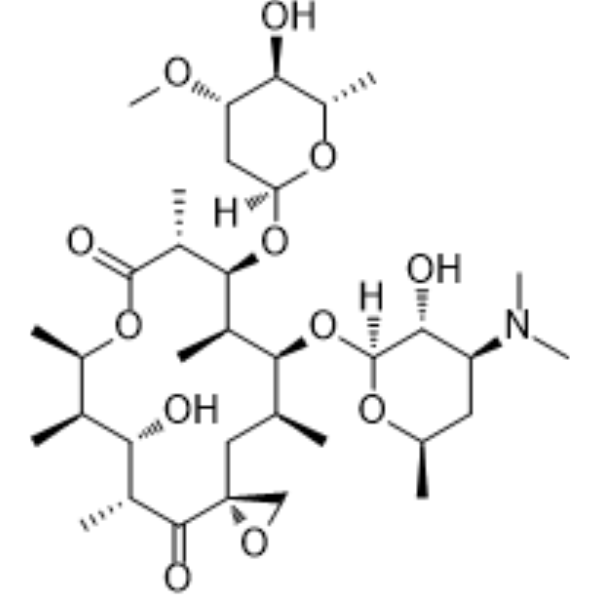
Oleandomycin is a macrolide antibiotic structurally closely related to Erythromycin. Oleandomycin is similar to Erythromycin with antimicrobial activity. Oleandomycin inhibits protein synthesis by interference with translation of activated amino acids to nascent peptide chains on the ribosomes.
Nur für Forschungszwecke. Wir verkaufen nicht an Patienten.
- Reinheit : 99.84%
- CAS. Nr.: 3922-90-5
- Formel: C35H61NO12
- Molecular Weight:687.86
-
Speicherung:Powder -20°C, 3 years ; In solvent -80°C, 6 months , -20°C, 1 month

To place orders, for customer services and technical support, please contact: MedChemExpress USA
Tel: 609-228-6898 E-mail: [email protected] [email protected]


-
 Biologische Aktivität
-
Chemical Information
-
Lösungsmittel & Löslichkeit
- Protokoll
- Reinheit & Dokumentation
- Verweise
-
 Help & FAQs


-
HY-B0221
Amphotericin BAntifungal Agent -
HY-B0398
Nalidixic acidAntibiotic -
HY-A0097
TeicoplaninBacterial Inhibitor -
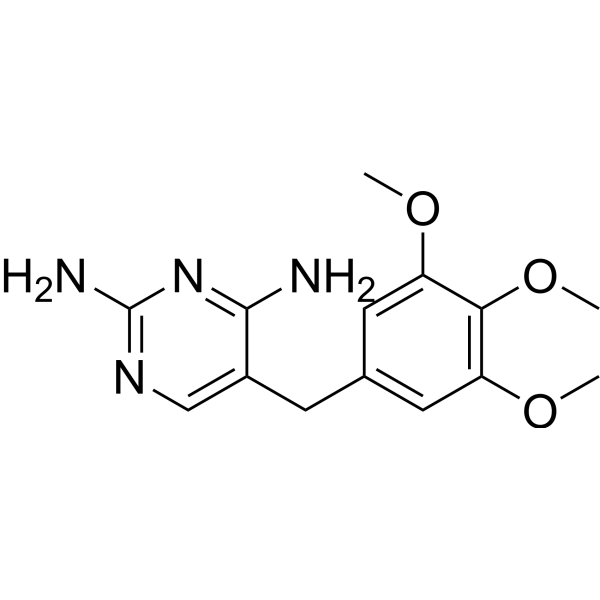
HY-B0510
TrimethoprimBacteriostatic Antibiotic -
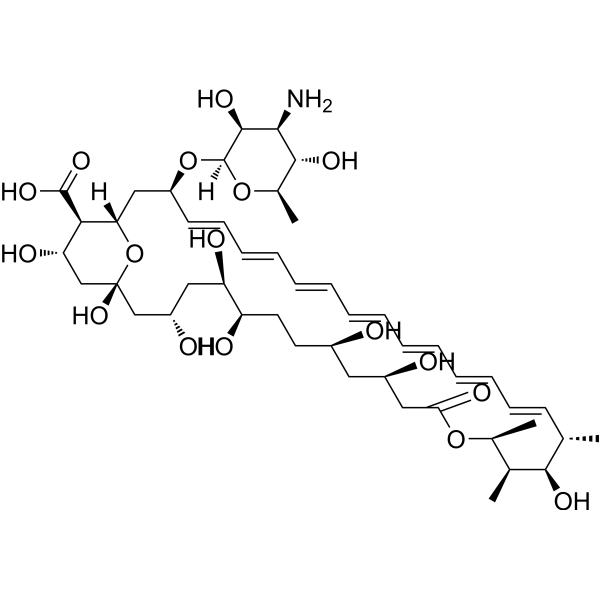
HY-B0221R
Amphotericin B (Standard) -
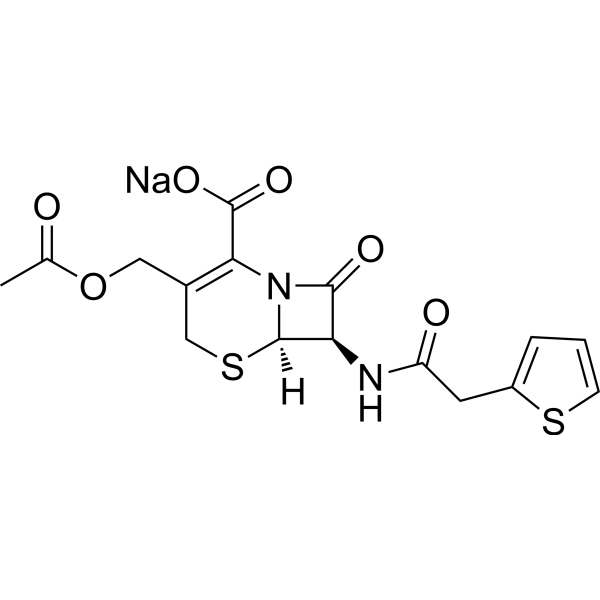
HY-B1275
Cephalothin sodiumβ-Lactam Antibiotic -

HY-B0510R
Trimethoprim (Standard)Bacteriostatic Antibiotic -

HY-B0398R
Nalidixic acid (Standard)Antibiotic -

HY-B1275R
Cephalothin sodium (Standard)Bacterial Inhibitor
Publications Citing Use of MedChemExpress (MCE) Oleandomycin
MoreAlle Antibiotic Isoform-spezifische Produkte anzeigen
More

Biologische Aktivität
Beschreibung
IC50 & Target
|
Macrolide |
In Vitro
Oleandomycin (0.5-50 μg/mL) inhibits the growth of Staph. aureus strain 13665[2].
MedChemExpress (MCE) has not independently confirmed the accuracy of these methods. They are for reference only.


Chemical Information
-
CAS. Nr. 3922-90-5
-
Appearance Solid
-
Molecular Weight 687.86
-
Formel C35H61NO12
-
Color White to off-white
-
SMILES
O=C1[C@H](C)[C@@H](O)[C@@H](C)[C@@H](C)OC([C@H](C)[C@@H](O[C@]2([H])O[C@@H](C)[C@H](O)[C@@H](OC)C2)[C@H](C)[C@@H](O[C@@]3([H])[C@H](O)[C@@H](N(C)C)C[C@@H](C)O3)[C@@H](C)C[C@@]14CO4)=O
-
Versand
Room temperature in continental US; may vary elsewhere.
-
Speicherung
Powder -20°C 3 years In solvent -80°C 6 months -20°C 1 month


Publications (1)
-
Journal Impact Factor
-
Most Recent
-
RSC Adv
Developing a novel magnetic organic polymer for selective extraction and determination of 16 macrolides in water and honey samples. [Abstract]2024 Mar 18;14(13):8726-8734. PMID: 38500629


Lösungsmittel & Löslichkeit
In Vitro:
DMSO : 100 mg/mL (145.38 mM; Need ultrasonic; Hygroscopic DMSO has a significant impact on the solubility of product, please use newly opened DMSO)
H2O : 12.5 mg/mL (18.17 mM; Need ultrasonic)
Please refer to the solubility information to select the appropriate solvent. Once prepared, please aliquot and store the solution to prevent product inactivation from repeated freeze-thaw cycles.
Storage method and period of stock solution: -80°C, 6 months; -20°C, 1 month. When stored at -80°C, please use it within 6 months. When stored at -20°C, please use it within 1 month.
* Note: If you choose water as the stock solution, please dilute it to the working solution, then filter and sterilize it with a 0.22 μm filter before use.
Please refer to the solubility information to select the appropriate solvent. Once prepared, please aliquot and store the solution to prevent product inactivation from repeated freeze-thaw cycles.
Storage method and period of stock solution: -80°C, 6 months; -20°C, 1 month. When stored at -80°C, please use it within 6 months. When stored at -20°C, please use it within 1 month.
* Note: If you choose water as the stock solution, please dilute it to the working solution, then filter and sterilize it with a 0.22 μm filter before use.
Konzentration (Stammlösung) × Volumen (Stammlösung) = Konzentration (Ziellösung) × Volumen (Ziellösung)
In Vivo:
Select the appropriate dissolution method based on your experimental animal and administration route.
- For the following dissolution methods, please ensure to first prepare a clear stock solution using an In Vitro approach and then sequentially add co-solvents:
- To ensure reliable experimental results, the clarified stock solution can be appropriately stored based on storage conditions. As for the working solution for In Vivo experiments, it is recommended to prepare freshly and use it on the same day.
- The percentages shown for the solvents indicate their volumetric ratio in the final prepared solution. If precipitation or phase separation occurs during preparation, heat and/or sonication can be used to aid dissolution.
Add each solvent one by one: 10% DMSO 40% PEG300 5% Tween-80 45% Saline
Solubility: ≥ 2.5 mg/mL (3.63 mM); Clear solution
This protocol yields a clear solution of ≥ 2.5 mg/mL (saturation unknown).
Taking 1 mL working solution as an example, add 100 μL DMSO stock solution (25.0 mg/mL) to 400 μL PEG300, and mix evenly; then add 50 μL Tween-80 and mix evenly; then add 450 μL Saline to adjust the volume to 1 mL.
Preparation of Saline: Dissolve 0.9 g sodium chloride in ddH₂O and dilute to 100 mL to obtain a clear Saline solution.
Add each solvent one by one: 10% DMSO 90% (20% SBE-β-CD in Saline)
Solubility: ≥ 2.5 mg/mL (3.63 mM); Clear solution
This protocol yields a clear solution of ≥ 2.5 mg/mL (saturation unknown).
Taking 1 mL working solution as an example, add 100 μL DMSO stock solution (25.0 mg/mL) to 900 μL 20% SBE-β-CD in Saline, and mix evenly.
Preparation of 20% SBE-β-CD in Saline (4°C, storage for one week): 2 g SBE-β-CD powder is dissolved in 10 mL Saline, completely dissolve until clear.
In Vivo Dissolution Calculator
Please enter the basic information of animal experiments:
-
-
-
-
Recommended: Prepare an additional quantity of animals to account for potential losses during experiments.
Please enter your animal formula composition:
-
%DMSO +
Recommended: Keep the proportion of DMSO in working solution below 2% if your animal is weak.
-
%+
-
+%Tween-80 + +
-
%Saline +
The co-solvents required include: DMSO, . All of co-solvents are available by MedChemExpress (MCE). , Tween 80. All of co-solvents are available by MedChemExpress (MCE).
Working solution concentration: 0.22 mg/mL
Method for preparing stock solution: mg drug dissolved in μL DMSO. Stock solution concentration: mg/mL.
1. Take μL DMSO stock solution;
2. Add μL .
μL , mix evenly;
3. Then add μL Tween 80, mix evenly;
4. Then add μL
Please ensure that the stock solution in the first step is dissolved to a clear state, and add co-solvents in sequence. You can use ultrasonic heating (ultrasonic cleaner, recommended frequency 20-40 kHz), vortexing, etc. to assist dissolution.


Reinheit & Dokumentation
-
Data Sheet (297 KB)
-
SDS (251 KB)
- English - EN (251 KB)
- Français - FR (251 KB)
- Deutsch - DE (251 KB)
- Norwegian - NO (251 KB)
- Español - ES (251 KB)
- Swedish - SV (251 KB)
- Italian - IT (251 KB)
- Korean - KR (251 KB)
- Portuguese - PT (251 KB)
-
Handling Instructions (2659 KB)
Verweise
[1]. Vilches C, et al. Role of glycosylation and deglycosylation in biosynthesis of and resistance to oleandomycin in the producer organism, Streptomyces antibioticus. J Bacteriol. 1992 Jan;174(1):161-5. [Content Brief]
[2]. Semenitz E, et al. The antibacterial activity of oleandomycin and erythromycin--a comparative investigation using microcalorimetry and MIC determination. J Antimicrob Chemother. 1978 Sep;4(5):455-7. [Content Brief]


Complete Stock Solution Preparation Table
Please refer to the solubility information to select the appropriate solvent. Once prepared, please aliquot and store the solution to prevent product inactivation from repeated freeze-thaw cycles.
Storage method and period of stock solution: -80°C, 6 months; -20°C, 1 month. When stored at -80°C, please use it within 6 months. When stored at -20°C, please use it within 1 month.
| Optional Solvent | Concentration Solvent Mass | 1 mg | 5 mg | 10 mg | 25 mg |
|---|---|---|---|---|---|
| H2O / DMSO | 1 mM | 1.4538 mL | 7.2689 mL | 14.5378 mL | 36.3446 mL |
| 5 mM | 0.2908 mL | 1.4538 mL | 2.9076 mL | 7.2689 mL | |
| 10 mM | 0.1454 mL | 0.7269 mL | 1.4538 mL | 3.6345 mL | |
| 15 mM | 0.0969 mL | 0.4846 mL | 0.9692 mL | 2.4230 mL | |
| DMSO | 20 mM | 0.0727 mL | 0.3634 mL | 0.7269 mL | 1.8172 mL |
| 25 mM | 0.0582 mL | 0.2908 mL | 0.5815 mL | 1.4538 mL | |
| 30 mM | 0.0485 mL | 0.2423 mL | 0.4846 mL | 1.2115 mL | |
| 40 mM | 0.0363 mL | 0.1817 mL | 0.3634 mL | 0.9086 mL | |
| 50 mM | 0.0291 mL | 0.1454 mL | 0.2908 mL | 0.7269 mL | |
| 60 mM | 0.0242 mL | 0.1211 mL | 0.2423 mL | 0.6057 mL | |
| 80 mM | 0.0182 mL | 0.0909 mL | 0.1817 mL | 0.4543 mL | |
| 100 mM | 0.0145 mL | 0.0727 mL | 0.1454 mL | 0.3634 mL |
* Note: If you choose water as the stock solution, please dilute it to the working solution, then filter and sterilize it with a 0.22 μm filter before use.


Oleandomycin Related Classifications
HY-116010 Related Classifications
 Powered by Bioz