



Anaplastic lymphoma kinase (ALK)
Anaplastic lymphoma kinase; ALK tyrosine kinase receptor; CD246; Cluster of differentiation 246
Anaplastic lymphoma kinase (ALK), a receptor tyrosine kinase in the insulin receptor superfamily, is predominantly expressed in the brain and implicated in neuronal development and cognition. ALK catalyzes the transference of a gamma-phosphate group from adenosine triphosphate (ATP) to a tyrosine residue on a substrate protein. Therefore, it catalyzes a tyrosine residue phosphorylation reaction on its substrate proteins. The phosphorylation and dephosphorylation of proteins are critical reactions catalyzed by different enzymes (kinases and phosphatases), which play critical roles in various cellular functions.
ALK gene activation is involved in the carcinogenesis process of several human cancers such as anaplastic large cell lymphoma, lung cancer, inflammatory myofibroblastic tumors and neuroblastoma, as a consequence of fusion with other oncogenes (NPM, EML4, TIM, etc) or gene amplification, mutation or protein overexpression. ALK is a transmembrane tyrosine kinase receptor that, upon ligand binding to its extracellular domain, undergoes dimerization and subsequent autophosphorylation of the intracellular kinase domain. When activated in cancer it represents a target for specific inhibitors, such as Crizotinib, Ceritinib, Alectinib etc. which use has demonstrated significant effectiveness in ALK-positive non-small cell lung cancer particularly.
All Product Categories
-
Anaplastic lymphoma kinase (ALK) Inhibitors
(170)
View all products
-
Anaplastic lymphoma kinase (ALK) Antagonist
(1)
View all products
-
Anaplastic lymphoma kinase (ALK) Activator
(1)
View all products
-
Anaplastic lymphoma kinase (ALK) Modulator
(1)
View all products
-
Anaplastic lymphoma kinase (ALK) Chemical
(1)
View all products
-
Anaplastic lymphoma kinase (ALK) Degraders
(24)
View all products
-
Anaplastic lymphoma kinase (ALK) Ligands
(10)
View all products
-
Anaplastic lymphoma kinase (ALK) Related Products (222)
Related Products (222)

-
Antibodies (4)
-
Rufutalkib
 0 ImagesCat. No.: HY-187922CAS No.: 1609170-61-7Rufutalkib is an orally active ALK modulator. It possesses thermodynamic and chemical stability, and can be used in research related to anaplastic large cell lymphoma, non-Hodgkin's lymphoma, inflammatory myofibroblastic tumor, neuroblastoma, glioblastoma, and ALK-positive malignancies.
-
ALK-IN-22
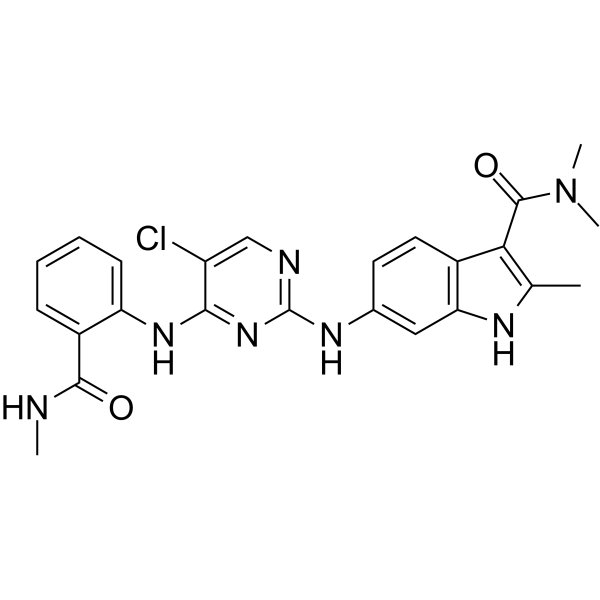 0 ImagesCat. No.: HY-147833CAS No.: 2468219-09-0
-
ALK5-IN-30
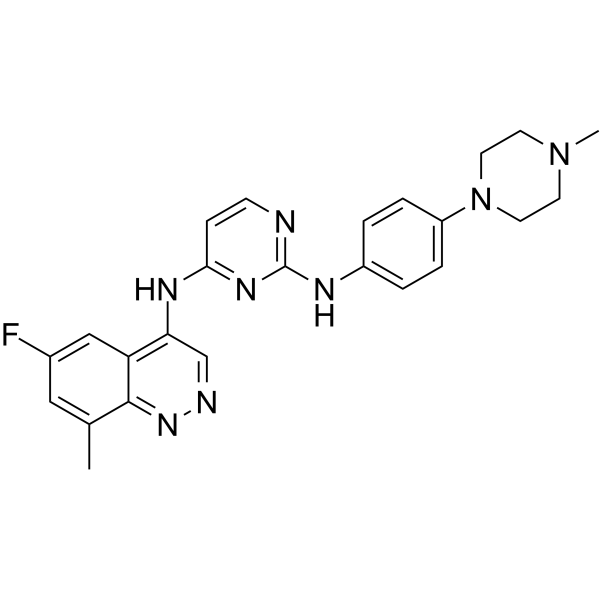 0 ImagesCat. No.: HY-151279CAS No.: 2785430-86-4
-
J-1048
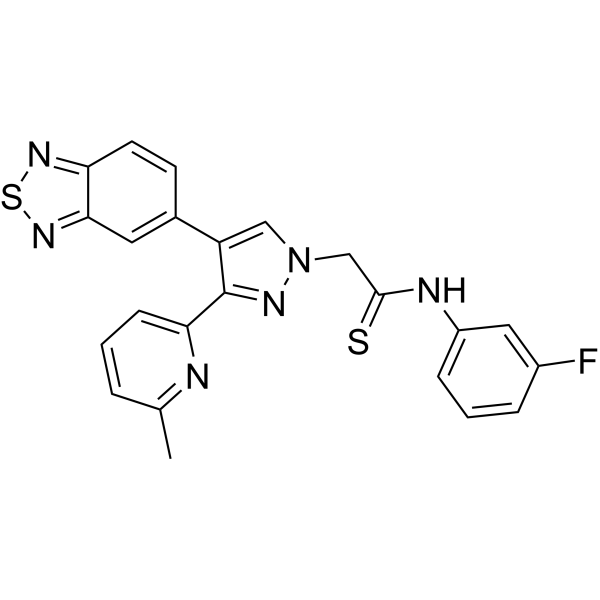 0 ImagesCat. No.: HY-149403CAS No.: 2374772-60-6J-1048 is an activin receptor-like kinase 5 (ALK5) inhibitor. J-1048 can inhibit TAA-induced liver fibrosis in mice by explicitly blocking the TGF-β/Smad signaling pathway.
-
EGFR-IN-176
 0 ImagesCat. No.: HY-178057CAS No.: 2754394-10-8EGFR-IN-176 is an orally active and ATP-competitive EGFR mutant inhibitor (particularly C797S-mediated EGFR triple mutant). EGFR-IN-176 effectively inhibits subsequent AKT signaling and induces apoptosis in Ba/F3 and PC-9 cells expressing EGFR19del/T790M/C797S and EGFRL858R/T790M/C797S. EGFR-IN-176 selectively inhibits EGFR signaling in cell lines harboring EGFR triple mutation and shows no inhibitory effect against A431 cells that express wild-type EGFR. EGFR-IN-176 can effectively inhibit the enzymatic activity of ALK (IC50 < 0.5 nM). EGFR-IN-176 can be used for the study of non-small cell lung cancer (NSCLC).
-
dALK-3
 0 ImagesCat. No.: HY-170592dALK-3 is an anaplastic lymphoma kinase (ALK) degrader. dALK-3 can effectively induce EML4-ALK degradation with a DC50 of 0.182 μM. dALK-3 has good anti-proliferation activity against H3122 cells and can be used in the study of cancer.
-
PROTAC ALK5 Degrader-1
 0 ImagesCat. No.: HY-183785CAS No.: 3125240-35-6PROTAC ALK5 Degrader-1 is a selective ALK5 PROTAC degrader. PROTAC ALK5 Degrader-1 induces ALK5 degradation via ALK5 ATP-binding pocket engagement, CRBN recruitment, and the ubiquitin-proteasome system.PROTAC ALK5 Degrader-1 inhibits ALK5 downstream signaling. PROTAC ALK5 Degrader-1 can be used for the research of pulmonary fibrosis.
-
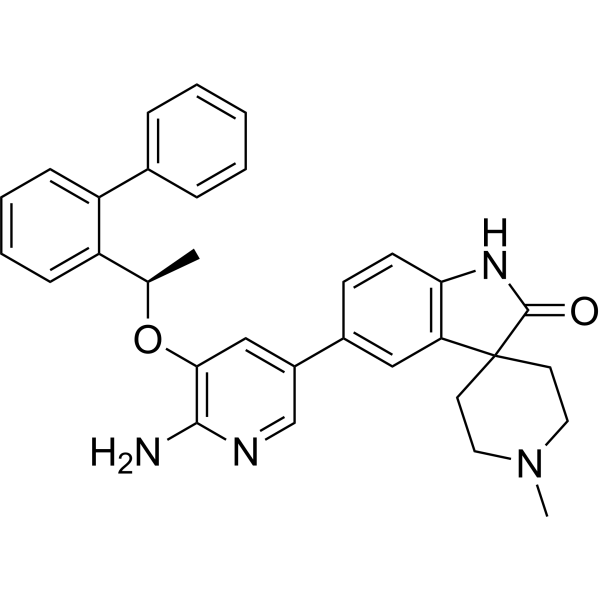
DDO-02267
 0 ImagesCat. No.: HY-170668CAS No.: 2919768-58-2DDO-02267 is a selective and lysine-targeting covalent inhibitor of ALKBH5, with an IC50 value of 0.49 μM. DDO-02267 increases N6-methyladenosine (m6A) levels and targets the ALKBH5-AXL signaling axis. DDO-02267 can serve as a probe for investigating the biological function of mRNA demethylase.
-
RepSox hydrochloride
 0 ImagesCat. No.: HY-W707119CAS No.: 2319939-07-4Synonyms: E-616452 hydrochloride; SJN 2511 hydrochlorideRepSox hydrochloride is a potent and selective inhibitor of transforming growth factor-β receptor I/activin-like kinase 5 (TGF-β-RI/ALK5). RepSox hydrochloride inhibits ALK5 autophosphorylation with an IC50 value of 4 nM. RepSox hydrochloride can be used in the study of obesity and related metabolic diseases such as type 2 diabetes.
-
SH-CER-6
 0 ImagesCat. No.: HY-187801SH-CER-6 is a double-warhead C2-COUPL derived from Ceritinib (HY-187801) that targets the EML4-ALK fusion protein complex and induces its degradation. SH-CER-6 simultaneously binds to structures near the ALK inhibitor-binding region and forms a covalent conjugate with a protein cysteine, thereby promoting ubiquitination and proteasome-dependent degradation of the EML4-ALK complex, which in turn inhibits the ALK signaling pathway. SH-CER-6 is useful for research related to ALK-positive non-small cell lung cancer.
-
DLX-521
 0 ImagesCat. No.: HY-P991533DLX-521 is an antibody that inhibits ALK. DLX-521 can be used in diagnosis and research for lung cancer.
-
ALK ligand-1
 0 ImagesCat. No.: HY-W754809CAS No.: 2353496-79-2
-
SH-E4A-66
 0 ImagesCat. No.: HY-161910SH-E4A-66 is a C2-COUPLr (COvalent Protein Ligator) with carbazole scaffold barring heterogeneous cysteine reactive warheads (acrylamide and chloroacetamide). SH-E4A-66 is capable of coupling with EML4-ALK (EC50=1.5 μM) and inhibiting the activity of EML4-ALK kinase (IC50=2.3 μM).
-
ALK5 ligand-1-amine-C2-piperazine-C4-OH
 0 ImagesCat. No.: HY-183442ALK5 ligand-1-amine-C2-piperazine-C4-OH is a conjugate of a ligand targeting ALK5 and a PROTAC linker. ALK5 ligand-1-amine-C2-piperazine-C4-OH can be used to synthesize the PROTAC degrader (a31). ALK5 PROTACs induce UPS-dependent and selective degradation of ALK5 over ALK4. ALK5 ligand-1-amine-C2-piperazine-C4-OH can be applied to research on pulmonary fibrosis.
-
PROTAC EML4-ALK Degrader-1
 0 ImagesCat. No.: HY-174368Synonyms: Pro-BAPROTAC EML4-ALK Degrader-1 (Pro-BA) is an orally active EML4-ALK PROTAC degrader that recruits GID4, with a Kd value of 144 nM against human EML4-ALK and a DC50 of 74 nM in H3122 cells. PROTAC EML4-ALK Degrader-1 promotes EML4-ALK ubiquitination and proteasomal degradation, reduces cancer cell viability, inhibits cancer cell and tumor growth, induces apoptosis, and alters cell cycle distribution. PROTAC EML4-ALK Degrader-1 can be used in studies related to EML4-ALK-positive cancers and non-small cell lung cancer.
-
LY580276
 0 ImagesCat. No.: HY-182547CAS No.: 476475-07-7
-
ALK-IN-9
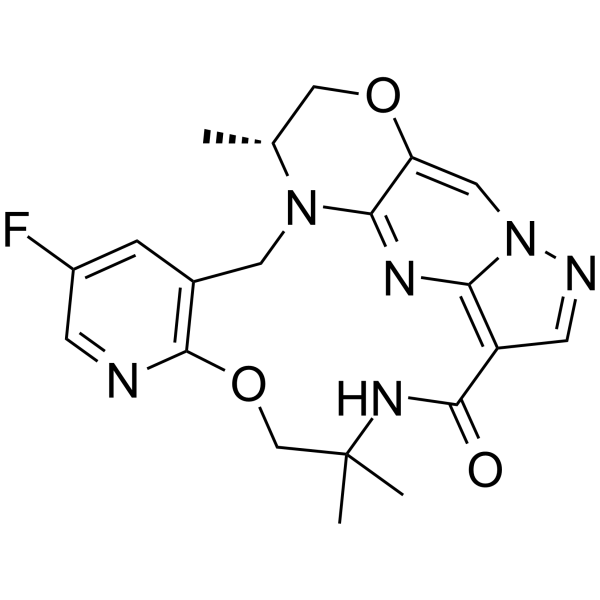 0 ImagesCat. No.: HY-131244CAS No.: 2359662-39-6ALK-IN-9 (compound 40) is a potent ALK inhibitor. ALK-IN-9 inhibits cell proliferation with IC50s of <0.2 nM, <0.2 nM, 0.2 nM for Ba/F3-EML4-ALK, KM 12 (TPM3-TRKA), KG-l cell (OP2-FGFR1), respectively.
-
X-376 (Standard)
 0 ImagesX-376 (Standard) is the analytical standard of X-376. This product is intended for research and analytical applications. X-376 is a potent and highly specific ALK tyrosine kinase inhibitor (TKI) (IC50=0.61 nM). X-376 is a less potent inhibitor of MET (IC50=0.69 nM). X-376 displays potent anti-tumor activity.
-
Ceritinib (Standard)
 0 ImagesSynonyms: LDK378 (Standard)Ceritinib (Standard) is the analytical standard of Ceritinib (HY-15656). This product is intended for research and analytical applications. Ceritinib is a selective, orally bioavailable, and ATP-competitive ALK tyrosine kinase inhibitor with an IC50 of 200 pM. Ceritinib also inhibits IGF-1R, InsR, and STK22D with IC50 values of 8, 7, and 23 nM, respectively. Ceritinib shows great antitumor potency.




