



Bacterial
Anything that destroys bacteria or suppresses their growth or their ability to reproduce. Heat, chemicals such as chlorine, and antibiotic drugs all have antibacterial properties. Many antibacterial products for cleaning and handwashing are sold today. Such products do not reduce the risk for symptoms of viral infectious diseases in otherwise healthy persons. This does not preclude the potential contribution of antibacterial products to reducing symptoms of bacterial diseases in the home.
All Product Categories
-
Bacterial Inhibitors
(7501)
View all products
-
Bacterial Agonists
(3)
View all products
-
Bacterial Antagonists
(9)
View all products
-
Bacterial Activators
(23)
View all products
-
Bacterial Modulators
(27)
View all products
-
Bacterial Chemicals
(2)
View all products
-
Bacterial Inducers
(7)
View all products
-
Bacterial Controls
(14)
View all products
-
Bacterial Substrates
(2)
View all products
-
Bacterial Ligand
(1)
View all products
-
Bacterial Related Products (8826)
Related Products (8826)

-
Antibodies (14)
-
Related Compound Screening Libraries (1)
-
16-Methyloxazolomycin
 0 ImagesCat. No.: HY-N14303CAS No.: 202863-86-316-Methyloxazolomycin is an antibiotic. 16-Methyloxazolomycin has the effect of resisting bacteria and algae. 16-Methyloxazolomycin against leukemia P388 and human lung adenocarcinoma cells.
-
Leucomycin A6
 0 ImagesCat. No.: HY-N15085CAS No.: 18361-48-3Leucomycin A6 is active against Gram-positive bacteria.
-
Trimethoprim-13C3
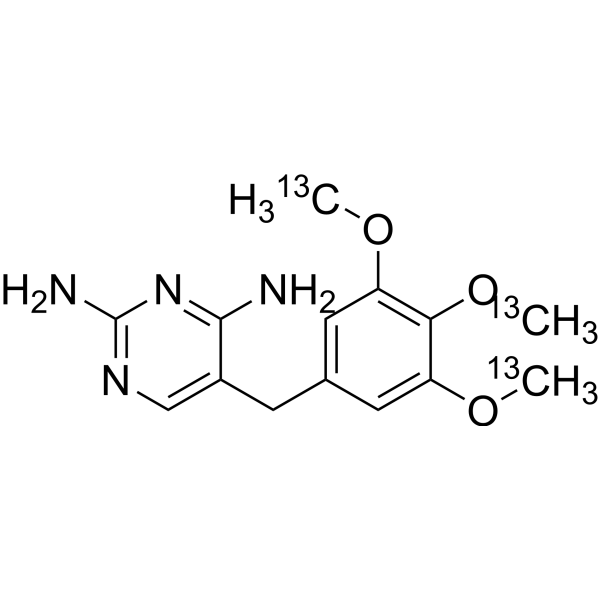 0 ImagesCat. No.: HY-B0510S3CAS No.: 1189970-95-3Trimethoprim-13C3 is the deuterium labeled Trimethoprim (HY-B0510). Trimethoprim is a bacteriostatic antibiotic and an orally active dihydrofolate reductase inhibitor. Trimethoprim is active against a wide range of Gram-positive and Gram-negative aerobic bacteria. Trimethoprim has the potential for the research of urinary tract infections, Shigellosis and Pneumocystis pneumonia. Trimethoprim can inhibit infection of Influenza A virus in chick embryo when combinated with zinc.
-
Iclaprim-d6
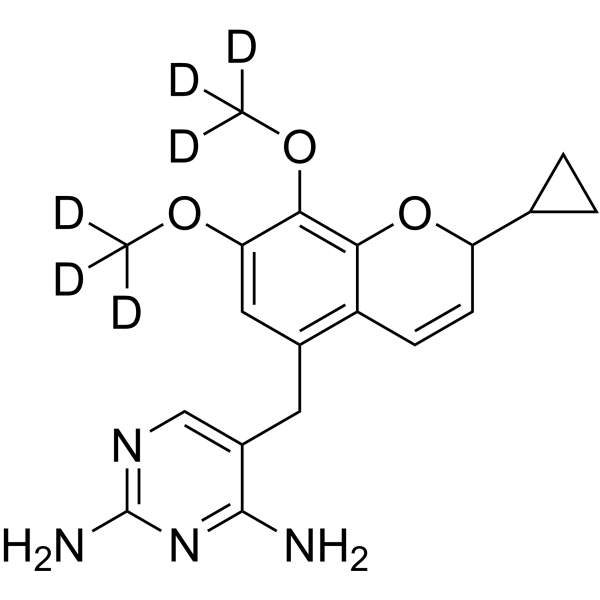 0 ImagesCat. No.: HY-101479SCAS No.: 1130072-57-9Iclaprim-d6 (AR-100-d6) is the deuterium labeled Iclaprim. Iclaprim is a new selective bacterial Dihydrofolate inhibitor, which can inhibit the growth of S. aureus (MRSA) with an MIC90 of 0.06 μg/mL.
-
Cremimycin
 0 ImagesCat. No.: HY-N14144CAS No.: 182285-29-6Cremimycin has anti-Gram-positive bacteria activity including methicillin-resistant Staphylococcus aureus (MRSA), MIC is 0.2-0.39 μg/mL. Cremimycin shows cytotoxicity to mouse tumor cell lines P388, L1210, IMC, S180, B16 and SS3 in vitro.
-
Dirithromycin (Standard)
 0 ImagesCat. No.: HY-B0643RCAS No.: 62013-04-1Synonyms: LY237216 (Standard)Dirithromycin (Standard) is the analytical standard of Dirithromycin. This product is intended for research and analytical applications. Dirithromycin (LY237216), a derivative of Erythromycin, is a potent and orally active semi-synthetic macrolide antibiotic. Dirithromycin is active against gram-positive bacteria, Legionella spp., Helicobacter pylori, and Chlamydia trachomatis.
-
Erythrosine B aluminum
 0 ImagesCat. No.: HY-107864ACAS No.: 12227-78-0Synonyms: Erythrosin extra bluish aluminum; Tetraiodofluorescein aluminumErythrosine B aluminum (Erythrosin extra bluish aluminum; Tetraiodofluorescein aluminum) is a visible red dye and insecticide with colorimetric and fluorescent properties. Erythrosine B aluminum serves as a membrane-impermeant live-cell dye for Gram-positive and Gram-negative bacteria, primarily staining dead cells with damaged plasma membranes. Erythrosine B aluminum exhibits photosensitive larvicidal toxicity against Culex pipiens quinquefasciatus larvae. Erythrosine B aluminum is used in live/dead bacterial assays in colorimetric and fluorescent measurements for low-, medium-, and high-throughput experiments, as well as in research related to mosquito-borne diseases and food coloring.
-
Espinomycin A3
 0 ImagesCat. No.: HY-N15032CAS No.: 35867-32-4Espinomycin A3 is a sixteen-membered macrolide antibiotic. Espinomycin A3 is active against Gram-positive bacteria.
-
FR295389
 0 ImagesCat. No.: HY-113590CAS No.: 1019207-72-7FR295389 is a dihydroimidazopyrazolium cephalosporin with antibacterial activity. FR295389 shows activity against IMP-type metallo-β-lactamases (MBL)-producing Klebsiella pneumoniae, Acinetobacter baumanii and Pseudomonas putida with MIC values ranging from 4 to 32 mg/mL.
-
Clofazimine (Standard)
 0 ImagesClofazimine (Standard) is the analytical standard of Clofazimine. This product is intended for research and analytical applications. Clofazimine is an orally-active anti-mycobacterial agent with a wide range of anti-mycobacterial activity including leprosy and tuberculosis. Clofazimine exerts anti-inflammatory activities and anti-tumor activities by interfering DNA replication and inhibiting IL2 (IC50 = 1.10 ± 0.26 μM, Jurkat T) production. Clofazimine can be used in mycobacterial and cancer research.
-
Pacidamycin 7
 0 ImagesCat. No.: HY-N14519CAS No.: 121808-59-1Pacidamycin 7 has inhibitory effect on Pseudomonas aeruginosa. Pacidamycin 7 also has effect on a few strains of bacteria such as suppurative staphylococcus and Escherichia coli. Serum can reduce its antibacterial activity, pH also affects its antibacterial activity.
-
Kibdelin C1
 0 ImagesCat. No.: HY-N14708CAS No.: 103549-47-9Kibdelin C1 is resistant to Gram-positive bacteria and has similar effects against Staphylococcus aureus (including methicillin-resistant strains) as Vancomycin (HY-B0671).
-
13-Hydroxyglucopiericidin A
 0 ImagesCat. No.: HY-N15026CAS No.: 132150-13-113-Hydroxyglucopiericidin A is an antibiotic. 13-Hydroxyglucopiericidin A has strong anti-tumor cell activity.
-
Tamarixetin (Standard)
 0 ImagesTamarixetin (Standard) is the analytical standard of Tamarixetin. This product is intended for research and analytical applications. Tamarixetin (4'-O-Methyl Quercetin) is an orally active natural flavonoid derivative of quercetin and caseinolytic protease p (ClpP) inhibitor with anti-inflammatory, antioxidant and antitumor effects. Tamarixetin inhibits the hydrolytic activity of ClpP to the fluorescent substrate Suc-LY-AMC with an IC50 of 49.73 μM, which can be used for the study of Staphylococcus aureus infection. Tamarixetin inhibits tumor cell growth, induces apoptosis, and cell cycle arrest. Tamarixetin prevents cardiac hypertrophy by inhibiting the NFAT and AKT pathways.
-
4"-Demethylgentamicin C1a
 0 ImagesCat. No.: HY-N5200CAS No.: 61769-70-84"-Demethylgentamicin C1a has anti-Gram-positive and negative bacteria activity.
-
cis,cis-Muconic acid (Standard)
 0 ImagesCat. No.: HY-W000800RCAS No.: 1119-72-8cis,cis-Muconic acid (Standard) is an analytical standard for cis,cis-Muconic acid (HY-W000800). This product is used for research and analytical applications. cis,cis-Muconic acid is a dicarboxylic acid produced by Saccharomyces cerevisiae. cis,cis-Muconic acid shows pH-dependent toxicity against Saccharomyces cerevisiae CEN.PK113-7D. cis,cis-Muconic acid can be used as intermediate for the production of various plastics and polymers.
-
β-Prumycin hydrochloride
 0 ImagesCat. No.: HY-N14912CAS No.: 54612-74-7β-Prumycin hydrochloride is a carbohydrate antibiotic. β-Prumycin hydrochloride has anti-fungal activity and weak anti-individual bacterial activity.
-
Methyl 1-hydroxy-4-oxocyclohexaneacetate
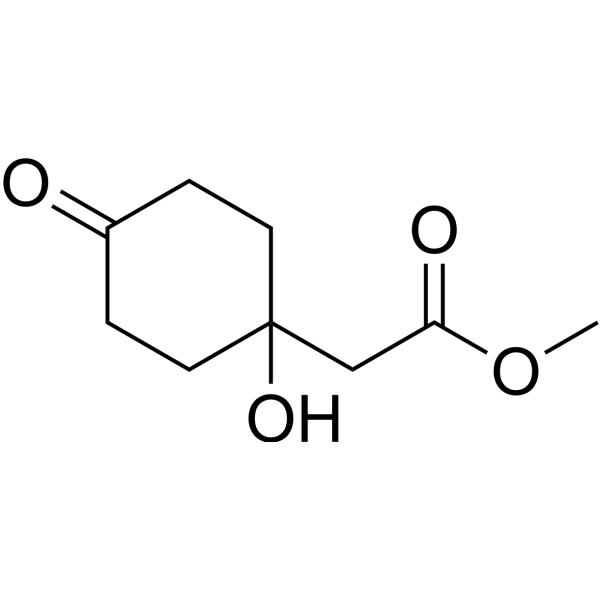 0 ImagesCat. No.: HY-N8797CAS No.: 81053-14-7Methyl 1-hydroxy-4-oxocyclohexaneacetate (Compound 7) is a lactone. Methyl 1-hydroxy-4-oxocyclohexaneacetate is isolated from the natural Senecio scandens. Methyl 1-hydroxy-4-oxocyclohexaneacetate has anti-inflammatory andantibacterialactivity .
-
1-Palmitoyl-2-linoleoyl-sn-glycerol
 0 ImagesCat. No.: HY-N15353CAS No.: 51621-26-21-Palmitoyl-2-linoleoyl-sn-glycerol is a diacylglycerol (DAG)-type lipid signaling molecule found in the coralloid roots of Cycas revoluta, and serves as a major active component of the plant-secreted hormogonium-inducing factor (HIF). At a concentration of 1 nmol/disc (approximately 0.6 µg), 1-palmitoyl-2-linoleoyl-sn-glycerol can significantly induce the differentiation of filamentous aggregates of Nostoc into motile hormogonia, thereby promoting chemotaxis toward host roots and the establishment of symbiosis. This compound holds significant research and application potential in areas such as plant–microbe interactions, rhizosphere signaling pathways, and nitrogen-fixing symbiosis.
-
Sildenafil-d5
 0 ImagesCat. No.: HY-15025S3CAS No.: 951385-70-9Synonyms: UK-92480-d5Sildenafil-d5 (UK-92480-d5) is deuterium labeled Sildenafil. Sildenafil (UK-92480) is a potent phosphodiesterase type 5 (PDE5) inhibitor with an IC50 of 5.22 nM.




