



HIV
HIV-1 is an RNA retrovirus that infects immune cells through the envelope glycoprotein Env, whose mature gp120/gp41 trimer mediates viral entry into host cells[1]. Mechanistically, gp120 binds CD4 and then the chemokine coreceptors CCR5 or CXCR4, while gp41 refolding brings viral and cellular membranes together for fusion[2][3]. After entry, viral replication depends on reverse transcriptase, protease, and integrase, making these enzymes core targets for antiretroviral research[4][5]. In disease relevance, untreated HIV replication causes progressive CD4+ T-cell loss and immunological abnormalities, increasing infectious and oncological complications[6]. Compared with related forms, HIV-1 remains the main focus because it is described as the most virulent and pathogenic subtype in diagnostic and treatment literature[7]. For experimental applications, entry inhibitors target gp120, gp41, CCR5, or CXCR4, while enzyme inhibitors target reverse transcriptase, protease, or integrase to suppress distinct stages of the HIV life cycle[4][8].
References:
- [1]. Anang S, et al. Characterization of full-length and cytoplasmic tail-truncated envelope glycoproteins incorporated into human immunodeficiency virus (HIV-1) virions and virus-like particles. J Virol. 2025 Dec 23;99(12):e0158525. [Content Brief]
- [2]. Teixeira C, et al. Viral surface glycoproteins, gp120 and gp41, as potential drug targets against HIV-1: brief overview one quarter of a century past the approval of zidovudine, the first anti-retroviral drug. Eur J Med Chem. 2011 Apr;46(4):979-92. [Content Brief]
- [3]. Princen K, et al. HIV chemokine receptor inhibitors as novel anti-HIV drugs. Cytokine Growth Factor Rev. 2005 Dec;16(6):659-77. [Content Brief]
- [4]. De Clercq E. Emerging anti-HIV drugs. Expert Opin Emerg Drugs. 2005 May;10(2):241-73. doi: 10.1517/14728214.10.2.241. PMID: 15934866. et al. Emerging anti-HIV drugs. Expert Opin Emerg Drugs. 2005 May;10(2):241-73. [Content Brief]
- [5]. Palmisano L. Role of integrase inhibitors in the treatment of HIV disease. Expert Rev Anti Infect Ther. 2007 Feb;5(1):67-75. doi: 10.1586/14787210.5.1.67. PMID: 17266455. et al. Role of integrase inhibitors in the treatment of HIV disease. Expert Rev Anti Infect Ther. 2007 Feb;5(1):67-75. [Content Brief]
- [6]. Deeks SG, et al. HIV infection. Nat Rev Dis Primers. 2015 Oct 1;1:15035. [Content Brief]
- [7]. Zulfiqar HF, et al. HIV Diagnosis and Treatment through Advanced Technologies. Front Public Health. 2017 Mar 7;5:32. [Content Brief]
- [8]. Greenberg M, et al. HIV fusion and its inhibition in antiretroviral therapy. Rev Med Virol. 2004 Sep-Oct;14(5):321-37. [Content Brief]
All Product Categories
-
HIV Related Products (907)
Related Products (907)

-
HIV-1 protease-IN-15
 0 ImagesCat. No.: HY-174998CAS No.: 2986573-09-3
-
BRD-6929 (Standard)
 0 ImagesBRD-6929 (Standard) is the analytical standard of BRD-6929 (HY-100719). This product is intended for research and analytical applications. BRD-6929 is a potent, selective brain-penetrant inhibitor of class I histone deacetylase HDAC1 and HDAC2 inhibitor with IC50 of 1 nM and 8 nM, respectively. BRD-6929 shows high-affinity to HDAC1 and HDAC2 with Ki of 0.2 and 1.5 nM, respectively. BRD-6929 can be used for mood-related behavioral model research.
-
(S)-Tenofovir (Standard)
 0 ImagesCat. No.: HY-W074930RCAS No.: 147127-19-3Synonyms: (S)-GS 1278 (Standard); (S)-PMPA (Standard); (S)-TDF (Standard)(S)-Tenofovir (Standard) is the analytical standard of (S)-Tenofovir. This product is intended for research and analytical applications. (S)-Tenofovir is the less active S-enantiomer of Tenofovir (HY-13910). Tenofovir is a nucleotide reverse transcriptase inhibitor to treat HIV and chronic Hepatitis B (HBV). (S)-Tenofovir has low activity to Orf virus. (S)-Tenofovir can be used for research on contagious pustular dermatitis.
-
Atazanavir-d24
 0 ImagesCat. No.: HY-17367S5CAS No.: 1092540-58-3Synonyms: BMS-232632-d24Atazanavir-d24 (BMS-232632-d24) is deuterium labeled Atazanavir. Atazanavir (BMS-232632) is a highly selective and orally active HIV-1 protease inhibitor . Atazanavir is a substrate and inhibitor of CYP3A4, and an inhibitor of P-glycoprotein (P-gp). Atazanavir is also a SARS-CoV 3CLpro inhibitor with an IC50 of 3.49 μM. Atazanavir inhibits cardiac fibrosis, hyperlipidemia and induces malignant glioma death.
-
Fumagillin (Standard)
 0 ImagesCat. No.: HY-B0751RCAS No.: 23110-15-8Synonyms: Amebacilin (Standard); NSC9168 (Standard)Fumagillin (Standard) is the analytical standard of Fumagillin. This product is intended for research and analytical applications. Fumagillin(NSC9168) is an antimicrobial compound first isolated in 1949 from the fungus Aspergillus fumigatu. Fumagillin can inhibits HIV‐1 infection through the inhibition of HIV-1 viral protein R (Vpr) activity.
-
2-Hydroxyacetophenone (Standard)
 0 ImagesSynonyms: Phenacyl alcohol (Standard)2-Hydroxyacetophenone is a principal root volatile of the Carissa edulis. 2-Hydroxyacetophenone can be used as biulding block.
-
D77
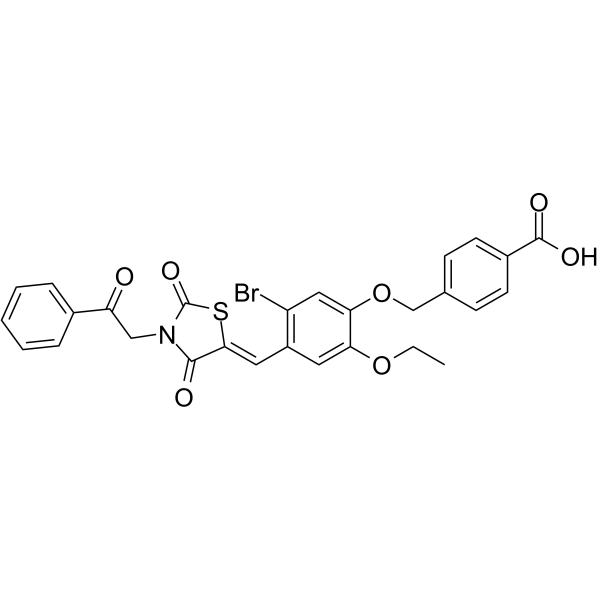 0 ImagesCat. No.: HY-18666CAS No.: 497836-10-9D77 is anti-HIV-1 inhibitor targeting the interaction between integrase and cellular LEDGF/p75. D77 inhibits HIV-1(IIIB) replication by EC50 value of 23.8 μg/ml in MT-4 cell (5.03 μg/ml for C8166 cells).



