



eRF3b/GSPT2
Eukaryotic release factor 3b (eRF3b), also known as G1 to S phase transition protein 2 (GSPT2), is a member of the eRF3 family of translation termination factors that participates in stop codon recognition and polypeptide release through interaction with eukaryotic release factor 1 (eRF1)[1][2]. GSPT2 belongs to the GTPase family of release factors and contains conserved regions involved in eRF1 binding and translation termination complex formation[1][3]. Mechanistically, eRF3 proteins promote translation termination by facilitating GTP-dependent conformational changes required for efficient peptide release[2]GSPT2 expression and function have been studied in translation regulation models because eRF3 family proteins contribute to maintaining accurate protein synthesis termination[2][4]. Compared with the related isoform eRF3a/GSPT1, GSPT2 shows a more restricted expression pattern and shares conserved eRF1-interacting domains required for translation termination activity[3][5]. Unlike eRF3a/GSPT1, which is broadly expressed and frequently studied in cancer-associated translation regulation, GSPT2 has been investigated primarily as a translation termination factor with distinct expression characteristics[5]. For experimental applications, GSPT2 function is analyzed using protein interaction studies, translation termination assays, expression profiling, and genetic manipulation approaches[3][4]. The limited availability of GSPT2-selective modulators has resulted in greater reliance on molecular and cellular approaches to study its role in translation termination[4].
References:
- [1]. Zhouravleva G, et al. Termination of translation in eukaryotes is governed by two interacting polypeptide chain release factors, eRF1 and eRF3. EMBO Journal. 1995;14(16):4065-4072. [Content Brief]
- [2]. Kisselev L, et al. Termination of translation: interplay of mRNA, rRNAs, and release factors. EMBO Journal. 2002;21(7):175-182.
- [3]. Chauvin C, et al. Involvement of human release factors eRF3a and eRF3b in translation termination and nonsense-mediated mRNA decay. Molecular and Cellular Biology. 2005;25(14):5801-5811. [Content Brief]
- [4]. Hoshino S, et al. The eukaryotic polypeptide chain release factor (eRF3/GSPT) carrying the translation termination signal promotes GTPase activity of eRF1. RNA. 1999;5(3):362-376. [Content Brief]
- [5]. Le Goff X, et al. Overexpression of human eRF3a and eRF3b proteins: differential effects on translation termination and nonsense-mediated mRNA decay. Molecular and Cellular Biology. 2002;22(16):6101-6110. [Content Brief]
All Product Categories
-
eRF3b/GSPT2 Related Products (6)
Related Products (6)

-
SJ6986
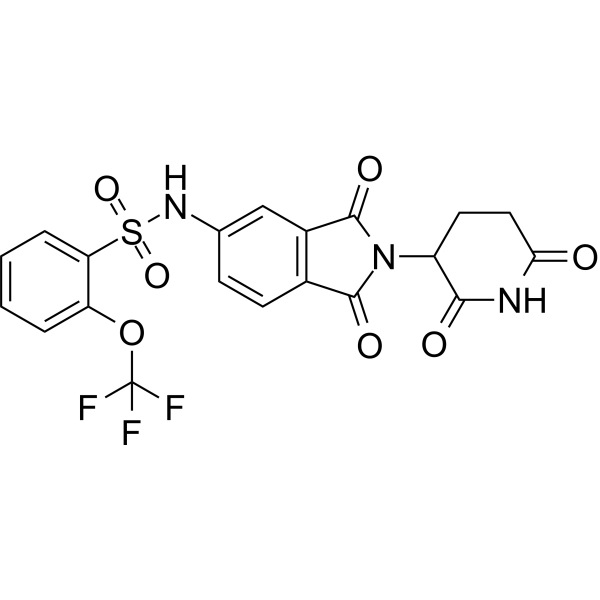 0 ImagesSJ6986 is an orally active GSPT1/2 molecular glue degrader, with a DC50 of 9.7 nM at 4 h and 2.1 nM at 24 h for GSPT1 degradation in MV4-11 cells. SJ6986 recruits GSPT1/2 to the CRBN E3 ligase complex, inducing ubiquitination and proteasomal degradation of GSPT1/2. SJ6986 triggers activation of the integrated stress response pathway and apoptosis downstream of GSPT1 degradation. SJ6986 serves as a chemical probe for investigating the functions of GSPT1/GSPT2 in vitro and in vivo. SJ6986 can be used for research on acute leukemia and medulloblastoma.
-
GT19630
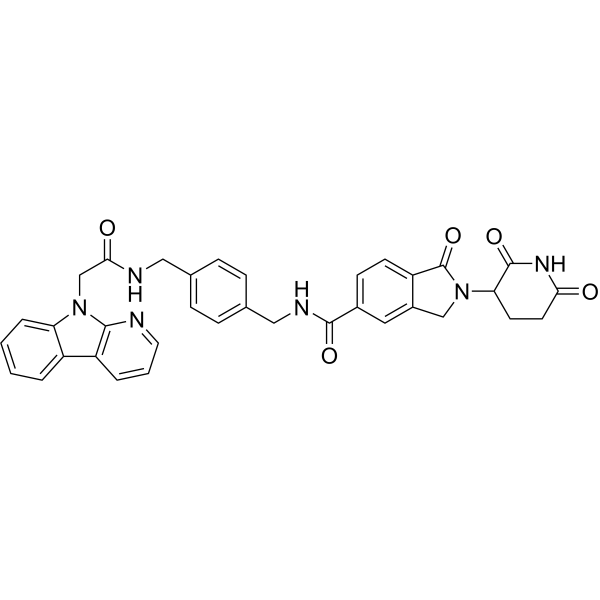 0 ImagesGT19630 is an orally active c-Myc PROTAC targeted degrader based on the cereblon E3 ubiquitin ligase, with an IC50 of 1.5 nM against human c-Myc. GT19630 mediates the degradation of MYC, GSPT1, GSPT2, CK1 alpha, N-Myc, B7-H3 and XIAP, and disrupts the MYC-GSPT1 synergistic regulatory feedback loop. GT19630 inhibits cell proliferation, blocks S-phase progression of the cell cycle, promotes cell apoptosis, reduces cell migration capacity, induces integrated stress response, and blocks oxidative phosphorylation by inhibiting the TCA cycle. GT19630 can be used in the research of Myc-driven hematological cancers, small cell lung cancer, breast cancer, TP53-mutant cancers, and venetoclax-resistant cancers.
-
MDEG-541
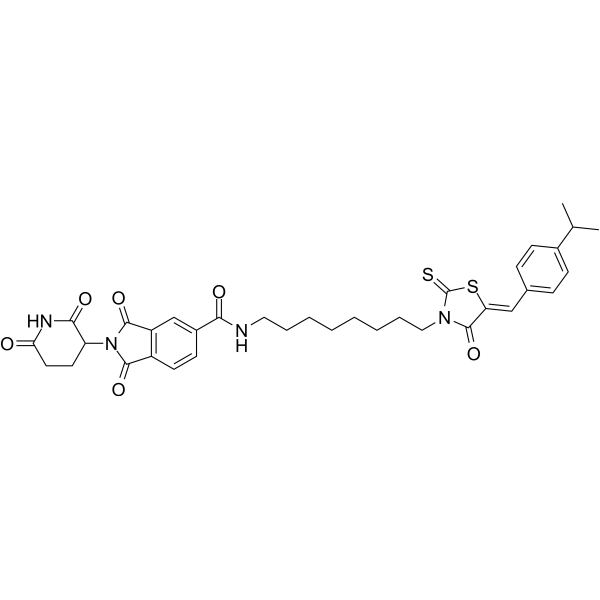 0 ImagesCat. No.: HY-150259Purity: 98.68%MDEG-541 is a PROTAC degrader targeting MYC, GSPT1/2 and PLK1. MDEG-541 induces degradation via proteasome- and ubiquitin-dependent pathways. MDEG-541 exhibits anti-tumor activity in gastrointestinal cancer cells and patient-derived organoids. MDEG-541 can be used for the research of gastrointestinal cancer.
-
KMG-1068
 0 ImagesKMG-1068 is a molecular glue degrader that induces proteasomal degradation of GSPT1 and GSPT2 with DC50 values of 126.7 nM and 42.2 nM, respectively. KMG-1068 binds to the C-terminal IMiD-binding site of CRBN, forms ternary complexes with GSPT1 and GSPT2, and mediates proteasomal degradation of target proteins via the CRL4 ubiquitination pathway. KMG-1068 is applicable to research related to acute myeloid leukemia.
-
GSPT2 degrader-1
 0 ImagesCat. No.: HY-177744CAS No.: 3093413-09-0GSPT2 degrader-1 (compound 619) is a selective molecular glue GSPT2 degrader targeting GSPT2. GSPT2 degrader-1 contains Thalidomide (HY-14658) and the linker of MDEG-541 (HY-150259). GSPT2 degrader-1 induces the degradation, but not GSPT1 or myelocytomatosis oncogene (MYC). GSPT2 degrader-1 can be used for research of gastrointestinal cancer.
-
FL2-14
 0 ImagesCat. No.: HY-177777FL2-14 is a CRBN-dependent selective molecular glue degrader of GSPT2. FL2-14 specifically degrades GSPT2 by recruiting the CRBN E3 ligase to recognize the G-loop sequence on the target protein GSPT2. FL2-14 can be used in related research on colorectal cancer.



