



Medulloblastoma
-
Medulloblastoma (7)

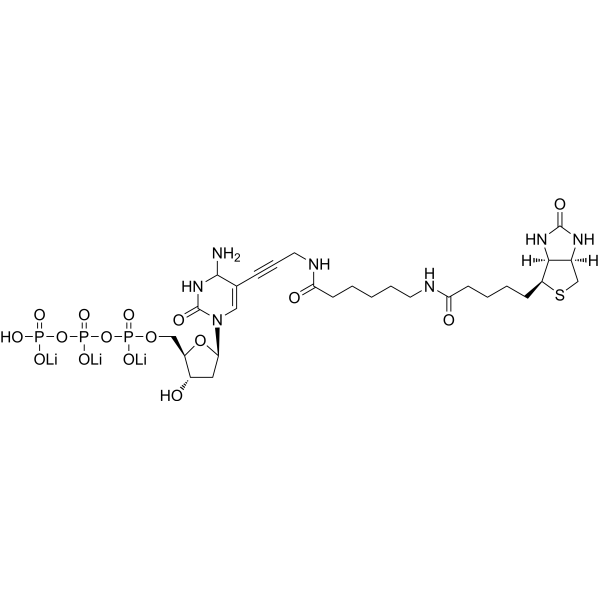
- Formula: C28H43Li3N7O16P3S
- Molecular Weight: 879.49
Biotin-11-dCTP is a biotinylated deoxynucleoside triphosphate and an important DNA labeling reagent. In random primer DNA labeling reactions, Biotin-11-dCTP incorporates into newly synthesized DNA strands to generate labeled DNA probes suitable for hybridization applications. In addition, Biotin-11-dCTP can serve as a substrate for terminal deoxynucleotidyl transferase to end-label oligonucleotides for telomere sequence detection, or to label the cut ends of linearized DNA molecules, thereby supporting streptavidin-based electron microscopy analysis. For example, Biotin-11-dCTP can label the cut ends of linearized DNA molecules under the action of dGTP and avian myeloblastosis virus reverse transcriptase.

- Formula: C17H22Cl2N6O
- Molecular Weight: 397.30
CT-179 is a brain-penetrant and orally active OLIG2 inhibitor with a human IC50 of 1250 nM. CT-179 disrupts OLIG2 dimerization, phosphorylation, and DNA binding, blocking OLIG2-driven transcription. CT-179 induces G2/M phase arrest and increases G0 population. CT-179 induces apoptosis by reducing anti-apoptotic proteins and increasing cleaved caspase-3 and cleaved PARP. CT-179 can be used for the research of subgroup medulloblastoma.
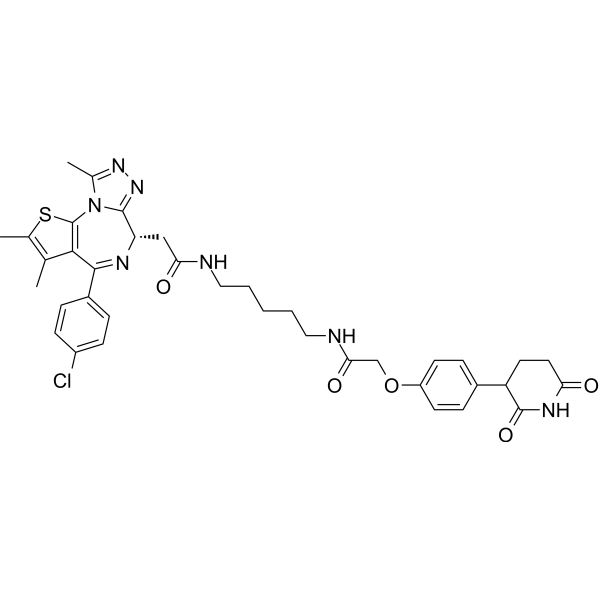
- Formula: C37H40ClN7O5S
- Molecular Weight: 730.28
SJ995973 is a BRD4 PROTAC degrader with DC50 values of 0.87 nM (12 h) and 0.16 nM (24 h), respectively. SJ995973 induces the formation of a ternary complex between purified BRD4 and CRBN-DDB1 proteins, with an IC50 of 17 nM against CRBN. SJ995973 inhibits the viability of human acute myeloid leukemia cells. SJ995973 can be used in studies related to acute myeloid leukemia and medulloblastoma.

- Molecular Weight: 146.18 kDa
Anti-ITGB1 Antibody (AIIB2) is a monoclonal antibody targeting integrin-β1 (integrin-β1). Anti-ITGB1 Antibody blocks the binding of the ITGB1 subunit to type I collagen ligands, and abrogates the adhesion of cancer cells to type I collagen-coated surfaces. Anti-ITGB1 Antibody inhibits the proliferation and induces apoptosis of human osteosarcoma cells by activating caspase-3 and regulating apoptosis-related proteins. Anti-ITGB1 Antibody is applicable to research related to osteosarcoma and medulloblastoma.

- Formula: C28H32N8O4
- Molecular Weight: 544.60
CJM061 is a WEE1 kinase inhibitor with a target IC50 of 2.8 nM. CJM061 acts as a sensitizer and exhibits synergistic effects with Cisplatin (HY-17394) in medulloblastoma cells. CJM061 can be used for the research of medulloblastoma.

- Formula: C15H24Cl4N2O2
- Molecular Weight: 406.18
QBS10072S dihydrochloride is a LAT1-selective substrate with blood-brain barrier permeability that inhibits tumor growth. QBS10072S dihydrochloride enters LAT1-expressing tumor cells via LAT1-mediated active transport, induces interstrand DNA cross-linking and cell apoptosis, and reduces leptomeningeal dissemination. QBS10072S dihydrochloride can be used in studies related to glioblastoma multiforme, diffuse intrinsic pontine glioma, triple-negative breast cancer brain metastases, and aggressive T-cell lymphoma.

- Formula: C40H45ClN8O3S
- Molecular Weight: 753.36
SJ44236 is a BET PROTAC degrader with activity against BRD2, BRD3 and BRD4 (DC50 = 127 pM). SJ44236 induces ubiquitination and proteasomal degradation by forming a ternary complex with BET proteins and CRBN-DDB1. SJ44236 downregulates c-Myc, upregulates p53 and reduces cancer cell viability. SJ44236 can be used for the research of leukemia and medulloblastoma.



