



FAP Ligand
- 1
-
Unlabeled FXX489
 0 ImagesSynonyms: NNS309
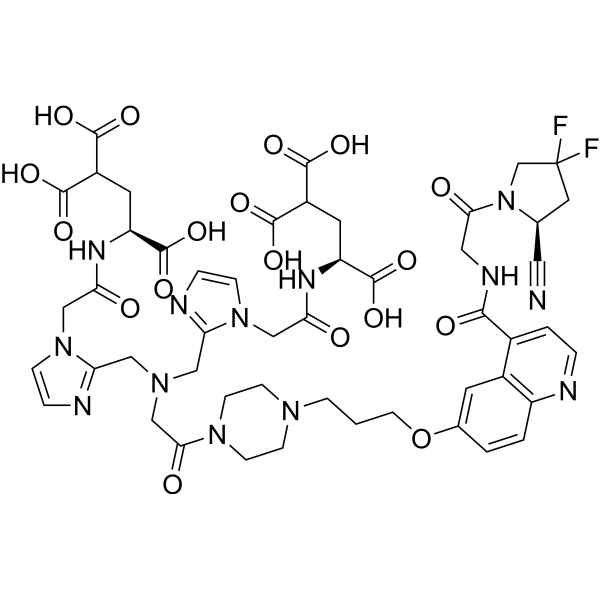
Unlabeled FXX489 (NNS309) is a ligand targeting fibroblast activation protein (FAP); its peptide component is the FAP-targeting peptide for FXX489 (HY-P10945). Unlabeled FXX489 can be labeled with 68Ga and 177Lu and shows anticancer effects. Unlabeled FXX489 can be used for the study of pancreatic ductal adenocarcinoma (PDAC), non-small cell lung cancer (NSCLC), breast cancer (BC), and colorectal cancer (CRC).
-
OncoFAP-GlyPro-MMAE
 0 ImagesSynonyms: OncoFAP glidotin
-
DOTA-ALB-02
 0 ImagesCat. No.: HY-175613Purity: 99.71%
DOTA-ALB-02 is an albumin-bound FAP inhibitor (FAPI) ligand. DOTA-ALB-02 labeled with 177Lu has a high FAP-binding affinity and enhanced tumor uptake and retention with a significant tumor/nontarget ratio. DOTA-ALB-02 can be used for PET/CT and SPECT/CT imaging of cancers, especially late-stage cancers.
-
DOTAGA.Glu.(FAPi)2
 0 ImagesCat. No.: HY-159768ACAS No.: 2882922-68-9
DOTAGA.Glu.(FAPi) 2 is a FAPI homodimer in which a central glutamic acid (Glu) linker connects FAPI and a chelator. Radiolabeled with gallium-68, lutetium-177 or terbium-161, DOTAGA.Glu.(FAPi) 2 is applicable to FAP-positive cancer PET imaging studies. DOTAGA.Glu.(FAPi) 2 is suitable for research related to prostate adenocarcinoma and recurrent glioblastoma multiforme.

-
FAPI-JNU
 0 ImagesCat. No.: HY-174421
FAPI-JNU is a molecule targeting fibroblast activation protein (FAP). FAPI-JNU specifically binds to FAP highly expressed in the tumor microenvironment, and uses radionuclides [68Ga]Ga or [177Lu]Lu to achieve tumor imaging diagnosis. [177Lu]Lu−FAPI−JNU can effectively target and inhibit tumor growth in tumor-bearing mice. FAPI-JNU is promising for research of FAP-positive tumors (such as various solid tumors).

-
NOTA-SP2A-FAPT
 0 ImagesCat. No.: HY-P11599
NOTA-SP2A-FAPT is a fibroblast activation protein (FAP) ligand. NOTA-SP2A-FAPT can be adiolabeled and exhibits rapid renal excretion with fast kidney tissue clearance, accumulates rapidly in and retains high levels in FAP-positive tumor xenografts to enable clear tumor visualization. NOTA-SP2A-FAPT can be used as a tracer of cancer.
-
FAP6-19
 0 ImagesCat. No.: HY-159771CAS No.: 3095069-75-0
FAP6-19 is a fibroblast activation protein (FAP) targeting radioligand with a Kd of 18.2 nM. FAP6-19 selectively delivers therapeutic radioactive nuclides (such as 177Lu) to the tumor site by targeting the overexpressed FAP protein in the tumor microenvironment, achieving precise killing of cancer cells while minimizing radiation damage to healthy tissues. FAP6-19 exhibits extremely high total cellular uptake and good intracellular retention ability in HT1080 cells. After being labeled with 111In, FAP6-19 produced extremely high tumor/kidney and tumor/liver dose ratios in the mouse model with 4T1 tumors. FAP6-19 can be used in the research of solid tumors expressing FAP.

- 1



