



Fluorescent Dye
Fluorescence is a phenomenon of photoluminescence in luminescence. When an atom is irradiated by light, some electrons around the nucleus jump from their original orbitals to higher energy orbitals under the influence of light energy, i.e., from the ground state to the first or second excited single-line state, etc. Due to the instability of the first or second excited singlet state, the electron returns from the excited singlet state to the ground state accompanied by released energy, resulting in fluorescence.
Fluorescent dyes can be covalently bound or physically adsorbed in the structure of the substance. The fluorescence properties allow for the characterization, localization and quantitative analysis of the labeled object. Fluorescent dyes have shown great potential for the detection of proteins, nucleic acids, cells, and immunoassays, attributed to the advantages in non-radioactive contamination, simple experimental operation and easy observation.
Fluorescent dyes have penetrated many fields such as pharmacology, physiology, environmental science, and information science, as well as functional studies of proteins and drug screening.
All Product Categories
-
Fluorescent Dye Related Products (4894)
Related Products (4894)

-
Antibodies (4)

-
Sambucus Nigra Lectin-AF594
 0 ImagesCat. No.: HY-NP080ESynonyms: SNA-AF594Sambucus Nigra Lectin-AF594 (SNA-AF594) is a phytohemagglutinin labeled with AF594, which can be used as a probe to specifically bind to biomolecules (such as polysaccharides and peptides). Sambucus Nigra Lectin-AF594 precisely locates the distribution of glycan chains on the cell surface through stable fluorescence signals, and can be used for glycobiology research (Ex/Em = 590/617 nm).
-
Sulfo-cy3 picolyl azide
 0 ImagesCat. No.: HY-W756144Sulfo-cy3 picolyl azide is a fluorescent dye used for detecting interactions between labeled molecules and proteins based on click chemistry. Sulfo-cy3 picolyl azide undergoes copper (I)-catalyzed azide-alkyne cycloaddition (CuAAC) to covalently bind to alkyne-labeled targets, enabling fluorescent detection via scanning. The excitation/emission wavelengths of Sulfo-cy3 picolyl azide are Ex/Em = 550/560 nm. Sulfo-cy3 picolyl azide can be used for in-gel detection of protein-small molecule interactions, as well as labeling ribosome-associated cellular protein targets.
-
FAM labled Zilebesiran sodium
 0 ImagesCat. No.: HY-145649CFAM labled Zilebesiran sodiumis a FAM labled Zilebesiran sodium.
-
Nitro Blue Diformazan
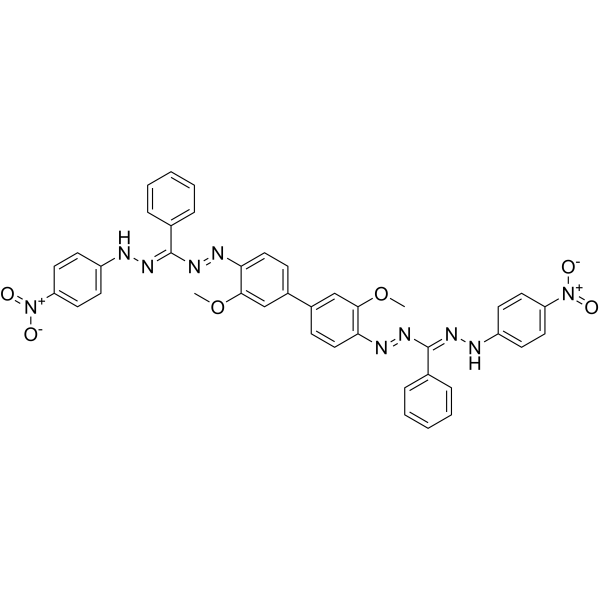 0 ImagesCat. No.: HY-D1454CAS No.: 16325-01-2Nitro Blue Diformazan is a multifunctional dye. Dyes are important tools in biological experiments. They can help researchers observe and analyze cell structures, track biomolecules, evaluate cell functions, distinguish cell types, detect biomolecules, study tissue pathology and monitor microorganisms. Their applications range from basic scientific research to clinical A wide range of diagnostics. Dyes are also widely used in traditional fields such as textile dyeing, as well as in emerging fields such as functional textile processing, food pigments and dye-sensitized solar cells.
-
FAM labled GNKG168 sodium
 0 ImagesCat. No.: HY-177635CFAM labled GNKG168 sodiumis a FAM labled GNKG168 sodium.
-
5-ROX-SE
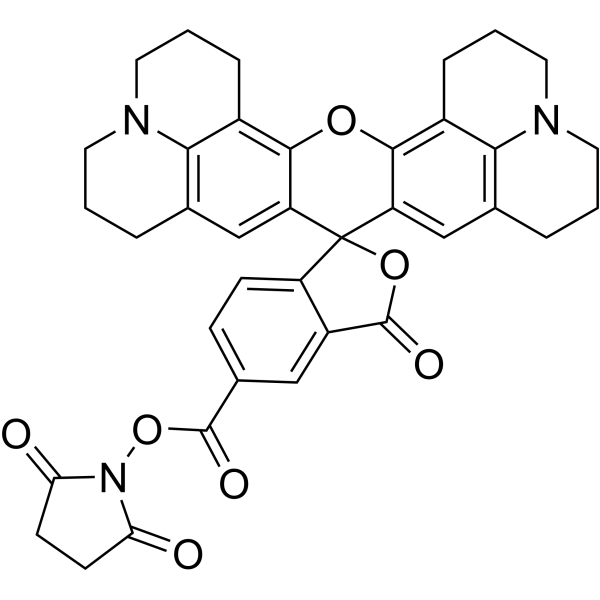 0 ImagesCat. No.: HY-D1774CAS No.: 344402-35-35-ROX-SE is the amine-reactive form of 5-carboxy-X-rhodamine single isomer.
-
RB-PEG1000-OH
 0 ImagesCat. No.: HY-D2882BSynonyms: Rhodamine B-PEG1000-OHRB-PEG1000-OH (Rhodamine B-PEG1000-OH) is a fluorescent dye composed of Rhodamine B (HY-Y0016), PEG and a Hydroxyl group. RB-PEG1000-OH can be used for fluorescent labeling and imaging (Ex/Em=546/610 nm).
-
Dansyl-morpholine
 0 ImagesCat. No.: HY-134096CAS No.: 78323-98-5Synonyms: DNS-MDansyl-morpholine (DNS-M) is a Fluorescent probe for lipid droplet imaging, cancer cell discrimination, and real-time tracking of lipid droplet dynamics. As a solvatochromic probe with a donor-π-acceptor structure, it relies on hydrophobic interaction for its mechanism of action: its good lipophilicity, confirmed by an oil-water partition coefficient LogP = 2.35, allows it to rapidly penetrate cell membranes, and it specifically localizes to the hydrophobic core of lipid droplets; its fluorescence is strongly enhanced in the nonpolar environment of lipid droplets, while it emits very weak fluorescence in polar environments like PBS buffer, and it exhibits a bathochromic shift in emission wavelength with increasing solvent polarity. It has negligible cytotoxicity, with cell viability remaining over 95% after 24-hour incubation with 100 μM of the probe, and it possesses excellent photostability, retaining over 97% of initial fluorescence intensity after 60 continuous laser scans. For cell imaging applications, its excitation/emission wavelengths for lipid droplet labeling are Ex/Em = 405/480−540 nm, and in a simulative lipid environment O/W emulsion, it has an excitation wavelength of ~346 nm and emission wavelength of ~500 nm, giving a Stokes shift of 154 nm[1].
-
Vari Fluor 640 SE
 0 ImagesCat. No.: HY-D1790Synonyms: VF 640 SEVari Fluor 640 SE (VF 640 SE) is a dye marker of the Vari Fluor SE series (Ex/Em=648 nm/664 nm). The Vari Fluor SE series of dyes are a class of fluorescent dyes containing NHS ester groups used to label free amines (-NHX) on antibodies, proteins, peptides, amine-modified oligonucleotides and other biomolecules.
-
Vari Fluor 565 SE
 0 ImagesCat. No.: HY-D1803Synonyms: VF 565 SEVari Fluor 565 SE (VF 565 SE) is a dye marker of the Vari Fluor SE series (Ex/Em=563 nm/594 nm). The Vari Fluor SE series of dyes are a class of fluorescent dyes containing NHS ester groups used to label free amines (-NHX) on antibodies, proteins, peptides, amine-modified oligonucleotides and other biomolecules.
-
Rhodamine-PEG750
 0 ImagesCat. No.: HY-D2892BRhodamine-PEG750 a fluorescent PEG derivative composed of Rhodamine B (HY-Y0016) and PEG. Rhodamine-PEG750 can be used for fluorescent labeling and imaging (Ex/Em=546/610 nm).
-
Cy3 labled Apatorsen sodium
 0 ImagesCat. No.: HY-145722HCy3 labled Apatorsen sodium is a Cy3 labled Apatorsen sodium.
-
TBZ-1
 0 ImagesCat. No.: HY-P11595CAS No.: 2357123-44-3TBZ-1 is a fluorescent probe that monitors the activity of immunoproteasome (Proteasome) (iCP) in cells. TBZ-1 undergoes fluorescence activation after being selectively cleaved by β5i, which is used for intracellular activity monitoring. TBZ-1 is applicable to cancer-related research.
-
Cy5-PEG2000-DSPE
 0 ImagesCat. No.: HY-D2542Cy5-PEG2000-DSPE is a PEG phospholipid with Cy5 (HY-D0821) dye used in protein/nucelic acid labeling and fluorescence microscopy. Cy5-PEG2000-DSPE can self-assemble in aqueous solution to form micelles/lipid bilayer and used to prepare liposomes or nanoparticles for nutrients delivery such as mRNA or DNA vaccine.

-
Cy3 labled Obudanersen sodium
 0 ImagesCat. No.: HY-177651DCy3 labled Obudanersen sodium is a Cy3 labled Obudanersen sodium.
-
6-JOE, SE
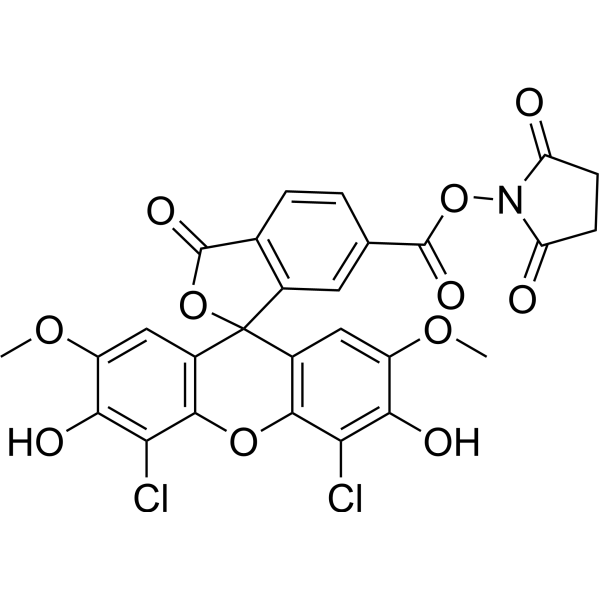 0 ImagesCat. No.: HY-D1089CAS No.: 113394-23-36-JOE, SE is an amine-reactive fluorescent probe and is suitable for postsynthetic labeling of amino-modified oligonucleotides.
-
Sulfo-Cy5.5-ALN
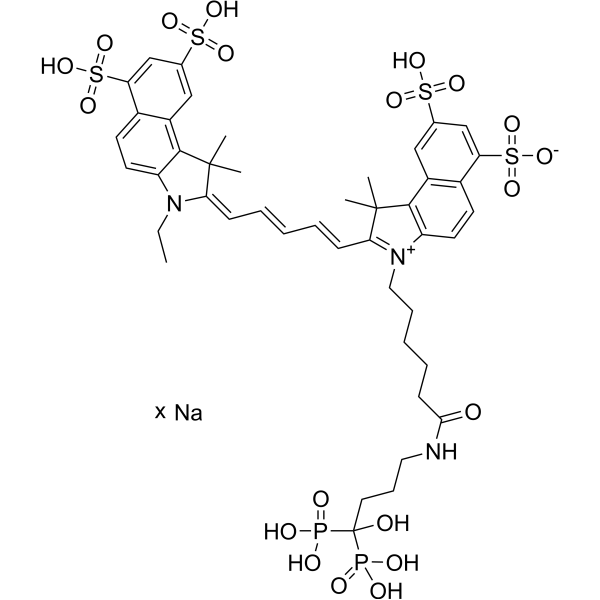 0 ImagesCat. No.: HY-D2132Sulfo-Cy5.5-ALN is a fluorescent labeled alendronate, which targets bone. Sulfo-Cy5.5-ALN binds to hydroxyapatite and differentiated osteoblasts in vitro. Sulfo-Cy5.5-ALN selectively binds to the mineralized areas of the tumor. Sulfo-Cy5.5-ALN can be used to detect bone overgrowth in prostate bone metastasis.
-
Acid Violet 7
 0 ImagesCat. No.: HY-W750458CAS No.: 4321-69-1Acid Violet 7 is an azo dye that can be used to determine the degradation of dyes by various microorganisms.




