



Fluorescent Dye
Fluorescence is a phenomenon of photoluminescence in luminescence. When an atom is irradiated by light, some electrons around the nucleus jump from their original orbitals to higher energy orbitals under the influence of light energy, i.e., from the ground state to the first or second excited single-line state, etc. Due to the instability of the first or second excited singlet state, the electron returns from the excited singlet state to the ground state accompanied by released energy, resulting in fluorescence.
Fluorescent dyes can be covalently bound or physically adsorbed in the structure of the substance. The fluorescence properties allow for the characterization, localization and quantitative analysis of the labeled object. Fluorescent dyes have shown great potential for the detection of proteins, nucleic acids, cells, and immunoassays, attributed to the advantages in non-radioactive contamination, simple experimental operation and easy observation.
Fluorescent dyes have penetrated many fields such as pharmacology, physiology, environmental science, and information science, as well as functional studies of proteins and drug screening.
All Product Categories
-
Fluorescent Dye Related Products (4894)
Related Products (4894)

-
Antibodies (4)
-
AM4-64
 0 ImagesCat. No.: HY-D3383AM4-64 is a fixable cationic styryl fluorescent dye for nerve terminals, which can be used for vesicle cycle evaluation, endocytic pathway tracing and endocytosis detection. AM4-64 inserts into the plasma membrane, is internalized via activity- or energy-dependent endocytosis, and accumulates in vesicles, endosomal compartments, vacuolar membranes, mitochondria and endolysosomal structures. The fluorescence of AM4-64 is enhanced in the membrane-bound state. AM4-64 is applicable to relevant studies on neurons, plant and fungal cells and tissues (Ex/Em = 510/750 nm).
-
Cy3 labled ALN-12115 sodium
 0 ImagesCat. No.: HY-177613DCy3 labled ALN-12115 sodium is a Cy3 labled ALN-12115 sodium.
-
Golgi-NO
 0 ImagesCat. No.: HY-D2967Golgi-NO is a Golgi-targeted fluorescent probe for nitric oxide (NO) (Ex/Em: 560 nm/589 nm). Golgi-NO exhibits excellent selectivity for various potential interfering substances. Golgi-NO can be used to study the function of NO within the Golgi apparatus in disease models such as Alzheimer's disease (AD).
-
Erythrina Cristagalli Lectin (Biotinylated)
 0 ImagesCat. No.: HY-NP0177Synonyms: ECL (Biotinylated)Erythrina Cristagalli Lectin (ECL) Biotinylated is a plant lectin that can be used as a probe to specifically bind biomolecules (such as polysaccharides, peptides, etc.).Erythrina Cristagalli Lectin (ECL) Biotinylated is a biological material or organic compound that can be used in life science research.
-
Disperse violet 93
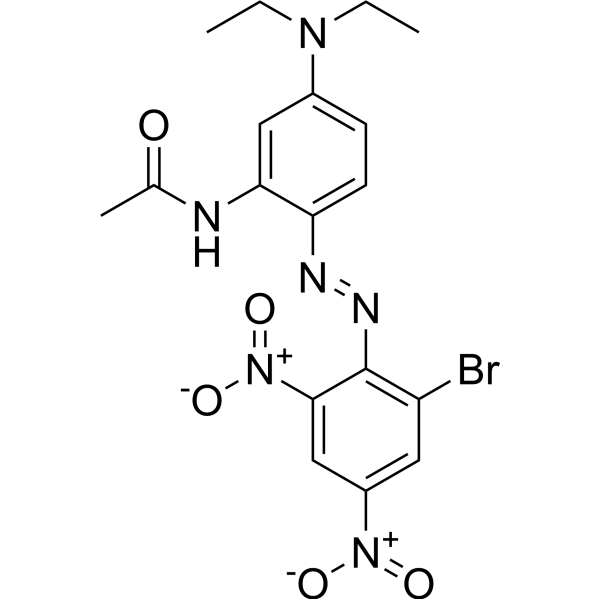 0 ImagesCat. No.: HY-D0575CAS No.: 52697-38-8Disperse violet 93 is a violet dye commonly used for fiber dyeing.
-
FITC-HA (MW 4000000)
 0 ImagesCat. No.: HY-D2836KSynonyms: FITC-Hyaluronate (MW 4000000)FITC-HA (MW 4000000) is hyaluronic acid (HA) (HY-B0633A) labeled with FITC (HY-66019). FITC-HA retains the ability of HA to bind to receptors (such as CD44) and form extracellular matrices, while it can be detected by fluorescence microscopy or flow cytometry for tracing the localization, binding, internalization and metabolic pathways of HA in cells, tissues or living organisms (Ex/Em ≈ 490/520 nM).
-
Cy3 labled SPC5001 sodium
 0 ImagesCat. No.: HY-148687ECy3 labled SPC5001 sodium is a Cy3 labled SPC5001 sodium.

-
18:1-C11 BODIPY 505/515 DG
 0 ImagesCat. No.: HY-N15889CAS No.: 2260795-65-918:1-C11 BODIPY 505/515 DG is a fluorescently labeled glycerolipid (Ex/Em = 495/503 nm).
-
pyCTZ hydrochloride
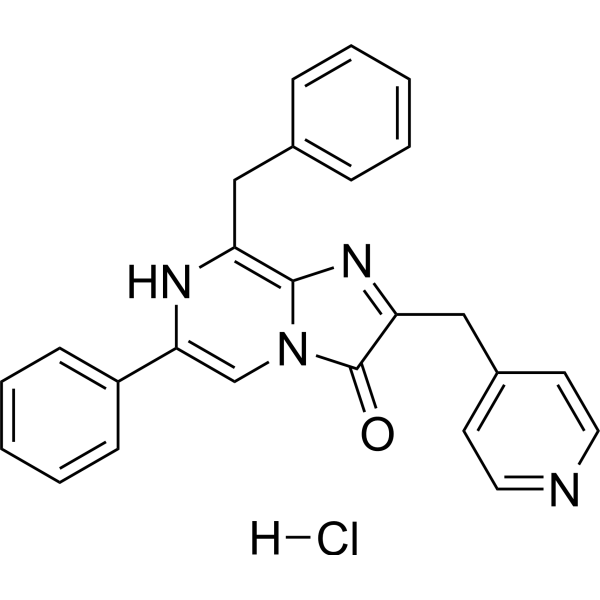 0 ImagesCat. No.: HY-135367BSynonyms: Pyridyl CTZ hydrochloridepyCTZ (Pyridyl CTZ) hydrochloride, a pyridyl Coelenterazine (CTZ) analog, and is an ATP-independent pyridyl substrate of LumiLuc luciferase. pyCTZ hydrochloride generates strong blue bioluminescence in the presence of luciferases. pyCTZ hydrochloride can be used for aequorin-based calcium sensing.
-
IRDye700Dx (Maleimide)
 0 ImagesCat. No.: HY-D2309IRDye700Dx Maleimide is a Photosensitizer. When conjugated with HER2 Affibody and activated by near-infrared light, IRDye700Dx Maleimide induces death in HER2-positive breast cancer cells without causing damage to HER2-negative breast cancer cells.
-
Rhodamine B-Chitosan (MW 3000)
 0 ImagesCat. No.: HY-D3048Rhodamine B-Chitosan (MW 3000) is a Rhodamine B (HY-Y0016)-labeled chitosan with a molecular weight of 3000. Rhodamine B-Chitosan (MW 3000) combines the polysaccharide properties of chitosan with the fluorescence properties of Rhodamine B, playing an important role in fields such as fluorescent labeling, cell imaging, and drug delivery research (Ex/Em = 546/610 nm).
-
Mito-PN
 0 ImagesCat. No.: HY-D1150CAS No.: 2674101-37-0Mito-PN is a multifunctional dye. Dyes are important tools in biological experiments. They can help researchers observe and analyze cell structures, track biomolecules, evaluate cell functions, distinguish cell types, detect biomolecules, study tissue pathology and monitor microorganisms. Their applications range from basic scientific research to clinical A wide range of diagnostics. Dyes are also widely used in traditional fields such as textile dyeing, as well as in emerging fields such as functional textile processing, food pigments and dye-sensitized solar cells.
-
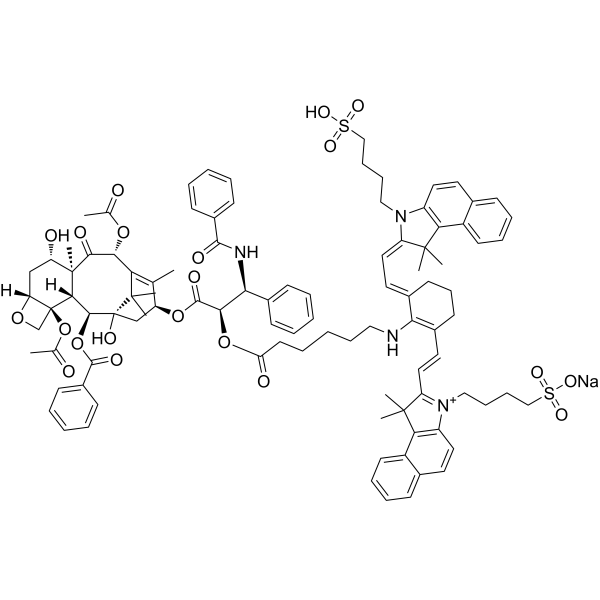
Datura Stramonium Lectin-AF405
 0 ImagesCat. No.: HY-NP065BSynonyms: DSL-AF405Datura Stramonium Lectin-AF405 (DSL-AF405) is a datura lectin (DSL) labeled with the AF405 fluorescent dye. Datura Stramonium Lectin is a dimeric glycoprotein that specifically recognizes and binds to glycan structures containing N-acetylglucosamine (GlcNAc) oligomers. Datura Stramonium Lectin-AF405 can be used for glycosyl studies on cell surfaces (Ex/Em = 405/435 nm).

-
ICAAc
 0 ImagesCat. No.: HY-172754ICAAc is a solvatochromic fluorophore with reduced basicity. ICAAc demonstrates significant solvatochromic behavior across solvents of varying polarity, with a large dipole moment difference and low quantum yield in water, making it a tunable solvatochromic fluorophore. ICAAc enables pH sensing via UV-vis/fluorescence detection and in microenvironments including sodium lauryl sulfate micelle Stern layers. ICAAc acts as a supravital cell stain for epifluorescence imaging of live cancer cells.
-
Disperse red 50
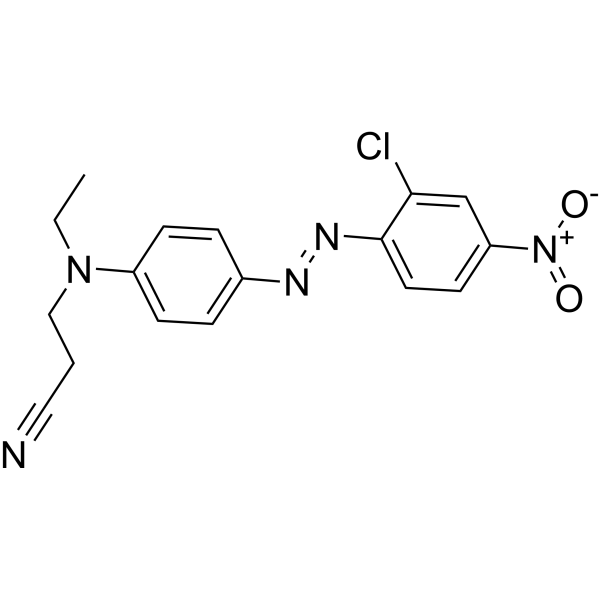 0 ImagesCat. No.: HY-D1037CAS No.: 40880-51-1Disperse red 50 is a red dye derived from anthraquinone. It is used in plastics, textiles and cosmetics.
-
RB-PEG5000-OH
 0 ImagesCat. No.: HY-D2882ESynonyms: Rhodamine B-PEG5000-OHRB-PEG5000-OH (Rhodamine B-PEG5000-OH) is a fluorescent dye composed of Rhodamine B (HY-Y0016), PEG and a Hydroxyl group. RB-PEG5000-OH can be used for fluorescent labeling and imaging (Ex/Em=546/610 nm).
-
Cy3 labled Cofirasersen sodium
 0 ImagesCat. No.: HY-139786ECy3 labled Cofirasersen sodium is a Cy3 labled Cofirasersen sodium.




