



Fluorescent Dye
Fluorescence is a phenomenon of photoluminescence in luminescence. When an atom is irradiated by light, some electrons around the nucleus jump from their original orbitals to higher energy orbitals under the influence of light energy, i.e., from the ground state to the first or second excited single-line state, etc. Due to the instability of the first or second excited singlet state, the electron returns from the excited singlet state to the ground state accompanied by released energy, resulting in fluorescence.
Fluorescent dyes can be covalently bound or physically adsorbed in the structure of the substance. The fluorescence properties allow for the characterization, localization and quantitative analysis of the labeled object. Fluorescent dyes have shown great potential for the detection of proteins, nucleic acids, cells, and immunoassays, attributed to the advantages in non-radioactive contamination, simple experimental operation and easy observation.
Fluorescent dyes have penetrated many fields such as pharmacology, physiology, environmental science, and information science, as well as functional studies of proteins and drug screening.
All Product Categories
-
Fluorescent Dye Related Products (4914)
Related Products (4914)

-
Antibodies (4)
-
Disperse red 50
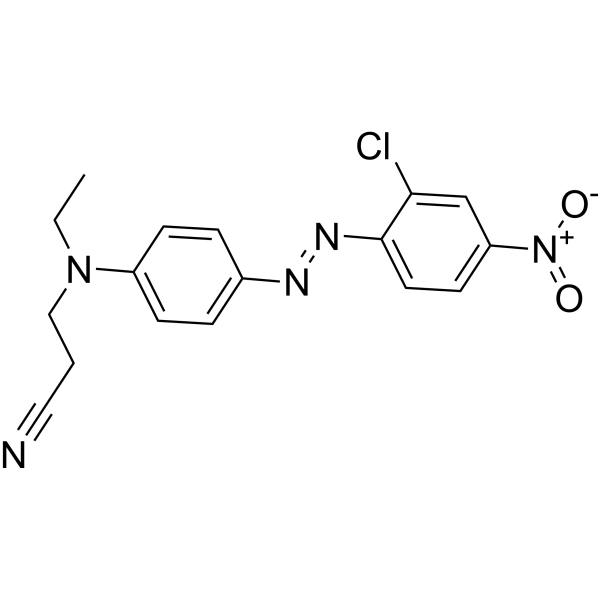 0 ImagesCat. No.: HY-D1037CAS No.: 40880-51-1Disperse red 50 is a red dye derived from anthraquinone. It is used in plastics, textiles and cosmetics.
-
RB-PEG5000-OH
 0 ImagesCat. No.: HY-D2882ESynonyms: Rhodamine B-PEG5000-OHRB-PEG5000-OH (Rhodamine B-PEG5000-OH) is a fluorescent dye composed of Rhodamine B (HY-Y0016), PEG and a Hydroxyl group. RB-PEG5000-OH can be used for fluorescent labeling and imaging (Ex/Em=546/610 nm).
-
Cy3 labled Cofirasersen sodium
 0 ImagesCat. No.: HY-139786ECy3 labled Cofirasersen sodium is a Cy3 labled Cofirasersen sodium.

-
N-hydroxy Rhodamine B amide
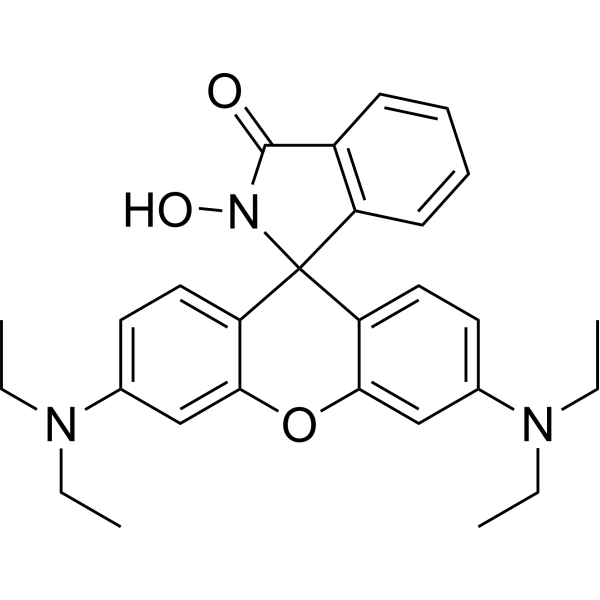 0 ImagesCat. No.: HY-D1769CAS No.: 1115867-62-3N-hydroxy Rhodamine B amide is a ClO- indicator, which is hydrolyzed to prduce fluorescence in the presence of ClO-. The fluorescence intensity of N-hydroxy Rhodamine B amide is proportional to the product, thus can be used to quantify ClO-.
-
Propyl red
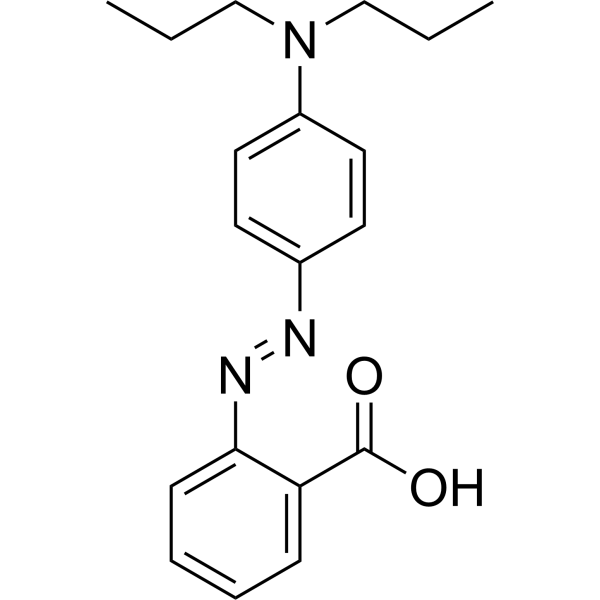 0 ImagesPropyl red is a multifunctional dye. Dyes are important tools in biological experiments. They can help researchers observe and analyze cell structures, track biomolecules, evaluate cell functions, distinguish cell types, detect biomolecules, study tissue pathology and monitor microorganisms. Their applications range from basic scientific research to clinical A wide range of diagnostics. Dyes are also widely used in traditional fields such as textile dyeing, as well as in emerging fields such as functional textile processing, food pigments and dye-sensitized solar cells.
-
PE-VF680 Maleimide
 0 ImagesCat. No.: HY-D2092PE-VF680 Maleimide is a double-dye dye that can undergo thiol reaction. It contains maleimide groups that can react with thiol groups to form covalent bonds. Ex/Em=495-566/701 nm. PE-VF680 Maleimide contains two dyes, PE and VF, with excitation wavelengths (Ex) of 495 nm and 566 nm, respectively. PE-VF594 Maleimide has an emission wavelength (Em) of 701 nm.
-
CDy11
 0 ImagesCat. No.: HY-D3192CAS No.: 2028316-07-4CDy11 is a fluorescent probe and amyloid-binding dye (λex=590 nm; λem=612 nm), with a Ka of 29 μM for Pseudomonas aeruginosa Fap. CDy11 specifically recognizes amyloid fibrils in bacterial biofilms and exhibits significantly enhanced fluorescence upon binding to the target. CDy11 shows no staining effect on amyloid-deficient mutant strains, planktonic cells or protein monomers. CDy11 supports in vivo imaging of Pseudomonas aeruginosa biofilms in mouse implant and corneal infection models. CDy11 is widely used in studies of Staphylococcus aureus biofilm infections, dental caries, and Pseudomonas aeruginosa-associated implant and corneal infections.
-
TRITC-Polysucrose 70
 0 ImagesCat. No.: HY-179073BTRITC-Polysucrose 70 is TRITC-labeled Polysucrose 70 (HY-131960A). Polysucrose 70 is a high molecular weight branched polysaccharide polymer. Polysucrose 70 is a copolymer of sucrose and epichlorohydrin and can be used for cell separation. TRITC-Polysucrose 70 is mainly used for permeability and microcirculation studies (Ex/Em = 544/570 nm).
-
Cy3 labled Suvodirsen sodium
 0 ImagesCat. No.: HY-132592ECy3 labled Suvodirsen sodium is a Cy3 labled Suvodirsen sodium.
-
Biotin-PEG3400-Alk
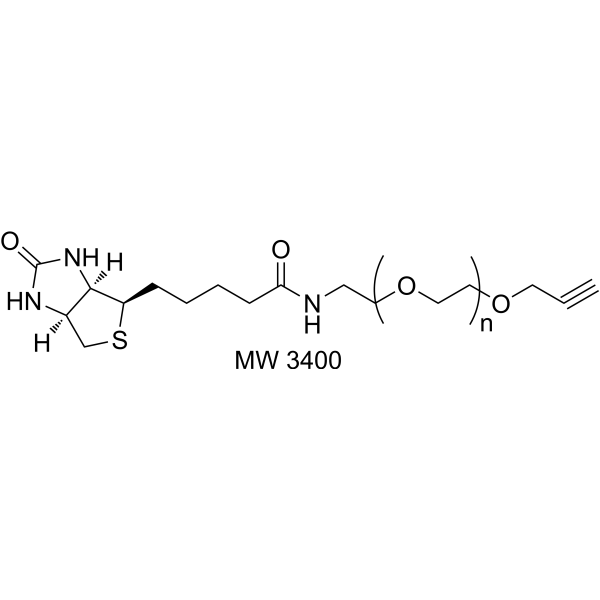 0 ImagesCat. No.: HY-147206CBiotin-PEG3400-Alk is a biotin labeled PEG derivative. Biotin is an enzyme co-factor, can be used for labeling protein; PEG is a hydrophilic and water-soluble polymer with low toxicity; Alk (Alkyne), acyclic (branched or unbranched) aliphatic hydrocarbon, can react with azido, which improve the efficiency of biotin binding targets. Biotin-PEG3400-Alk is a click chemistry reagent, it contains an Alkyne group and can undergo copper-catalyzed azide-alkyne cycloaddition (CuAAc) with molecules containing Azide groups.
-
Datura Stramonium Lectin-AF568
 0 ImagesCat. No.: HY-NP065DSynonyms: DSL-AF568Datura Stramonium Lectin-AF568 (DSL-AF568) is a datura lectin (DSL) labeled with the AF568 fluorescent dye. Datura Stramonium Lectin is a dimeric glycoprotein that specifically recognizes and binds to glycan structures containing N-acetylglucosamine (GlcNAc) oligomers. Datura Stramonium Lectin-AF568 can be used for glycosyl studies on cell surfaces (Ex/Em = 579/603 nm).

-
Ac-VQVD-pNA
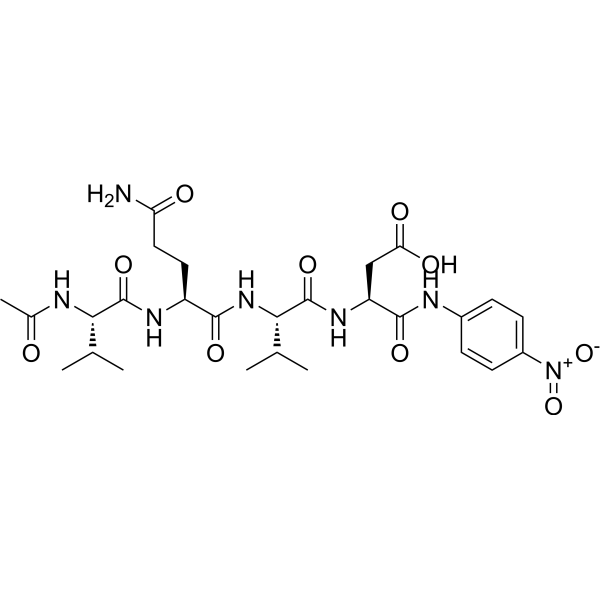 0 ImagesCat. No.: HY-P10083CAS No.: 189684-55-7Ac-VQVD-pNA is a chromogenic substrate of caspase 3.
-
DANSYL-X, SE
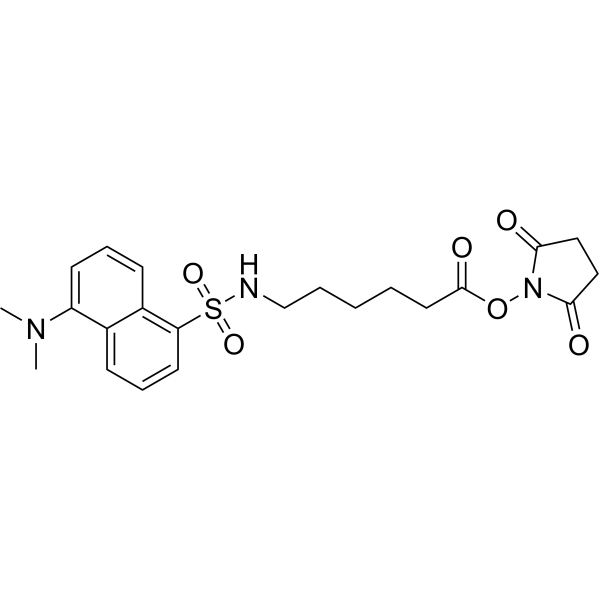 0 ImagesCat. No.: HY-D1645CAS No.: 217176-82-4DANSYL-X, SE is an environmentally sensitive hydrophobic dye (Excitation 333 nM; Emission 518 nM). DANSYL-X, SE can increase fluorescence intensity in hydrophobic environment.
-
AF594 C5 Maleimide
 0 ImagesCat. No.: HY-D3580AF594 C5 Maleimide is a fluorescent dye for site-specific labeling of cysteine-containing proteins. AF594 C5 Maleimide acts as an acceptor fluorophore and covalently labels cysteine residues, including Cys316 of rhodopsin and a surface-exposed cysteine at position 252 of ClyA variants. The excitation/emission wavelength of AF594 C5 Maleimide is Ex/Em = 595/620 nm.
-
Wheat germ agglutinin-AF532
 0 ImagesCat. No.: HY-NP163BSynonyms: WGA-AF532Wheat germ agglutinin-AF532 (WGA-AF532) is a plant lectin that contains the fluorescent dye AF532, which can be used to identify carbohydrate chains. Wheat germ agglutinin-AF532 can be used to assess abnormal glycosylation levels in the body. The specific glycosylation detection sites of Wheat germ agglutinin is bis-GlcNAc, SA.
-
18:0 Sulfo-cyanine 5 PE ammonium
 0 ImagesCat. No.: HY-N16311CAS No.: 3091879-66-918:0 Sulfo-cyanine 5 PE ammonium is a fluorescent lipid that can be used to visualize cell membranes (Ex/Em = 650/670 nm).

-
Sulfo-cyanine3 azide
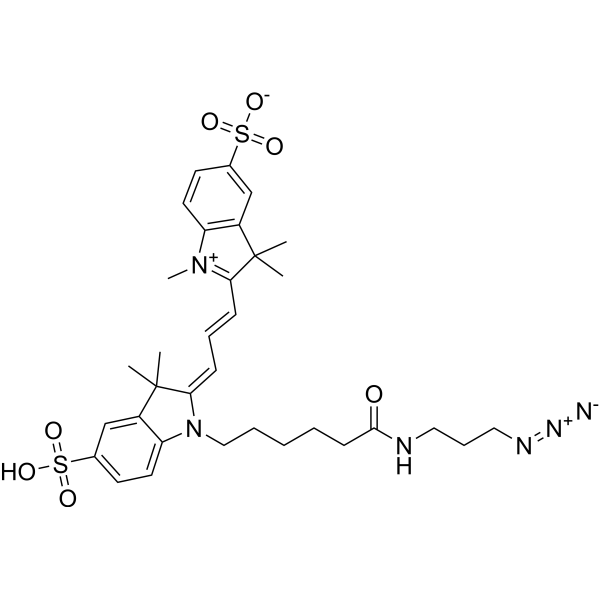 0 ImagesCat. No.: HY-D1274CAS No.: 1658416-54-6Sulfo-cyanine3 azide is an azide cyanine dye and fluorescent probe (Ex/Em=548/563 nm). Sulfo-cyanine3 azide can be involved in synthesis of fused tricyclic heterocycles, produces immunostimulatory agents. It contains an azide group and can undergo copper-catalyzed azide-alkyne cycloaddition (CuAAc) with molecules containing alkyne groups. It can also undergo ring strain-promoted alkyne-azide cycloaddition (SPAAC) with molecules containing DBCO or BCN groups.




