Fluorescent Dye
Fluorescence is a phenomenon of photoluminescence in luminescence. When an atom is irradiated by light, some electrons around the nucleus jump from their original orbitals to higher energy orbitals under the influence of light energy, i.e., from the ground state to the first or second excited single-line state, etc. Due to the instability of the first or second excited singlet state, the electron returns from the excited singlet state to the ground state accompanied by released energy, resulting in fluorescence.
Fluorescent dyes can be covalently bound or physically adsorbed in the structure of the substance. The fluorescence properties allow for the characterization, localization and quantitative analysis of the labeled object. Fluorescent dyes have shown great potential for the detection of proteins, nucleic acids, cells, and immunoassays, attributed to the advantages in non-radioactive contamination, simple experimental operation and easy observation.
Fluorescent dyes have penetrated many fields such as pharmacology, physiology, environmental science, and information science, as well as functional studies of proteins and drug screening.
All Product Categories
-
Fluorescent Dye Related Products (4914)
Related Products (4914)

-
Antibodies (4)
-
AgAuSe-COOH (1000 nm)
 0 ImagesCat. No.: HY-D2194AgAuSe-COOH (1000 nm) is a fluorescent quantum dot that emits fluorescence in the near-infrared II region, with an emission peak reaching 1000 nm. AgAuSe-COOH (1000 nm) has the advantages of narrow band gap, large Stokes shift, and good photostability. AgAuSe-COOH (1000 nm) can bind proteins, antibodies, peptides, PEG, etc., and can be widely used in the field of biological imaging.
-
2-(Pyren-1-ylaminocarbonyl)ethyl methanethiosulfonate
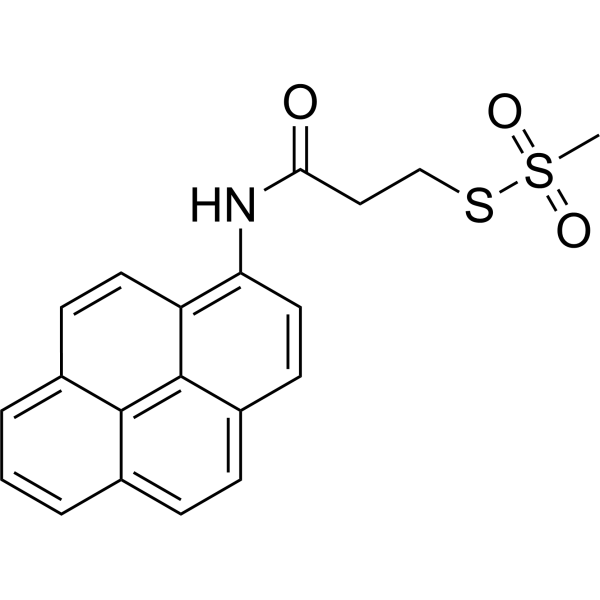 0 ImagesCat. No.: HY-D1508CAS No.: 384342-64-72-(Pyren-1-ylaminocarbonyl)ethyl methanethiosulfonate is a fluorescent.
-
AF 430 carboxylic acid dipotassium
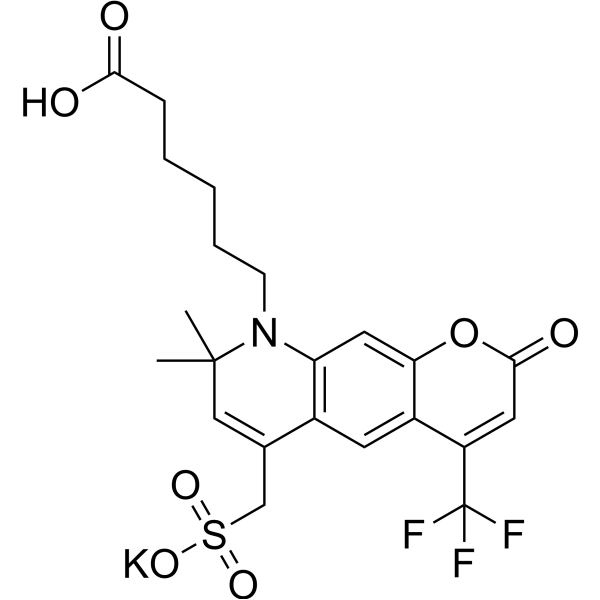 0 ImagesCat. No.: HY-D2154AF 430 carboxylic acid is a derivative of the yellow fluorescent dye AF 430. AF430 has an excitation wavelength of 425 nm and an emission wavelength of 542 nm. AF 430 carboxylic acid can form covalent bonds through a condensation reaction between carboxylic acid groups and molecules containing amino groups. To achieve specific coupling of dye labels and biomolecules.
-
CY5-Alginate
 0 ImagesCat. No.: HY-D3019CY5-Alginate is a CY5 (HY-D0821)-labeled alginate.CY5-Alginate combines the polysaccharide properties of alginate with the fluorescence properties of CY5, playing an important role in fields such as fluorescent labeling, cell imaging, and drug delivery research (Ex/Em = 633/670 nm).
-
Cy3 labled Belcesiran sodium
 0 ImagesCat. No.: HY-177619DCy3 labled Belcesiran sodium is a Cy3 labled Belcesiran sodium.
-
Methyl violet dye
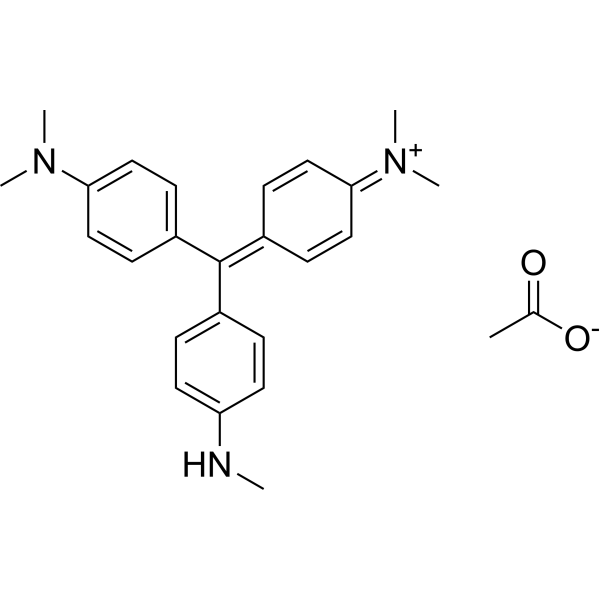 0 ImagesCat. No.: HY-D0951CAS No.: 84434-47-9Methyl violet dye is a multifunctional dye. Dyes are important tools in biological experiments. They can help researchers observe and analyze cell structures, track biomolecules, evaluate cell functions, distinguish cell types, detect biomolecules, study tissue pathology and monitor microorganisms. Their applications range from basic scientific research to clinical A wide range of diagnostics. Dyes are also widely used in traditional fields such as textile dyeing, as well as in emerging fields such as functional textile processing, food pigments and dye-sensitized solar cells.
-
4,4-Difluoro-8-(4'-iodophenyl)-1,7-bis-(1'-napthyl)-4-bora-3alpha,4alpha-diaza-s-indacene
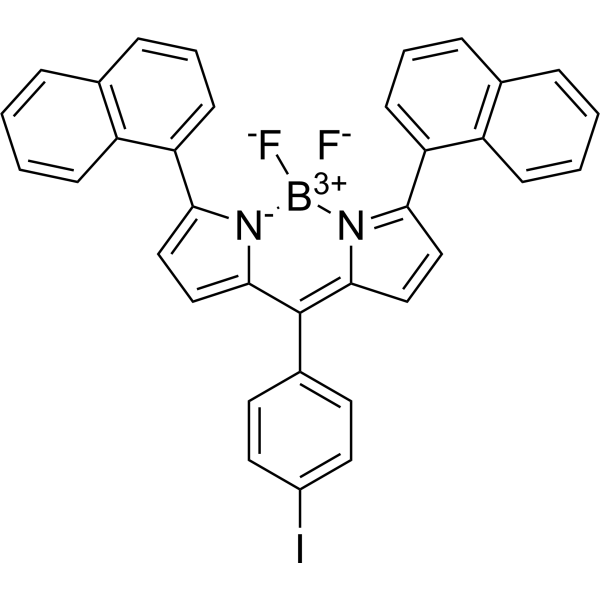 0 ImagesCat. No.: HY-D1486CAS No.: 216255-54-84,4-Difluoro-8-(4'-iodophenyl)-1,7-bis-(1'-napthyl)-4-bora-3alpha,4alpha-diaza-s-indacene is a fluorescent dye for DNA sequencing.
-
Biotin-PEG1000-Alk
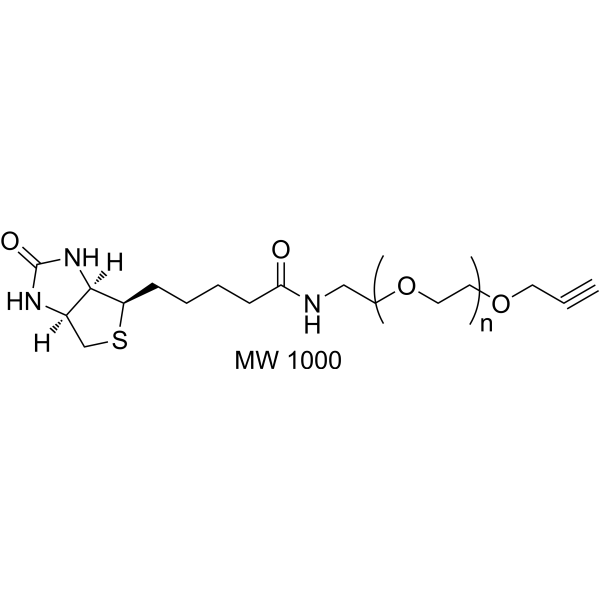 0 ImagesCat. No.: HY-147206ABiotin-PEG1000-Alk is a biotin labeled PEG derivative. Biotin is an enzyme co-factor, can be used for labeling protein; PEG is a hydrophilic and water-soluble polymer with low toxicity; Alk (Alkyne), acyclic (branched or unbranched) aliphatic hydrocarbon, can react with azido, which improve the efficiency of biotin binding targets. Biotin-PEG1000-Alk is a click chemistry reagent, it contains an Alkyne group and can undergo copper-catalyzed azide-alkyne cycloaddition (CuAAc) with molecules containing Azide groups.

-
Dabcyl-GLRTQSFS-EDANS
 0 ImagesCat. No.: HY-P11425CAS No.: 145682-87-7Dabcyl-GLRTQSFS-EDANS is a fluorogenic peptide substrate. Dabcyl-GLRTQSFS-EDANS can be used to measure the enzymatic activities of Hepatitis A Virus 3C proteinase.
-
O-Methyl-O-(N-butylfluorescein)phosphate
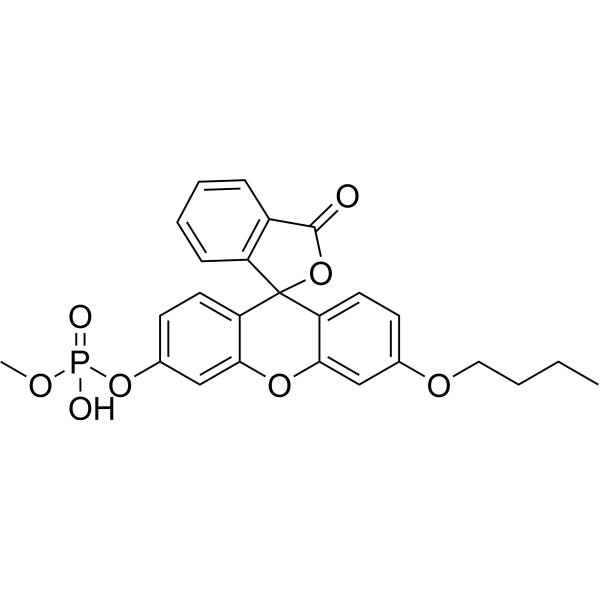 0 ImagesCat. No.: HY-D1513CAS No.: 887406-94-2O-Methyl-O-(N-butylfluorescein)phosphate is a fluorescent dye.
-
Cyanine 5 azide
 0 ImagesCat. No.: HY-W749217ACAS No.: 2204261-66-3Cyanine 3.5 azide is a cyanine dye functionalized with an azide. Cyanine 3.5 azide is a click chemistry reagent, it contains an Azide group and can undergo copper-catalyzed azide-alkyne cycloaddition reaction (CuAAc) with molecules containing Alkyne groups. It can also undergo strain-promoted alkyne-azide cycloaddition (SPAAC) reactions with molecules containing DBCO or BCN groups (Ex/Em = 633/670 nm).


-
ALDH2 probe 5
 0 ImagesCat. No.: HY-D3442CAS No.: 3121565-89-4ALDH2 probe 5 is a ALDH2 isoform-selective fluorescent probe with an emission wavelength centered at 494 nm. ALDH2 probe 5 is a turn-on fluorescent substrate for ALDH2; in its unreacted aldehyde form, twisted intramolecular charge transfer (TICT) occurs, resulting in fluorescence quenching. After ALDH2 probe 5 is catalytically oxidized to carboxylate by ALDH2, TICT is inhibited and fluorescence is significantly enhanced. ALDH2 probe 5 enables highly sensitive quantitative imaging of ALDH2 activity in recombinant enzymes, live cells, blood, tissue homogenates, and the brains of living mice. ALDH2 probe 5 can be used for studies related to neuroinflammation.
-
Aleuria Aurantia Lectin (Fluorescein)
 0 ImagesCat. No.: HY-NP095Synonyms: AAL (Fluorescein)Aleuria Aurantia Lectin (AAL) Fluorescein is a plant lectin that can be used as a probe to specifically bind biomolecules (such as polysaccharides, peptides, etc.).Aleuria Aurantia Lectin (AAL) Fluorescein is a biological material or organic compound that can be used in life science research.
-
Cy5-DSPE chloride ammonium
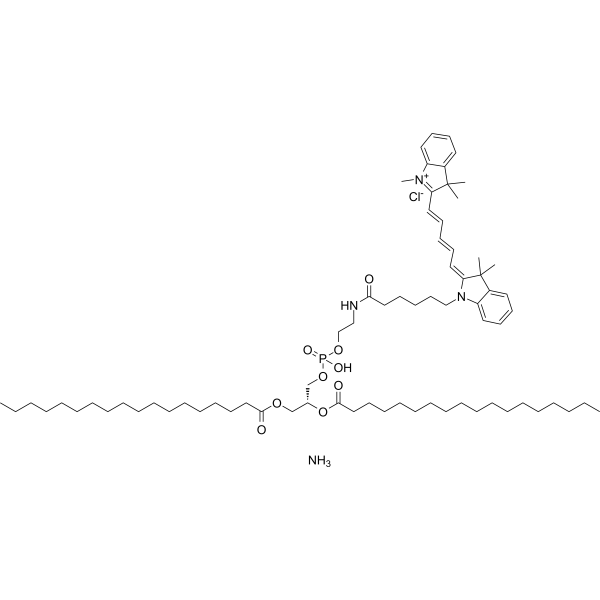 0 ImagesCat. No.: HY-D2100ACAS No.: 2260669-69-8Cy5-DSPE chloride ammonium is a far-infrared fluorescent phospholipid (λex/λem = 600/665 nm). Cy5-DSPE chloride ammonium is used to label liposomes, membranes and lipid nanoparticles, and can be applied to tracking and imaging studies of liposomes.
-
JF626-HTL
 0 ImagesCat. No.: HY-D3444CAS No.: 3029700-81-7JF626-HTL is a fluorescent dye conjugated from Janelia Fluor 635 and HaloTag ligand (HTL). JF626-HTL is used for far-red fluorescent labeling of HaloTag-tagged proteins, enabling live-cell imaging and dynamic tracking (Ex/Em = 626/638 nm).
-
Cy3 labled Manusiran sodium
 0 ImagesCat. No.: HY-147278ECy3 labled Manusiran sodium is a Cy3 labled Manusiran sodium.