



Fluorescent Dye
Fluorescence is a phenomenon of photoluminescence in luminescence. When an atom is irradiated by light, some electrons around the nucleus jump from their original orbitals to higher energy orbitals under the influence of light energy, i.e., from the ground state to the first or second excited single-line state, etc. Due to the instability of the first or second excited singlet state, the electron returns from the excited singlet state to the ground state accompanied by released energy, resulting in fluorescence.
Fluorescent dyes can be covalently bound or physically adsorbed in the structure of the substance. The fluorescence properties allow for the characterization, localization and quantitative analysis of the labeled object. Fluorescent dyes have shown great potential for the detection of proteins, nucleic acids, cells, and immunoassays, attributed to the advantages in non-radioactive contamination, simple experimental operation and easy observation.
Fluorescent dyes have penetrated many fields such as pharmacology, physiology, environmental science, and information science, as well as functional studies of proteins and drug screening.
All Product Categories
-
Fluorescent Dye Related Products (4894)
Related Products (4894)

-
Antibodies (4)
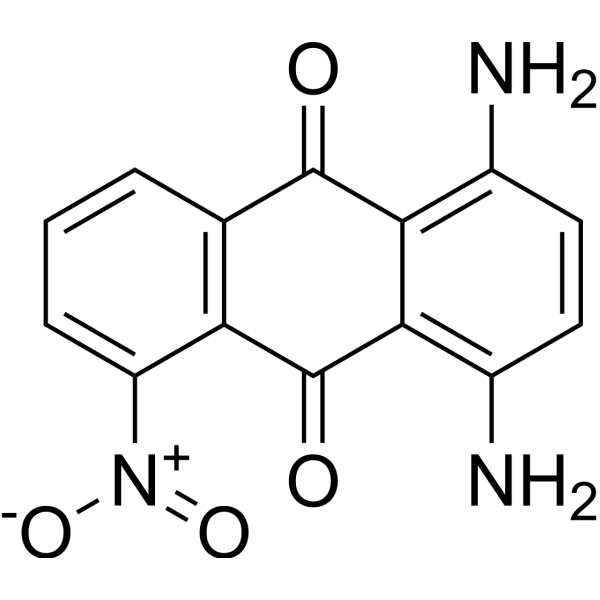
-
610CP TFA
 0 ImagesCat. No.: HY-D1346A610CP TFA is a new type of actin labeling dye. It dissolves in organic solvents. In DMSO the 610CP TFA excitation/emission wavelength is between 609 and 634 nm. 610CP TFA is a fluorescent dye that penetrates living cells. Upon cell entry, 610CP TFA binds to Bromo-des-methyl-Jasplakinolide Therefore, 610CP TFA dye can be used to stain actin fluorescence images with low background and high resolution.
-
Cyclo(Val-Val-Ile-d-Ala-Trp(Bodipy)-Gly)
 0 ImagesCat. No.: HY-P11912Cyclo (Val-Val-Ile-d-Ala-Trp (Bodipy)-Gly) is a cyclic peptide-BODIPY conjugate. Cyclo (Val-Val-Ile-d-Ala-Trp (Bodipy)-Gly) detects prefibrillar Aβ1-42 aggregates in neuronal cells, generating perinuclear punctate fluorescent spots. Cyclo (Val-Val-Ile-d-Ala-Trp (Bodipy)-Gly) is applicable to Alzheimer's disease-related research.
-
Golgi-P
 0 ImagesCat. No.: HY-D2970Golgi-P is a near-infrared Golgi-targeted fluorescent probe specifically used for the detection of Golgi polarity in living cells and living tissues. Golgi-P exhibits a significant polarity-dependent spectral behavior, with its emission wavelength shifting redward with polarity (Ex/Em: 700 nm/780-825 nm). Golgi-P achieves near-infrared fluorescence imaging directly in the brain tissue of depressed mice. Golgi-P combines polarity sensing with Golgi-targeting functionality, providing a new tool for the molecular diagnosis of depression.
-
Datura Stramonium Lectin-AF488
 0 ImagesCat. No.: HY-NP065CSynonyms: DSL-AF488Datura Stramonium Lectin-AF488 (DSL-AF488) is a datura lectin (DSL) labeled with the AF488 fluorescent dye. Datura Stramonium Lectin is a dimeric glycoprotein that specifically recognizes and binds to glycan structures containing N-acetylglucosamine (GlcNAc) oligomers. Datura Stramonium Lectin-AF488 can be used for glycosyl studies on cell surfaces (Ex/Em = 470/520 nm).
-
Phaseolus Vulgaris Leucoagglutinin (Fluorescein)
 0 ImagesCat. No.: HY-NP0140Synonyms: PHA-L (Fluorescein)Phaseolus Vulgaris Leucoagglutinin (PHA-L) Fluorescein is a plant lectin that can be used as a probe to specifically bind biomolecules (such as polysaccharides, peptides, etc.).Phaseolus Vulgaris Leucoagglutinin (PHA-L) Fluorescein is a biological material or organic compound that can be used in life science research.
-
Jun14157
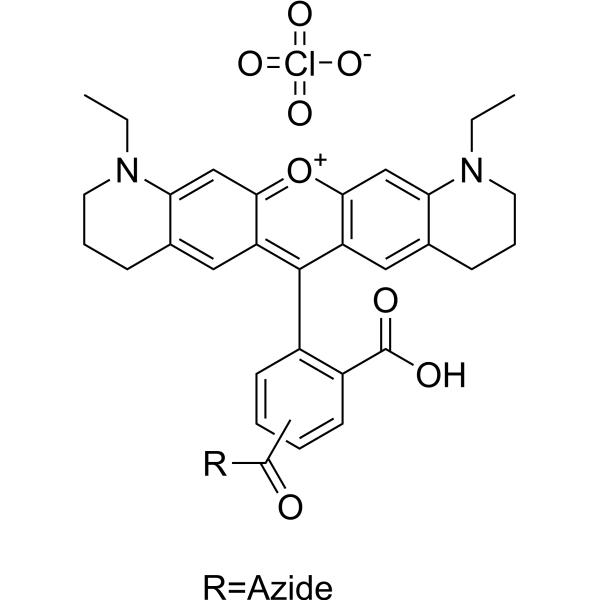
 0 ImagesCat. No.: HY-D2898Jun14157 is a fluorescence polarization probe that can specifically bind to the conserved allosteric site of enterovirus 2C proteins (Ex: 485/20; Em: 528/20). Jun14157 has Kd values of 2.3 μM, 1.4 μM, and 1.1 μM for EV-D68 2C, EV-A71 2C, and CVB3 2C, respectively. Jun14157 can be used in research related to enteroviruses.
-
DPH propionic acid
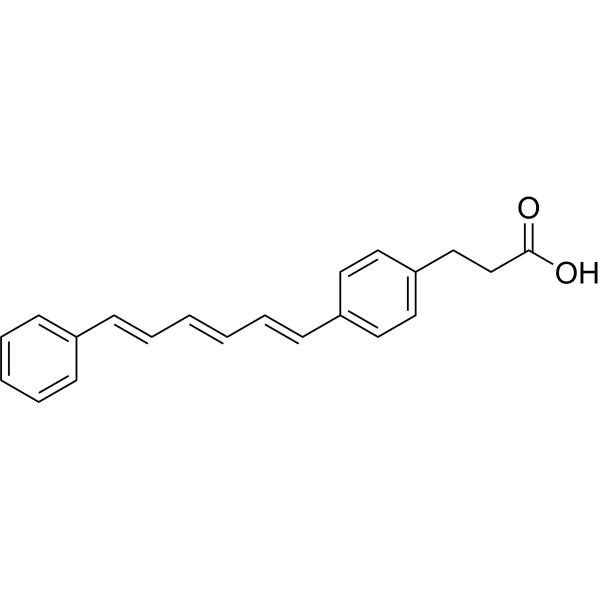 0 ImagesCat. No.: HY-D1743CAS No.: 84294-98-4DPH propionic acid is a fluorescent dye.

-
Sulfo-Cy3-PEG3-biotin potassium
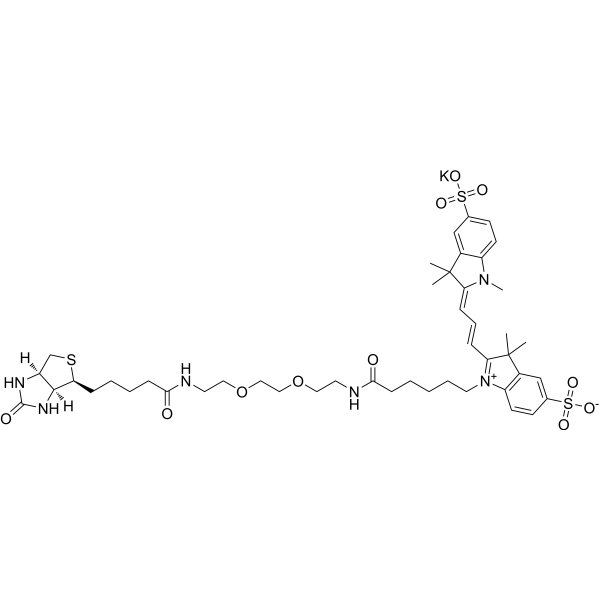 0 ImagesCat. No.: HY-D1870Sulfo-Cy3-PEG3-biotin potassium is a biotin-modified derivative of Cy3 (Cyanine3) (HY-D0822) dye containing a TCO group. The TCO group of Sulfo-Cy3-PEG3-biotin potassium reacts with the tetrazine functional group in highly specific click chemistry to form a covalent bond. Thus, Sulfo-Cy3-PEG3-biotin potassium can be covalently bound to some biomolecules (especially antibodies, proteins, etc.) to track their location and dynamic changes in biological samples. And because it is labeled with biotin, it is often used in affinity chromatography experiments, such as immunoprecipitation.
-
FAM labled LSP-GR3 sodium
 0 ImagesCat. No.: HY-148828DFAM labled LSP-GR3 sodiumis a FAM labled LSP-GR3 sodium.
-
Chlorophenol red
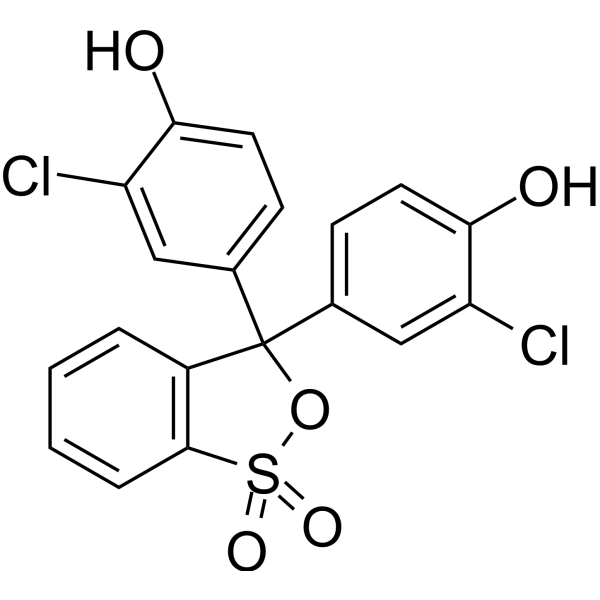 0 ImagesChlorophenol red (Dichlorophenolsulphonephthalein) is a multifunctional dye. Dyes are important tools in biological experiments. They can help researchers observe and analyze cell structures, track biomolecules, evaluate cell functions, distinguish cell types, detect biomolecules, study tissue pathology and monitor microorganisms. Their applications range from basic scientific research to clinical A wide range of diagnostics. Dyes are also widely used in traditional fields such as textile dyeing, as well as in emerging fields such as functional textile processing, food pigments and dye-sensitized solar cells.

-
Ctrl-CF4-S2
 0 ImagesCat. No.: HY-150087CAS No.: 2365532-65-4Ctrl-CF4-S2 is a chemically modified control probe of the copper probe Copper Fluor-4 (CF4, HY-150086), in which two of the four thioether ligands in CF4 (HY-150086) are replaced with methylene groups. CF4 (HY-150086) is a fluorescent probe used for detecting the presence and distribution of copper ions, whereas Ctrl-CF4-S2 does not respond to copper ions. This allows it to eliminate background signals from copper, thereby helping to determine whether the signals from CF4 (HY-150086) accurately reflect the dynamic changes of copper ions in biological systems
-
Umbelliferone-13C6
 0 ImagesCat. No.: HY-W777393CAS No.: 1189992-05-9Synonyms: 7-Hydroxycoumarin-13C6; Hydrangin-13C6; NSC 19790-13C6Umbelliferone-13C6 (7-Hydroxycoumarin-13C6) is the 13C-labeled Umbelliferone (HY-N0573). Umbelliferone (7-Hydroxycoumarin), a natural orally active product of the coumarin family, is a fluorescing compound which can be used as a sunscreen agent. Umbelliferone induces cell cycle arrest, apoptosis and DNA fragmentation in HepG2 cells. Umbelliferone exhibits significant anticancer effects. Umbelliferone attenuates the alteration characteristics of allergic airway inflammation. Umbelliferone displays the neuroprotective effects and cross the blood-brain barrier. Umbelliferone exhibits anti-inflammatory and antioxidant effects in chronic alcohol-fed rats.
-
HS-CyBz
 0 ImagesCat. No.: HY-D3133CAS No.: 2410296-16-9HS-CyBz is a Fluorescent probe for H₂S detection, enabling ratiometric optical/photoacoustic dual-modality in/ex vivo imaging. Its detection mechanism relies on nucleophilic substitution of its benzoic ester group by HS⁻, which releases an enolic meso-hydroxyltricarboheptamethine cyanine that then undergoes keto-enol tautomerization to form Cy-ketone; this tautomerization causes distinct shifts in absorption and emission spectra, producing a ratiometric response that reduces interferences from tissue scattering, autofluorescence, and probe concentration. In its initial state, HS-CyBz has an excitation wavelength of 595 nm, with emission bands centered at 805 nm (main) and 630 nm (minor); upon reaction with H₂S, the 805 nm emission band decreases while the 630 nm band drastically increases, and its absorption spectrum shows a sharp band at 775 nm and a shoulder band at 708 nm, which decrease upon H₂S reaction with a minor increase at 850 nm and an isosbestic point at 825 nm. For in vivo optical imaging, excitation at 560 nm is used with emission channels at 620 nm and 790 nm, while in vivo photoacoustic imaging uses excitation at 775 nm and 825 nm. The detection limit of HS-CyBz for H₂S is 0.5 μM, and it shows high selectivity, with only H₂S inducing a distinct enhancement of the emission ratio F₆₃₀/F₈₀₅ and PA ratio PA₈₂₅/PA₇₇₅, while other biochemical species including cations, anions, reactive oxygen species, biothiols, and carboxylesterase trigger only minor changes and do not interfere with H₂S sensing. Tail intravenous injection of HS-CyBz leads to accumulation in the liver of mice, and it can be used to verify endogenous H₂S upregulation triggered by S-adenosyl-L-methionine via ratiometric optical/photoacoustic imaging.
-
Chromotrope 2R
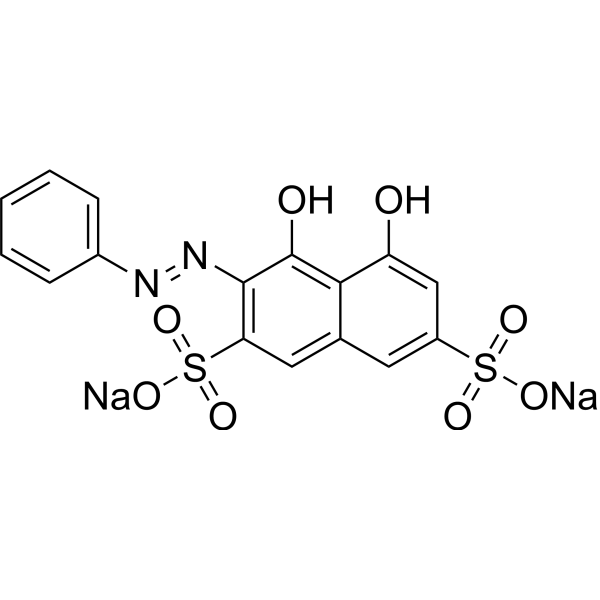 0 ImagesCat. No.: HY-W133997CAS No.: 4197-07-3Chromotrope 2R can be used as a chromogenic analytical probe for the quantification of proteins. Basic proteins stained red and the peak wavelength red shifts from 501.6 nm to 567 nm.

-
Amaranth free acid
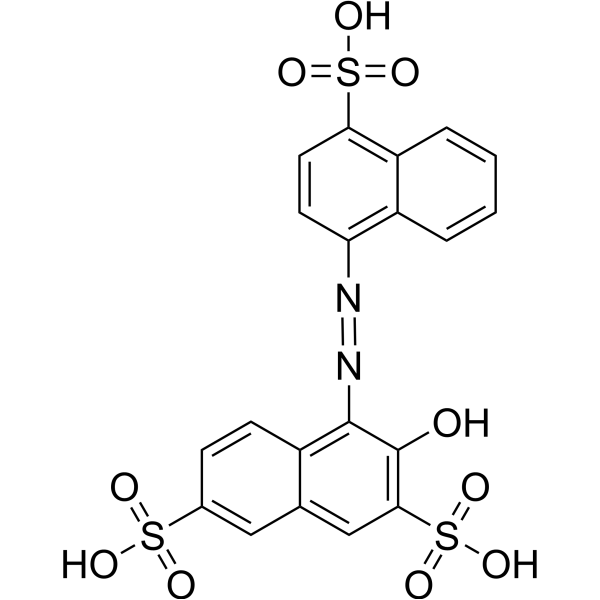 0 ImagesSynonyms: Acid Red 27 free acid; Azorubin S free acid; FD & C Red Dye No. 2 free acidAmaranth free acid (Acid Red 27 free acid; Azorubin S free acid; FD & C Red Dye No. 2 free acid) is a multifunctional dye. Dyes are important tools in biological experiments. They can help researchers observe and analyze cell structures, track biomolecules, evaluate cell functions, distinguish cell types, detect biomolecules, study tissue pathology and monitor microorganisms. Their applications range from basic scientific research to clinical A wide range of diagnostics. Dyes are also widely used in traditional fields such as textile dyeing, as well as in emerging fields such as functional textile processing, food pigments and dye-sensitized solar cells.




