



Fluorescent Dye
Fluorescence is a phenomenon of photoluminescence in luminescence. When an atom is irradiated by light, some electrons around the nucleus jump from their original orbitals to higher energy orbitals under the influence of light energy, i.e., from the ground state to the first or second excited single-line state, etc. Due to the instability of the first or second excited singlet state, the electron returns from the excited singlet state to the ground state accompanied by released energy, resulting in fluorescence.
Fluorescent dyes can be covalently bound or physically adsorbed in the structure of the substance. The fluorescence properties allow for the characterization, localization and quantitative analysis of the labeled object. Fluorescent dyes have shown great potential for the detection of proteins, nucleic acids, cells, and immunoassays, attributed to the advantages in non-radioactive contamination, simple experimental operation and easy observation.
Fluorescent dyes have penetrated many fields such as pharmacology, physiology, environmental science, and information science, as well as functional studies of proteins and drug screening.
All Product Categories
-
Fluorescent Dye Related Products (4894)
Related Products (4894)

-
Antibodies (4)
-
ATTO 514 NHS ester
 0 ImagesCat. No.: HY-D2026ATTO 514 NHS ester is a new fluorescent marker based on the Rhodamine structure. It has strong absorption, high fluorescence quantum yield, high thermal stability and photochemical stability, and is suitable for single molecule detection and high-resolution microscopy. ATTO 514 NHS ester is an NHS ester derivative of ATTO 514 that can be used to label proteins or antibodies.
-
12-AS
 0 ImagesCat. No.: HY-D3012CAS No.: 30536-60-812-AS is a 9-anthracenoxy fatty acid probe. 12-AS’s fluorescence decay is not a single index, and its lifetime increases with the red shift of the emission wavelength.
-
Luxol Fast Blue Staining Solution
 0 ImagesCat. No.: HY-DY2025Luxol Fast Blue Staining Solution is a copper phthalocyanine-based histological dye that specifically binds to lipid-rich structures such as myelin sheaths and mitochondria, staining them blue-green. Luxol Fast Blue Staining Solution is suitable for displaying myelin sheaths in neural tissues, staining mitochondria in tissues such as kidney/liver, and staining sections for phase contrast microscopy. It is often used in combination with PAS, Phloxine or Cresyl Violet to enhance structural contrast.
-
FAM labled Rimigorsen sodium
 0 ImagesCat. No.: HY-177659CFAM labled Rimigorsen sodiumis a FAM labled Rimigorsen sodium.
-
N-(4-Anilino-1-naphthyl)maleimide
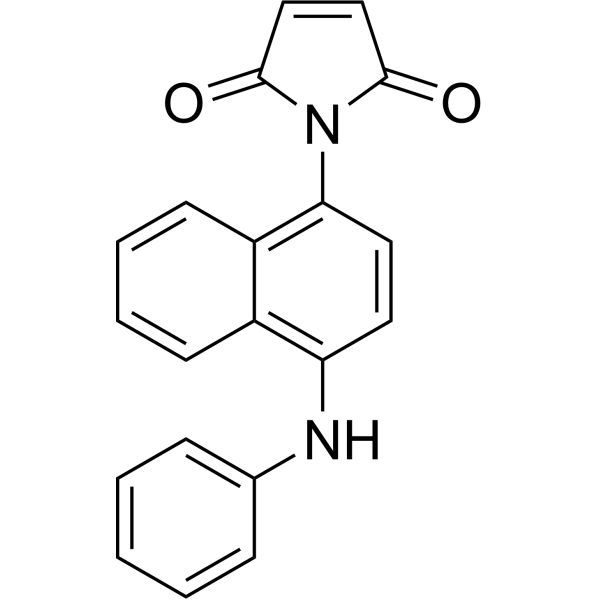 0 ImagesCat. No.: HY-D1526CAS No.: 50539-45-2N-(4-Anilino-1-naphthyl)maleimide is a fluorescent probe that can be used to detect thiol groups in proteins. N-(4-Anilino-1-naphthyl)maleimide reacts with thiol groups and immediately produces a stable fluorescent compound with the λex=355 nm, λem=448 nm.
-
SQM-NBD
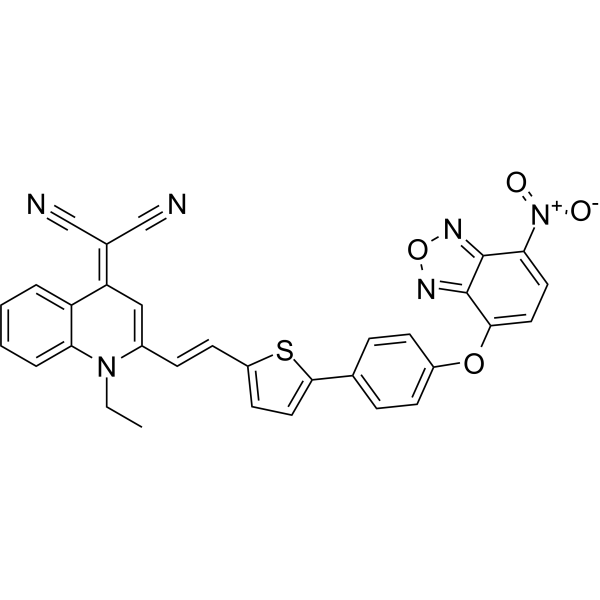 0 ImagesCat. No.: HY-147738CAS No.: 2786704-34-3SQM-NBD is a potent and selectiveAIE fluorescent probe. SQM-NBD exhibits excellent sensitivity to Cys and Hcy with the LOD of 54 nM and 72 nM, respectively.SQM-NBD has good cell permeability and low cytotoxicity. SQM-NBD has the potential for Cys/Hcy identification under physiological and pathological conditions.
-
Flutax-2
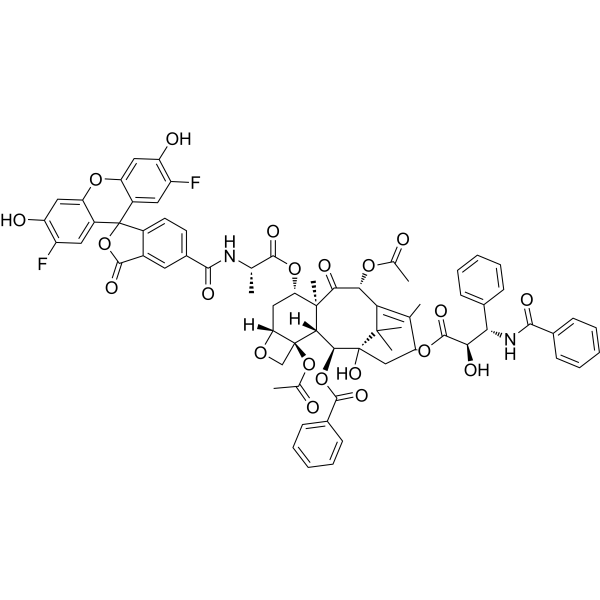 0 ImagesCat. No.: HY-162161CAS No.: 301844-13-3Flutax-2 is an active fluorescent derivative of Paclitaxel (HY-B0015) that binds to polymerized αβ-tubulin dimers. Flutax-2 is applicable for imaging microtubules in live cells, isolated cytoskeletons and parasites (Ex/Em=496/526 nm).
-
RB-PEG1000-DSPE
 0 ImagesCat. No.: HY-D2887BSynonyms: Rhodamine B-PEG1000-DSPERB-PEG1000-DSPE (Rhodamine B-PEG1000-DSPE) is a PEG phospholipid labeled Rhodamine B (HY-Y0016). RB-PEG1000-DSPE can be used to prepare liposomes or nanoparticles for nutrients delivery such as mRNA or DNA vaccine (Ex/Em=546/610 nm).
-
AldRed 659-A
 0 ImagesCat. No.: HY-D3183CAS No.: 1623011-10-8AldRed 659-A is a red-shifted fluorescent substrate for aldehyde dehydrogenase (ALDH). AldRed 659-A exhibits only minimal fluorescent uptake shift in comparison with DEAB (ALDH inhibitor)-treated control.
-
AF488 Picolyl Azide
 0 ImagesCat. No.: HY-D3574AF488 Picolyl Azide is a Fluorescent dye designed for bioorthogonal visualization applications. AF488 Picolyl Azide functions via copper (I)-catalyzed azide-alkyne cycloaddition click chemistry, where its azide group undergoes covalent reaction with alkyne-functionalized molecules to form fluorescent triazole conjugates. AF488 Picolyl Azide enables the visualization of metabolically labeled isoprenoids in bacteria, which localize to the cell membrane and division septum.
-
BADAN
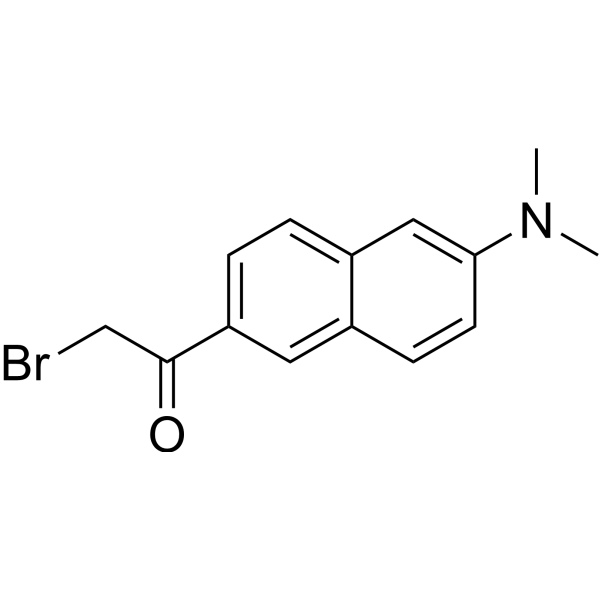 0 ImagesCat. No.: HY-D1470CAS No.: 210832-86-3BADAN is a thiol-reactive, environment-sensitive fluorescent probe used for site-specific labeling of protein cysteine residues to detect protein topology, local polarity, protein-lipid interactions, and conformational changes. The bromoacetyl group of BADAN covalently binds to cysteine thiols, and its fluorescence originates from the intramolecular charge transfer (ICT) excited state. The emission peak position varies with the polarity of the surrounding medium: it blue-shifts to approximately 488 nm in nonpolar environments (such as the hydrophobic core of lipid bilayers) and red-shifts to approximately 496-507 nm in polar environments (such as aqueous phases), independent of enzymes, pH, or membrane potential. Ex = 380-402 nm; Em = 400-600 nm.
-
FAM labled ATL 1102 sodium
 0 ImagesCat. No.: HY-153481DFAM labled ATL 1102 sodiumis a FAM labled ATL 1102 sodium.
-
Griffonia (Bandeiraea) Simplicifolia Lectin II
 0 ImagesCat. No.: HY-NP069Synonyms: GSL IIGriffonia (Bandeiraea) Simplicifolia Lectin II (GSL II) is a plant lectin that can be used as a probe to specifically bind biomolecules (such as polysaccharides, peptides, etc.).Griffonia (Bandeiraea) Simplicifolia Lectin II (GSL II) is a biological material or organic compound that can be used in life science research.
-
Galanthus Nivalis Lectin (Biotinylated)
 0 ImagesCat. No.: HY-NP149Synonyms: GNL (Biotinylated)Galanthus Nivalis Lectin Biotinylated is a plant lectin that can be used as a probe to specifically bind biomolecules (such as polysaccharides, peptides, etc.). Galanthus Nivalis Lectin Biotinylated is a biological material or organic compound that can be used in life science research.
-
MPAC-Br
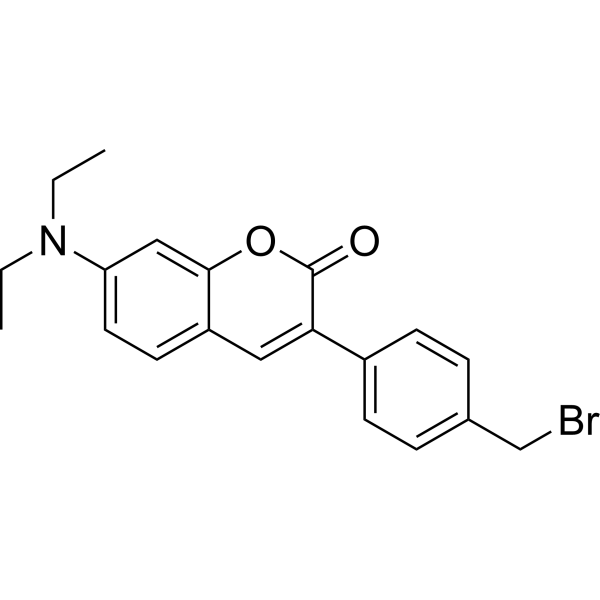 0 ImagesCat. No.: HY-D0035CAS No.: 177093-58-2MPAC-Br is a highly sensitive fluorescent derivatization reagent for carboxylic acids in HPLC.

-
gGlu-2OMe SiR600
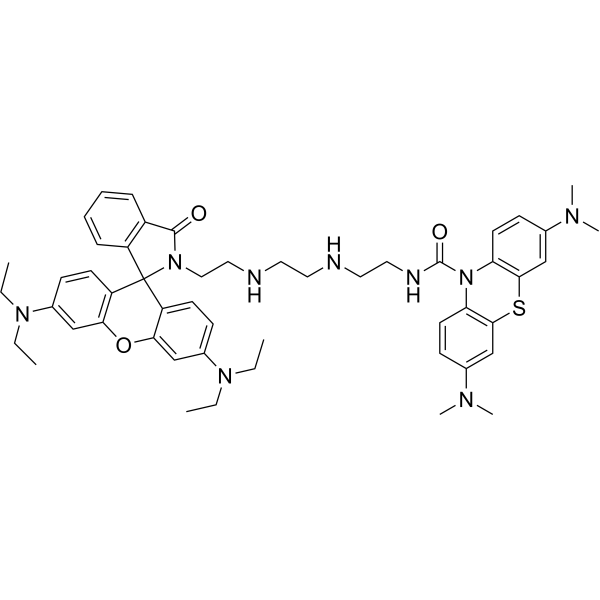
 0 ImagesCat. No.: HY-D3188CAS No.: 2730023-28-4gGlu-2OMe SiR600 is a γ-glutamyl transpeptidase (GGT) responsive fluorescent probe. gGlu-2OMe SiR600 can be converted into a highly fluorescent molecule via reaction with GGT, and its initial fluorescence is quenched through a photoinduced electron transfer (PeT) mechanism. gGlu-2OMe SiR600 exhibits fluorescence activation in malignant breast cancer and benign breast fibroadenoma tissues, enabling lesion visualization. gGlu-2OMe SiR600 can be used for research related to breast cancer and fibroadenoma.
-
RB-PEG1000-FA
 0 ImagesCat. No.: HY-D2888BSynonyms: Rhodamine B-PEG1000-FARB-PEG1000-FA (Rhodamine B-PEG1000-FA) is a fluorescent dye composed of Rhodamine B (HY-Y0016), PEG and Folic acid (FA) (HY-16637). RB-PEG1000-FA can be used for cell imaging, folate receptor targeting and detection (Ex/Em=546/610 nm).
-
RB-PEG2000-OH
 0 ImagesCat. No.: HY-D2882CSynonyms: Rhodamine B-PEG2000-OHRB-PEG2000-OH (Rhodamine B-PEG2000-OH) is a fluorescent dye composed of Rhodamine B (HY-Y0016), PEG and a Hydroxyl group. RB-PEG2000-OH can be used for fluorescent labeling and imaging (Ex/Em=546/610 nm).




