Fluorescent Dye
Fluorescence is a phenomenon of photoluminescence in luminescence. When an atom is irradiated by light, some electrons around the nucleus jump from their original orbitals to higher energy orbitals under the influence of light energy, i.e., from the ground state to the first or second excited single-line state, etc. Due to the instability of the first or second excited singlet state, the electron returns from the excited singlet state to the ground state accompanied by released energy, resulting in fluorescence.
Fluorescent dyes can be covalently bound or physically adsorbed in the structure of the substance. The fluorescence properties allow for the characterization, localization and quantitative analysis of the labeled object. Fluorescent dyes have shown great potential for the detection of proteins, nucleic acids, cells, and immunoassays, attributed to the advantages in non-radioactive contamination, simple experimental operation and easy observation.
Fluorescent dyes have penetrated many fields such as pharmacology, physiology, environmental science, and information science, as well as functional studies of proteins and drug screening.
All Product Categories
-
Fluorescent Dye Related Products (4888)
Related Products (4888)

-
Antibodies (4)
-
Hydroxystilbamidine
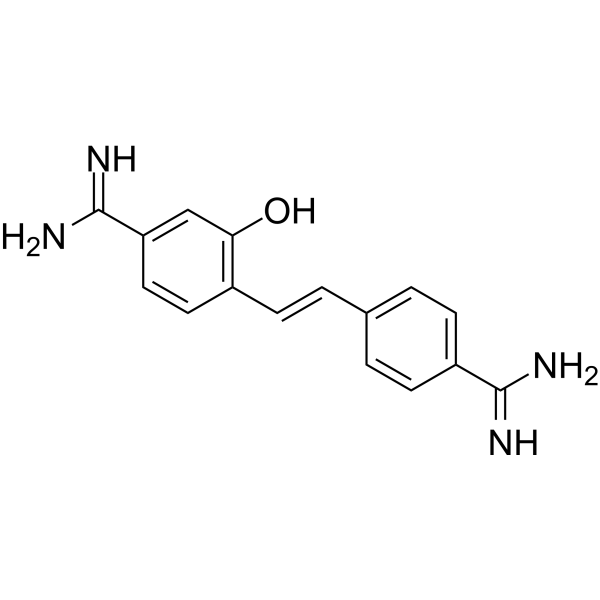 0 ImagesHydroxystilbamidine, a dye capable of binding to both DNA and RNA, is a powerful inhibitor of cellular ribonucleases. Hydroxystilbamidine is a retrograde fluorescent tracer and a histochemical stain[1]
-
RB-PEG600-OH
 0 ImagesCat. No.: HY-D2882ASynonyms: Rhodamine B-PEG600-OHRB-PEG600-OH (Rhodamine B-PEG600-OH) is a fluorescent dye composed of Rhodamine B (HY-Y0016), PEG and a Hydroxyl group. RB-PEG600-OH can be used for fluorescent labeling and imaging (Ex/Em=546/610 nm).
-
Cy3 labled PS220 sodium
 0 ImagesCat. No.: HY-153324ECy3 labled PS220 sodium is a Cy3 labled PS220 sodium.
-
MOR-CES2
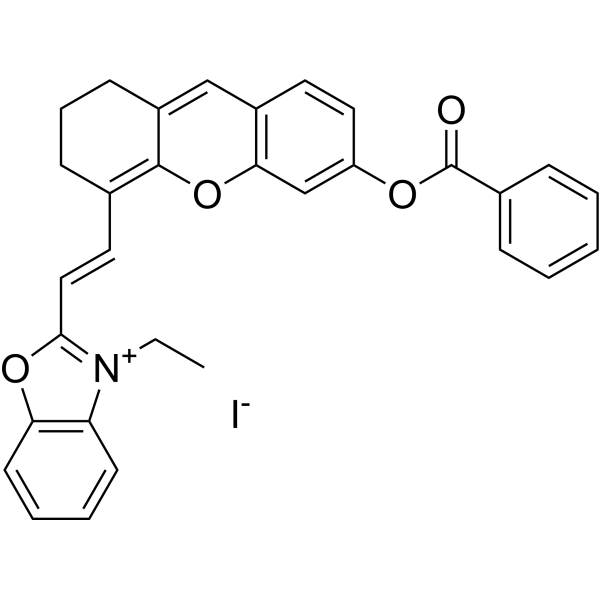 0 ImagesCat. No.: HY-D2285CAS No.: 2956672-93-6
-
Disperse Yellow 232
 0 ImagesCat. No.: HY-D0547CAS No.: 35773-43-4Disperse Yellow 232 is a coumarin-based fluorescent dye suitable for synthetic fibers. The excitation wavelength used in its photolysis experiment is 300 nm.
-
Cy3 labled ATU027 sodium
 0 ImagesCat. No.: HY-153482ECy3 labled ATU027 sodium is a Cy3 labled ATU027 sodium.
-
FAM labled ISIS 532401 sodium
 0 ImagesCat. No.: HY-159697CFAM labled ISIS 532401 sodiumis a FAM labled ISIS 532401 sodium.
-
STB-2
 0 ImagesCat. No.: HY-D3408STB-2 is a fluorescent dye for near-infrared window II (NIR-II) fluorescence angiography. STB-2 achieves high-brightness NIR-II fluorescence by restricting the twisted intramolecular charge transfer state. STB-2, when modified with ApoE to form nanoparticles, can cross the blood-brain barrier and accumulate in gliomas (Ex/Em = 808/1020 nm). STB-2 is used in studies related to NIR-II fluorescence and single-/two-photon cerebrovascular imaging of gliomas.
-
IR 650 maleimide
 0 ImagesCat. No.: HY-D3252IR 650 maleimide is a near-infrared fluorescent dye. It should be noted that IR 650 maleimide‘s fluorescence stability is poor, with less than 16% of the fluorescence signal retained after the expansion microscopy experimental procedure.
-
Bz-VGR-AMC
 0 ImagesCat. No.: HY-137897CAS No.: 87779-49-5Bz-VGR-AMC is a fluorescent substrate for the trypsin-like activity of the 20S proteasome. Bz-VGR-AMC can be used to measure the trypsin-like (β2) activity of the 20S proteasome (Ex/Em = 360/460 nm).
-
Cy3 labled Zilebesiran sodium
 0 ImagesCat. No.: HY-145649DCy3 labled Zilebesiran sodium is a Cy3 labled Zilebesiran sodium.
-
Ulex Europaeus Agglutinin I-Cy3
 0 ImagesCat. No.: HY-NP090KSynonyms: UEA I-Cy3Ulex Europaeus Agglutinin I-Cy3 (UEA I-Cy3) is a Cy7-labeled glehnia littoralis lectin I (UEA-I). Ulex Europaeus Agglutinin I exhibits specificity for cell surface glycoconjugates containing α-L-fucosylate. Ulex Europaeus Agglutinin I-Cy3 can be used for vascular endothelial labeling, glycan imaging, and tissue staining studies (Ex/Em = 554/568 nm).
-
FAM labled Erisonersen sodium
 0 ImagesCat. No.: HY-177630CFAM labled Erisonersen sodiumis a FAM labled Erisonersen sodium.
-
BODIPY TMR-X alkyne
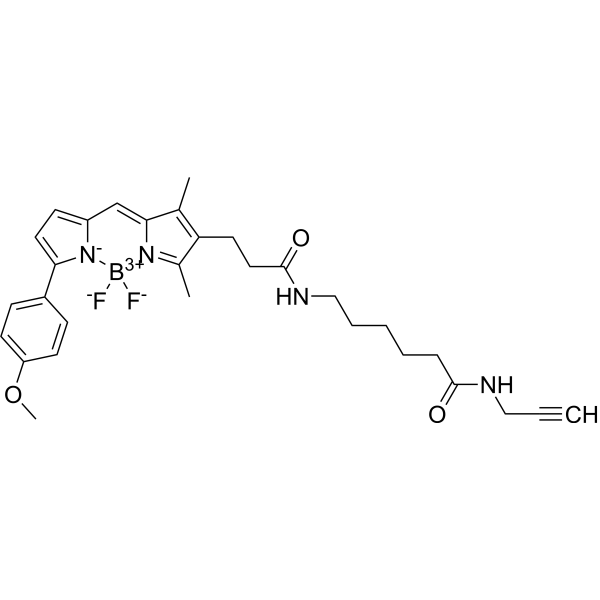 0 ImagesCat. No.: HY-D1593CAS No.: 2923990-43-4BODIPY TMR-X alkyne, an orange-fluorescent dye, is an alkyne modified BODIPY TMR-X. BODIPY TMR-X alkyne can react with azides by the copper-catalyzed click reaction. BODIPY TMR-X alkyne is not sensitive to pH.
-
Wheat germ agglutinin-AF430
 0 ImagesCat. No.: HY-NP163KSynonyms: WGA-AF 430Wheat germ agglutinin-AF430 (WGA-AF 430) is a plant lectin that contains the fluorescent dye AF430, which can be used to identify carbohydrate chains. Wheat germ agglutinin-AF430 can be used to assess abnormal glycosylation levels in the body. The specific glycosylation detection sites of Wheat germ agglutinin is bis-GlcNAc, SA.
-
AF430 NHS ester
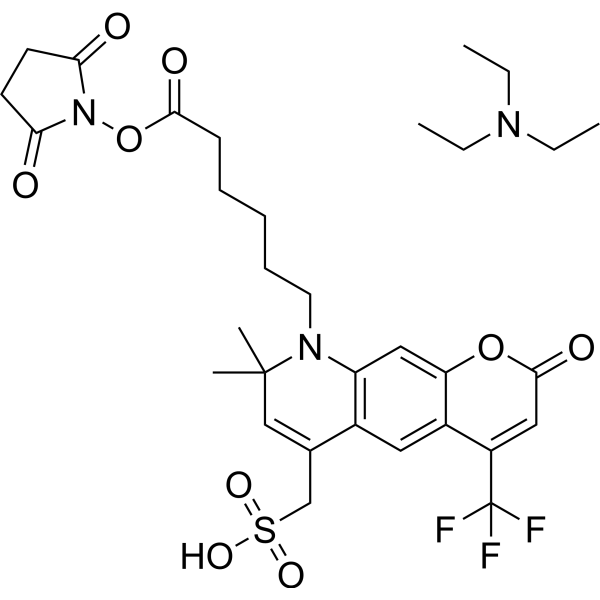 0 ImagesCat. No.: HY-149117CAS No.: 467233-94-9AF430 NHS ester is an AF 430 maleimide is a derivative of the yellow fluorescent dye AF 430. AF430 has an excitation wavelength of 425 nm and an emission wavelength of 542 nm. AF430 NHS ester can be uesd for the labeling of amino-groups in peptides, proteins, and oligonucleotides. To achieve specific coupling of dye labels and biomolecules.
-
SBP-1
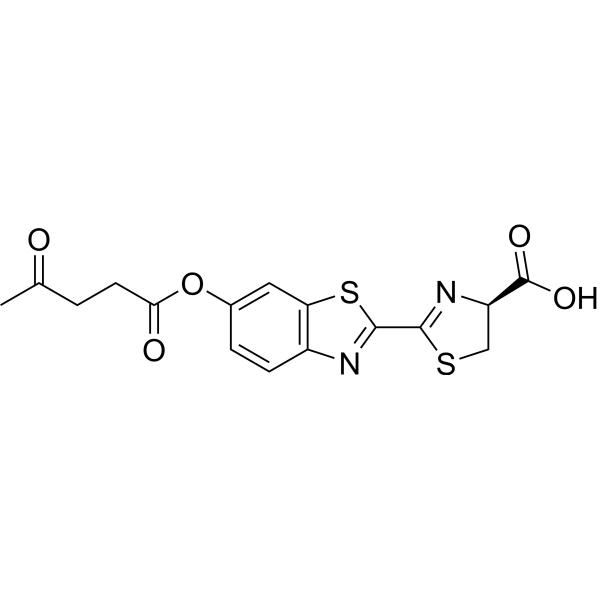 0 ImagesCat. No.: HY-147507CAS No.: 2451986-45-9SBP-1 is a sulfite bioluminescent probe (SBP). SBP-1 exhibits the excellent responsivity, selectivity and sensitivity towards sulfite. The recognition of SBP-1 towards sulfite is based on the mechanism of a sulfite-mediated intramolecular cleavage reaction. SBP-1 can be used for detection of exogenous and endogenous sulfite in living animal. SBP-1 also possesses a capability for quantitatively detecting sulfite within a certain concentration range in solution.