



Fluorescent Dye
Fluorescence is a phenomenon of photoluminescence in luminescence. When an atom is irradiated by light, some electrons around the nucleus jump from their original orbitals to higher energy orbitals under the influence of light energy, i.e., from the ground state to the first or second excited single-line state, etc. Due to the instability of the first or second excited singlet state, the electron returns from the excited singlet state to the ground state accompanied by released energy, resulting in fluorescence.
Fluorescent dyes can be covalently bound or physically adsorbed in the structure of the substance. The fluorescence properties allow for the characterization, localization and quantitative analysis of the labeled object. Fluorescent dyes have shown great potential for the detection of proteins, nucleic acids, cells, and immunoassays, attributed to the advantages in non-radioactive contamination, simple experimental operation and easy observation.
Fluorescent dyes have penetrated many fields such as pharmacology, physiology, environmental science, and information science, as well as functional studies of proteins and drug screening.
All Product Categories
-
Fluorescent Dye Related Products (4888)
Related Products (4888)

-
Antibodies (4)

-
Seph-PAO
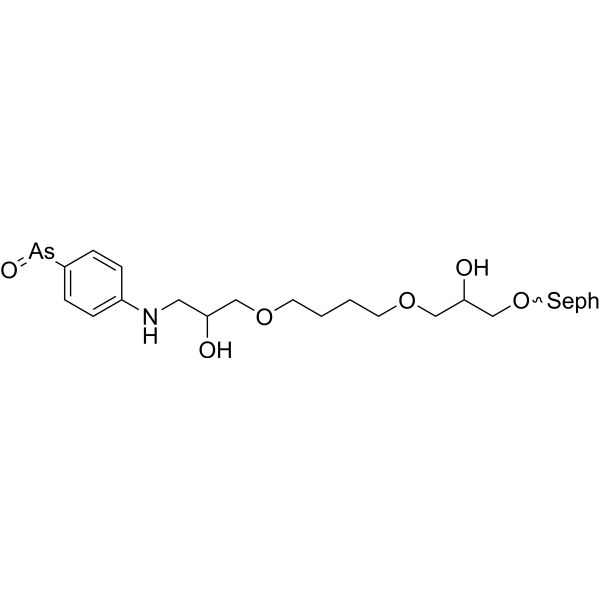 0 ImagesCat. No.: HY-D1268CAS No.: 851461-65-9Seph-PAO is the modified PAO attached a sepharose fluorophore and is used to detect the thioredoxin reductase (TrxR).
-
pH630 Deep Red maleimide, Thiol Reactive
 0 ImagesCat. No.: HY-D3522pH630 Deep Red maleimide, Thiol Reactive is a fluorescent labeling reagent combining pH responsiveness and thiol targeting capabilities. It combines pH sensitivity and thiol-specific labeling, primarily used for highly specific, low-background fluorescent labeling and imaging of thiol-containing biomolecules in acidic environments (Ex/Em = 630/650 nm).
-
BV-1
 0 ImagesCat. No.: HY-D3108CAS No.: 2569032-08-0BV-1 is a fluorescent probe for viscosity detection and imaging in living cells. BV-1 can be used to detect changes in intracellular viscosity and mitochondrial viscosity in living cells. BV-1 responds to environmental viscosity via a molecular rotor mechanism. In a low-viscosity environment, the centrally located unsaturated structure induces a twisted intramolecular charge transfer (TICT) state and promotes non-radiative transitions, resulting in fluorescence quenching; when viscosity increases, molecular rotation is restricted, the TICT state is attenuated, and fluorescence is enhanced with a red shift. BV-1 can be used for real-time monitoring of changes in cytoplasmic viscosity and the viscosity increase during cell apoptosis. Ex/Em = 480/570 nm.
-
Cy3 labled LSP-GR3 sodium
 0 ImagesCat. No.: HY-148828ECy3 labled LSP-GR3 sodium is a Cy3 labled LSP-GR3 sodium.
-
PRMT5-targeted fluorescent ligand-1
 0 ImagesCat. No.: HY-170603PRMT5-targeted fluorescent ligand-1 (Compound 7) is a PRMT5-targeted fluorescent ligand, that inhibits PRMT5 with an IC50 of 29.39 nM. PRMT5-targeted fluorescent ligand-1 exhibits cell imaging activity, that exhibits good fluorescence signal in MCF-7 with an IC50 of 29 nM. PRMT5-targeted fluorescent ligand-1 induces apoptosis. PRMT5-targeted fluorescent ligand-1 exhibits a maximal excitation wavelength of 438 nm and a maximal emission wavelength of 550 nm.
-
Janelia Fluor® 526, SE
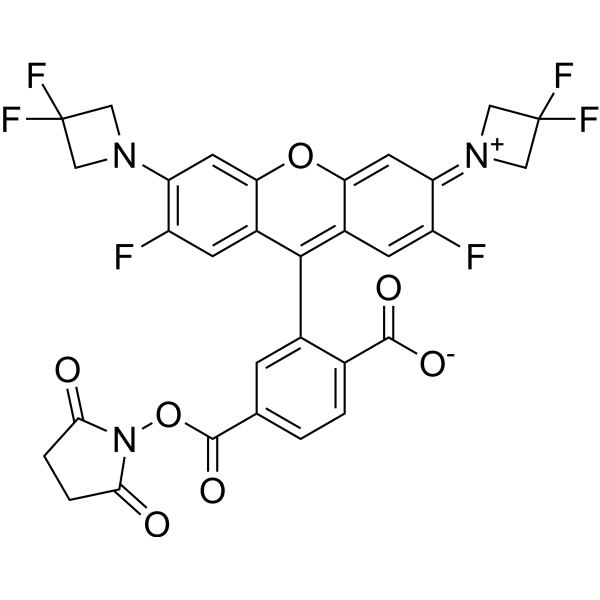 0 ImagesCat. No.: HY-138658Synonyms: JF526, SE; JF526, NHSJanelia Fluor 526, SE (JF526,SE) is a fluorogenic yellow fluorescent dye that contains NHS ester group. JF526 is a versatile scaffold for fluorogenic ligands, including labels for genetically encoded self-labeling protein tags and stains for endogenous structures. Janelia Fluor fluorescent dyes can be chemically conjugated to the specific HaloTag substrate (a chloroalkane ligand) to form a fluorescent ligand, rather than binding directly to the HaloTag protein itself. Janelia Fluor products are licensed under U.S. Pat. Nos. 9,933,417, 10,018,624 and 10,161,932 and other patents from Howard Hughes Medical Institute (Ex/Em = 526/550 nm).
-
TAMRA-PEG4-methyltetrazine
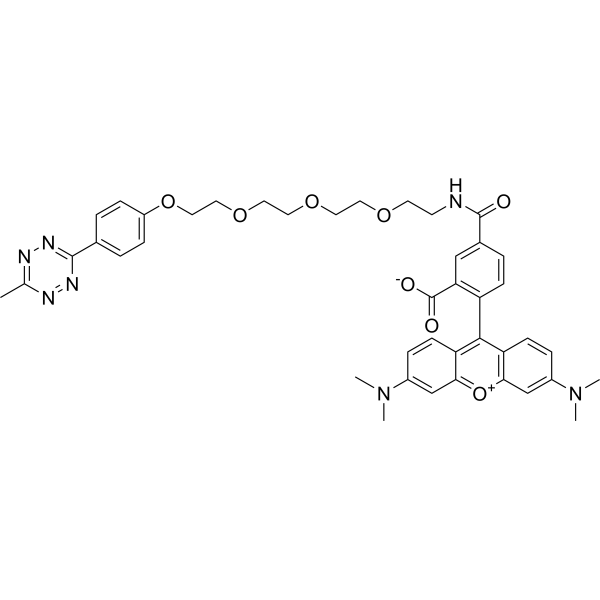 0 ImagesCat. No.: HY-141286CAS No.: 2163772-19-6

-
Lucifer yellow cadaverine
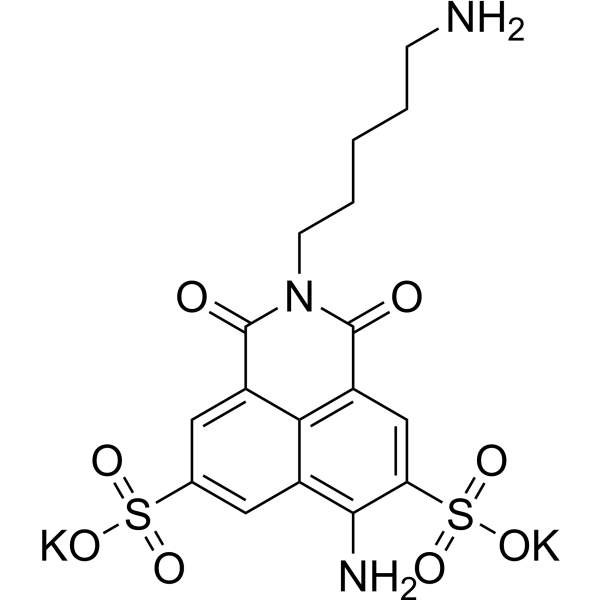 0 ImagesCat. No.: HY-D1753CAS No.: 149733-79-9Synonyms: LYCLucifer yellow cadaverine (LYC) can be used as a cell tracer. Lucifer yellow cadaverine can be used to label endocytic vacuoles in cells.
-
Ac-RR-AFC TFA
 0 ImagesCat. No.: HY-P11325Purity: 99.56%Ac-RR-AFC TFA is a Cathepsin B fluorogenic substrate (Ex=400 nm, Em=505 nm). Cathepsin B activity in cells lysates is determined by measuring cleavage of Ac-RR-AFC TFA and its cleavage occurs at the RR-AFC amide bond. Ac-RR-AFC TFA can be used for activity assays and mechanistic studies on cathepsin B.

-
D-Val-Leu-Lys-AMC
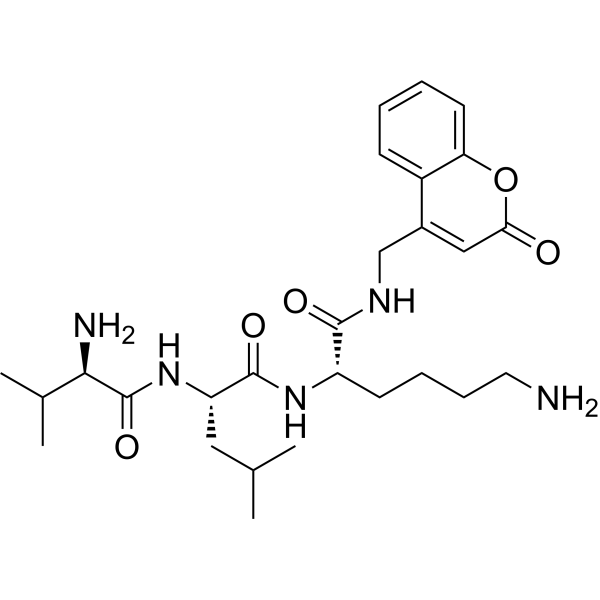 0 ImagesCat. No.: HY-P4341CAS No.: 152881-17-9D-Val-Leu-Lys-AMC is a selective fluorogenic peptide substrate of plasmin. D-Val-Leu-Lys-AMC can be used for the quantification of enzymatic activity of plasmin. Ex: 360-380 nm, Em: 440-460 nm.
-
Concanavalin A (Rhodamine)
 0 ImagesCat. No.: HY-NP0153Synonyms: Con A (Rhodamine)Concanavalin A (Con A) Rhodamine is a plant lectin that can be used as a probe to specifically bind biomolecules (such as polysaccharides, peptides, etc.).Concanavalin A (Con A) Rhodamine is a biological material or organic compound that can be used in life science research.
-
Pentetic acid-13C5
 0 ImagesCat. No.: HY-W749825CAS No.: 470462-57-8Synonyms: Diethylenetriaminepentaacetic acid-13C5; DTPA-13C5Pentetic acid-13C5 (Diethylenetriaminepentaacetic acid-13C5) is the 13C-labeled Pentetic acid (HY-B1335). Pentetic acid (Diethylenetriaminepentaacetic acid) is an orally active compound with biodegradability used to construct magnetic adsorbent, which can simultaneously remove heavy metal and dye from complex wastewater. Pentetic acid can form strong metal complexes, which prevents metal ions from catalysing the decomposition of peroxygen chemicals, especially hydrogen peroxide.
-
HCP
 0 ImagesCat. No.: HY-D3224CAS No.: 2413777-91-8HCP is a two-photon fluorescent probe capable of crossing the blood-brain barrier, which is specifically designed for real-time detection of hypochlorous acid (HClO/ClO-) produced by myeloperoxidase (MPO). Chlorination of the quinoline skeleton of HCP generates HCP-Cl, which eliminates intramolecular charge transfer (ICT) quenching and thereby produces fluorescence. HCP is suitable for in vivo dynamic imaging of HClO in the brains of epileptic mice and high-throughput screening of antiepileptic drugs (HCP-Cl: Ex/Em = 800 nm/495 nm).
-
NRLD
 0 ImagesCat. No.: HY-D3090CAS No.: 2757682-04-3NRLD is a lipid droplet-targeting solvatochromic fluorescent probe developed based on Nile Red (HY-D0718), which can target lipid droplets and sense the non-polar lipid microenvironment inside lipid droplets. NRLD exhibits superior lipid droplet-targeting selectivity compared to the parent Nile Red dye in HeLa cell imaging. NRLD achieves detection relying on the solvatochromic effect generated by excited-state charge transfer, and its emission wavelength shifts according to the local polarity changes of the microenvironment it locates in: the more compact and ordered the lipid packing and the lower the environmental polarity, the more blue-shifted the emission; the looser the lipid packing or the stronger the hydration and the higher the environmental polarity, the more red-shifted the emission. NRLD shows blue shift in the non-polar oil core of lipid droplets and red shift in high-polarity environments such as phosphate buffer.
-
Cy3 labled ALN-3133 sodium
 0 ImagesCat. No.: HY-177614CCy3 labled ALN-3133 sodium is a Cy3 labled ALN-3133 sodium.
-
Human Serum Albumin-CY7
 0 ImagesCat. No.: HY-D3028Synonyms: HSA-CY7Human Serum Albumin-CY7 (HSA-CY7) is a CY7 (HY-D0825) labeled serum albumin. Human Serum Albumin-CY7 plays an important role in fluorescent labeling, drug delivery research, and other fields (Ex/Em = 740/770 nm).
-
DAz-1
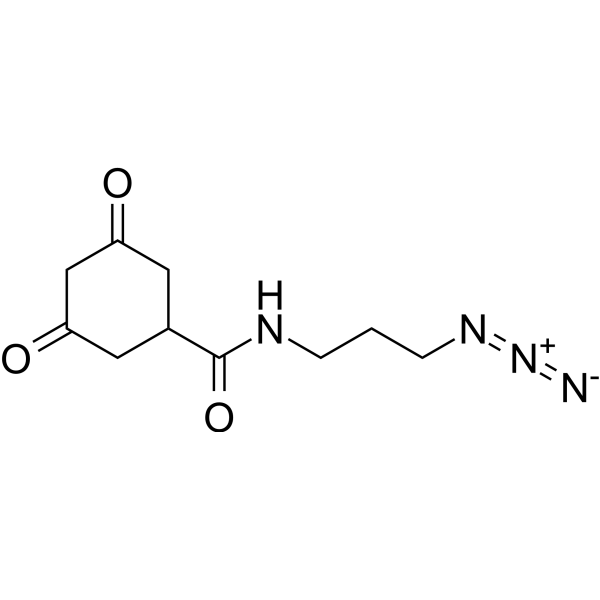 0 ImagesCat. No.: HY-115402CAS No.: 1112977-84-0DAz-1 is a sulfonic acid probe for living cells, which can directly detect sulfonic acid-modified proteins in living cells and is cell-permeable.




