



Insecticide
Insecticide
Insecticides refer to any toxic substances used to kill insects, which exert toxic effects on pests through different mechanisms, thereby achieving the purpose of controlling pest populations and protecting crops and human health. Insecticides have both chemical and biological origins and can be classified into organochlorine insecticides, organophosphorus insecticides, carbamate insecticides, and mineral insecticides based on their chemical properties. Insecticides interact with different target and non-target sites, including receptors, enzymes, and many other known and unknown molecules. Most insecticides are neurotoxicants that target the nervous system, but they can also affect other organs and body systems. Insecticides are metabolized through different metabolic pathways and often serve as biomarkers of exposure in the form of their parent compounds or metabolites. The toxicity of insecticides can be acute, subacute, or chronic, depending on the duration of exposure and the dose involved. Therefore, selecting sensitive, accurate, and validated biomarkers of exposure, effects, and susceptibility appears to be a challenging task.
Insecticides are widely used in agriculture, horticulture, forestry, gardening, homes, offices, and other fields[1][2].
All Product Categories
-
Insecticide Related Products (530)
Related Products (530)

-
Tolfenpyrad (Standard)
 0 ImagesTolfenpyrad (Standard) is the analytical standard of Tolfenpyrad (HY-17516). This product is intended for research and analytical applications. Tolfenpyrad is an orally active insecticide, acaricide and antibacterial agent. Tolfenpyrad inhibits Complex I in the mitochondrial respiratory electron transport chain, interfering with the cell respiration process. Tolfenpyrad has significant insecticidal activity against a variety of insect pests such as H. contortus, Coccinella septempunctata. Tolfenpyrad has antibacterial activity against Francisella novicida, with an IC50 of 1.2 µM or 1.5 µM.
-
Insecticidal agent 38
 0 ImagesCat. No.: HY-187808CAS No.: 257880-89-0Insecticidal agent 38 is a AChE inhibitor and Insecticide, with an IC50 of 49.08 μg/mL against AChE. Insecticidal agent 38 inhibits the activities of SOD, Catalase and Glutathione-S-transferase. Insecticidal agent 38 induces intracellular ROS, lipofuscin and lipid accumulation, increases malondialdehyde levels, disrupts redox homeostasis and triggers oxidative damage. Insecticidal agent 38 inhibits the feeding and reproductive capabilities of the pine wood nematode (Bursaphelenchus xylophilus). Insecticidal agent 38 exhibits insecticidal activity against nematodes. Insecticidal agent 38 can be used in studies of plant-parasitic nematode infections.
-
Fipronil desulfinyl
 0 ImagesCat. No.: HY-W585834CAS No.: 205650-65-3Fipronil desulfinyl is a photodegradation product of the insecticide Fipronil (HY-B0822) and has similar in vivo toxicity to Fipronil but higher environmental pollution.
-
Phorate sulfone
 0 ImagesCat. No.: HY-W588214CAS No.: 2588-04-7Phorate sulfone, Phorate metabolite, is an insecticide. Phorate sulfone shows inhibitory activity aainst acetylcholinesterase with an IC50 of 40 μM, leading to acetylcholine accumulation at cellular and subcellular levels. Phorate sulfone can be used for the research of severe phorate poisoning.
-
Bayer 9017
 0 ImagesBayer 9017 is an insecticide with plasma cholinesterase inhibitory activity and toxicity. Bayer 9017 inhibits plasma cholinesterase activity in chicks. Bayer 9017 prevents the colonization of Lucilia sericata larvae, kills first-instar Lucilia sericata larvae, and provides myiasis protection for sheep, with seasonal variations in its protective performance. Bayer 9017 is applicable to research related to myiasis.
-
Ajugamacrin B
 0 ImagesCat. No.: HY-N19913CAS No.: 123313-59-7Ajugamacrin B is a new clerodane-type diterpenoid that interferes with the feeding behavior of fifth-instar larvae of Spodoptera littoralis. Ajugamacrin B is promising for research related to pest control.

-
Daigremontianin
 0 ImagesCat. No.: HY-122401CAS No.: 98205-50-6Daigremontianin is an insecticidal bufadienolide that can be isolated from K. daigremontiana x tubiflora. Daigremontianin shows insecticidal activity for silkworm.
-
Pyrimidifen
 0 ImagesCat. No.: HY-W703863CAS No.: 105779-78-0Pyrimidifen is a phenoxyethyl amine compound and is an acaricide. Pyrimidifen controls the African red mite, Eutetranychus africanus with a persistency of 14-21 days.
-
Athidathion
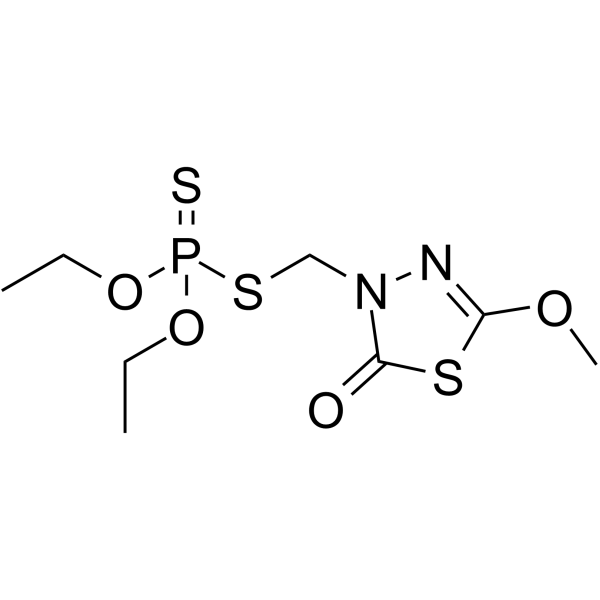 0 ImagesCat. No.: HY-17523CAS No.: 19691-80-6Synonyms: GS-13006Athidathion (GS-13006) is an organophosphate insecticide.
-
Insecticidal agent 34
 0 ImagesCat. No.: HY-206897CAS No.: 183992-66-7Insecticidal agent 34 is an orally active insecticide. Insecticidal agent 34 inhibits voltage-gated sodium channel and blocks acetylcholine release. Insecticidal agent 34 induces ataxia, paralysis, curling, tremors/convulsions and progressive death in lepidopteran larvae, inhibits neural activity in the central nervous system, and blocks nerve firing in larval stretch receptor preparations. Insecticidal agent 34 can be used for insecticidal research.
-
Transfluthrin
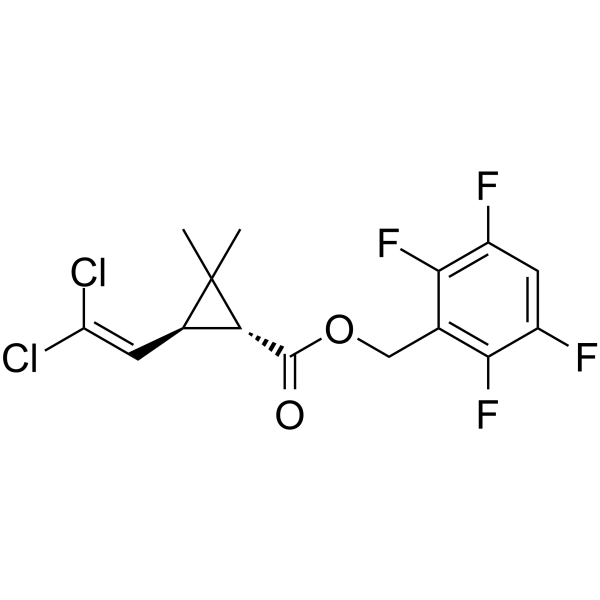 0 ImagesCat. No.: HY-W075176CAS No.: 118712-89-3Transfluthrin is an insecticide with extremely low acute toxicity to vertebrates. Transfluthrin acts as a mosquito repellent, exerts mosquito control effects via electric heating fumigators, and is widely used in studies related to malaria, bancroftian filariasis and mosquito-borne infectious diseases. Transfluthrin may also induce adverse reactions such as pulmonary sensory irritation, sensitization, genotoxicity and respiratory depression, and can increase the concentrations and activities of CYP2E1 and CYP3A2 in rat brains. Transfluthrin can be removed from wastewater through biodegradation and activated sludge adsorption, and can be degraded by microorganisms such as Azovibrio and Tauera.
-
δ-Nonalactone
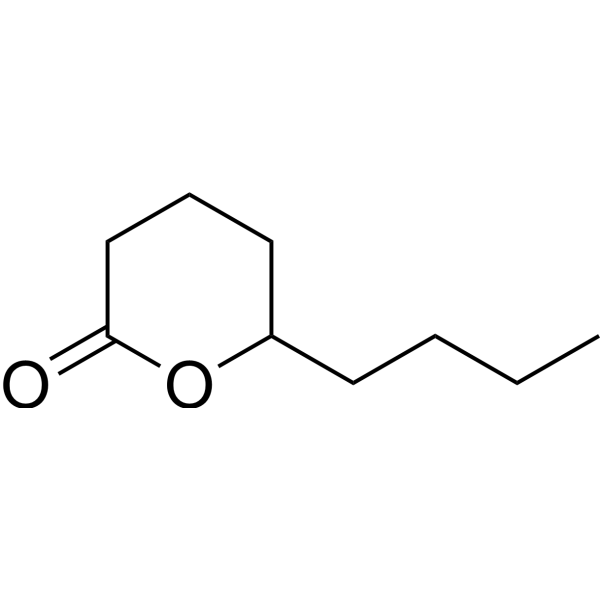 0 Imagesδ-Nonalactone has potent tsetse repellency effect.
-
Dofenapyn
 0 ImagesCat. No.: HY-W751253CAS No.: 42873-80-3Synonyms: CGA-29170Dofenapyn (CGA-29170) is a miticide that can be used for field pest control.
-
Insecticidal agent 20
 0 ImagesCat. No.: HY-173073Insecticidal agent 20 (Compound 17) is an insecticide that can bind to AChBP. Insecticidal agent 20 exhibits good insecticidal activity against the larvae (LC50: 1.57 ppm) and pupae (LC50: 4.17 ppm) of Culex pipiens.
-
Insecticidal agent 37
 0 ImagesCat. No.: HY-187441Insecticidal agent 37 is an insecticide with activity against both nymph and adult stages of Aphis fabae. Insecticidal agent 37 exhibits strong binding affinity to the acetylcholine-binding protein of Aplysia californica via forming multiple hydrogen bonds and hydrophobic interactions with key residues.
-
Spirobudiclofen
 0 ImagesCat. No.: HY-W783659CAS No.: 1305319-70-3Spirobudiclofen is a selective, non-systemic acaricide and insecticide, primarily used to control mites in agriculture. Spirobudiclofen significantly inhibited survival and reproduction of Panonychus citri (Acari: Tetranychidae) , and the effects aggravated as concentration increased.
-
Profluthrin
 0 ImagesCat. No.: HY-167246CAS No.: 401620-61-9Profluthrin is a pyrethroid insecticide. Profluthrin can be used as mothproof repellents for clothes.
-
Teflubenzuron (Standard)
 0 ImagesCat. No.: HY-B2055RCAS No.: 83121-18-0Teflubenzuron (Standard) is the analytical standard of Teflubenzuron. This product is intended for research and analytical applications. Teflubenzuron is a chitin synthesis inhibitor used as a biocide. Teflubenzuron is toxic for F. candida.



