



Amantadine hydrochloride (Standard)

Based on 1 Customer Validation
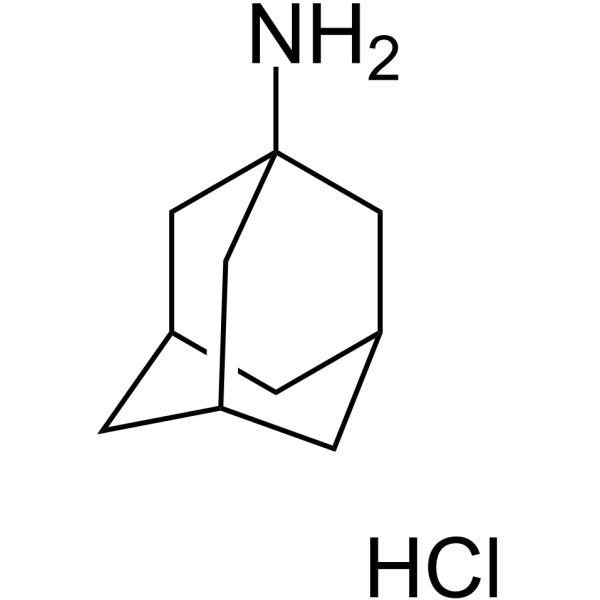
Amantadine (hydrochloride) (Standard) is the analytical standard of Amantadine (hydrochloride). This product is intended for research and analytical applications. Amantadine (1-Adamantanamine) hydrochloride is an orally avtive and potent antiviral agent with activity against influenza A viruses. Amantadine hydrochloride inhibits several ion channels such as NMDA and M2, and also inhibits Coronavirus ion channels. Amantadine hydrochloride also has anti-orthopoxvirus and anticancer activity. Amantadine hydrochloride can be used for Parkinson's disease, postoperative cognitive dysfunction (POCD) and COVID-19 research.
For research use only. We do not sell to patients.
- Purity : 99.83%
- CAS No.: 665-66-7
- Formula: C₁₀H₁₈ClN
- Molecular Weight:187.71
-
Storage:
Please store the product under the recommended conditions in the Certificate of Analysis.


To place orders, for customer services and technical support, please contact: MedChemExpress USA
Tel: 609-228-6898 E-mail: [email protected] [email protected]


-
 Product Information
-
Chemical Information
- Purity & Documentation
-
 Help & FAQs


-
HY-B0402A
Amantadine hydrochloride -
HY-15296
Cabergoline -
HY-N0304
L-DOPA -
HY-B0402
Amantadine -
HY-P0017
Aprotinin -
HY-N0304R
L-DOPA (Standard) -

HY-15296R
Cabergoline (Standard) -
HY-17589
Chloroquine phosphate -
HY-13210
Zanamivir -
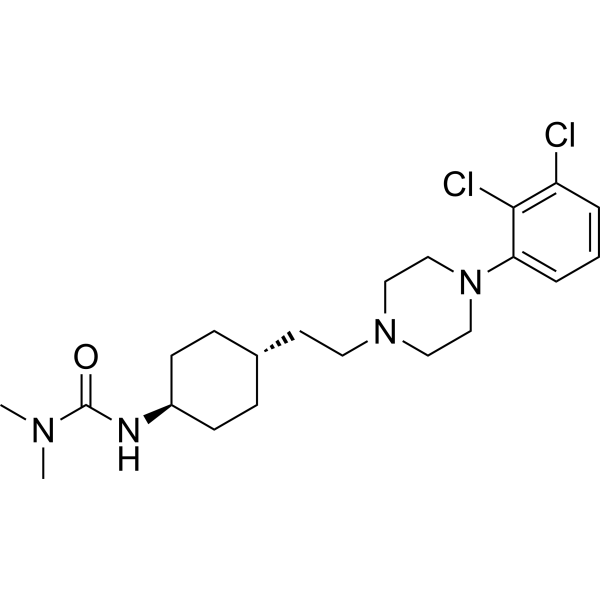
HY-14763
Cariprazine -
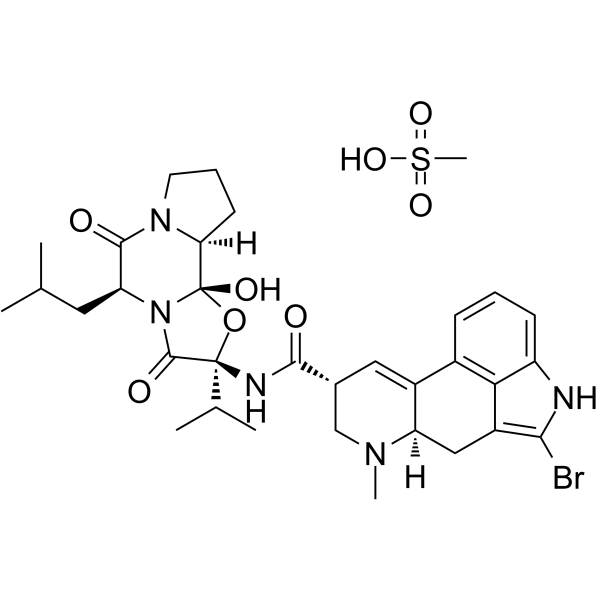
HY-12705A
Bromocriptine mesylate -
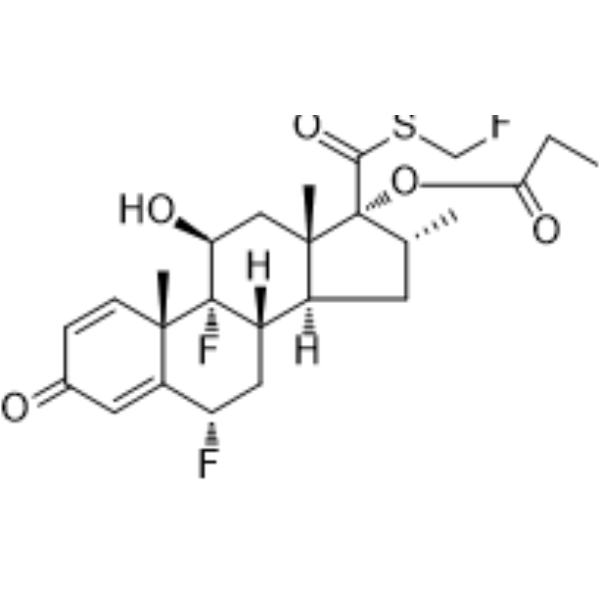
HY-B0154
Fluticasone propionate


Product Information
Information
Application
The compound is the grade of analytical standard, which is the reference standard supplied assay. It is commonly used in qualitative, quantitative and methodological research experiments in HPLC, GC and MS.


Chemical Information
-
CAS No. 665-66-7
-
Appearance Solid
-
Molecular Weight 187.71
-
Formula C₁₀H₁₈ClN
-
Color White to off-white
-
SMILES
NC1(C2)C[C@@H]3C[C@@H](C[C@H]2C3)C1.Cl
-
Synonyms
1-Adamantanamine hydrochloride (Standard); 1-Adamantylamine hydrochloride (Standard); 1-Aminoadamantane hydrochloride (Standard)
-
Shipping
Room temperature in continental US; may vary elsewhere.
-
Storage
Please store the product under the recommended conditions in the Certificate of Analysis.


Purity & Documentation
-
SDS (778 KB)
- English - EN (778 KB)
- Français - FR (778 KB)
- Deutsch - DE (778 KB)
- Norwegian - NO (778 KB)
- Español - ES (778 KB)
- Swedish - SV (778 KB)
- Italian - IT (778 KB)
- Korean - KR (778 KB)
- Portuguese - PT (778 KB)
-
Handling Instructions (2659 KB)
References
[1]. Suzuki H, et al. Emergence of amantadine-resistant influenza A viruses: epidemiological study. J Infect Chemother. 2003;9(3):195-200. [Content Brief]
[2]. Hubsher G, et al. Amantadine: the journey from fighting flu to treating Parkinson disease. Neurology. 2012;78(14):1096-1099. [Content Brief]
[3]. Donald F Smee, et al. A review of compounds exhibiting anti-orthopoxvirus activity in animal models. Antiviral Res. 2003 Jan;57(1-2):41-52. [Content Brief]
[4]. Fink K, et al. Amantadine Inhibits SARS-CoV-2 In Vitro. Viruses. 2021 Mar 24;13(4):539. [Content Brief]
[5]. Zhang J, et al. Amantadine alleviates postoperative cognitive dysfunction possibly by increasing glial cell line-derived neurotrophic factor in rats. Anesthesiology. 2014 Oct;121(4):773-85. [Content Brief]
[6]. Lan Z, et al. Amantadine inhibits cellular proliferation and induces the apoptosis of hepatocellular cancer cells in vitro. Int J Mol Med. 2015;36(3):904-910. [Content Brief]

Calculators
Concentration (start) × Volume (start) = Concentration (final) × Volume (final)


Amantadine hydrochloride (Standard) Related Classifications
HY-B0402AR Related Classifications
 Powered by Bioz
Keywords
- Amantadine hydrochloride (Standard)
- 665-66-7
- 1-Adamantanamine hydrochloride (Standard)
- 1-Adamantylamine hydrochloride (Standard)
- 1-Aminoadamantane hydrochloride (Standard)
- Reference Standards
- Influenza Virus
- Orthopoxvirus
- SARS-CoV
- Apoptosis
- Bcl-2 Family
- CDK
- M2 proton channel
- antiviral
- Parkinson's disease
- Vero E6 cells
- antiviral drugs
- Covid-19
- SARS-CoV-2
- orthopoxvirus
- memory impairment
- Postoperative cognitive dysfunction
- POCD
- Neuroinflammation
- HCC cells
- HepG2
- SMMC?7721
- hepatitis C virus
- anticancer
- liver cancer
- Inhibitor
- inhibitor
- inhibit