



AKR1C1 Antibody (YA4180)
(Synonyms: C9; DD1; DDH; DDH1; H-37; HBAB; MBAB; HAKRC; DD1/DD2; 2-ALPHA-HSD; 20-ALPHA-HSD)Based on 1 Customer Validation
AKR1C1 Antibody (YA4180) is a Mouse-derived and non-conjugated IgG1 monoclonal antibody, targeting to AKR1C1.
-
Host:
Mouse
-
Isotype:
IgG1
-
Application:
WB, IHC-P, FC
-
Reactivity :
Human, Mouse, Rabbit
-
Formulation:
1.Supplied in PBS containing 50% glycerol, 1% BSA and 0.02% sodium azide, pH 7.3.
2.Supplied in PBS with 0.05% sodium azide.
-
Conjugation:
Non-conjugated


To place orders, for customer services and technical support, please contact: MedChemExpress USA
Tel: 609-228-6898 E-mail: [email protected] [email protected]





Applications
| Application |
WB

WB: Western Blot
|
IHC-P
IHC-P: Immunohistochemistry-Paraffin
|
FC
FC: Flow Cytometry
|
|---|---|---|---|
| Dilution Ratio | 1:500-1:1000 | 1:200-1:400 | 1:200-1:400 |


Product Details
AKR1C1 Antibody (YA4180) is a Mouse-derived and non-conjugated IgG1 monoclonal antibody, targeting to AKR1C1.
-
Host Mouse

-
Clonality Monoclonal

-
Species ReactivityHuman, Mouse, Rabbit
-
Observed Molecular WeightObserved band size: 37 kDa
Note: Due to possible protein modifications or aggregation, the molecular weight should be confirmed by actual measurement, and the predicted value is for reference only.

-
Calculated Molecular Weight Predicted band size: 37 kDa

Purified fusion protein with human AKR1C1 aa 1-323.
affinity purified.
Non-conjugated
Unmodified
IgG1


Product Properties
-
Appearance
Solution
-
Formulation
1.Supplied in PBS containing 50% glycerol, 1% BSA and 0.02% sodium azide, pH 7.3.
2.Supplied in PBS with 0.05% sodium azide. -
Concentration
Batch-dependent, Please check the COA for the concentration of each lot. Check Lot Concentration
-
Storage & Stability
Stored at -20°C for 1 year. Avoid repeated freeze / thaw cycles.
-
Shipping
Shipping with blue ice.


Verification Images
-
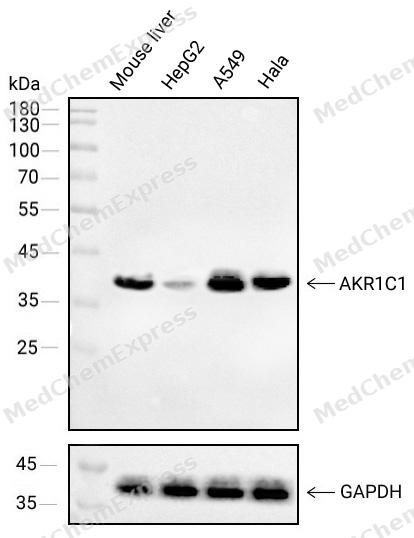 Western blot analysis of extracts from Mouse liver(lane 1(40μg) ),HepG2(lane 2(40μg) ),A549(lane 3(40μg) )and Hela(lane 4(40μg) ) using AKR1C1 antibody. Proteins were transferred to a NC membrane and blocked with 5% Skim milk in TBST for 2 hour at room temperature. The primary antibody ( 1/1000) and Loading control antibody (GAPDH, 1/1000) was used in 5% Skim milk in TBST at 4°C overnight. Goat Anti-Mouse IgG-HRP Secondary Antibody (1/10,000) was used for 1 hour at room temperature.
 -
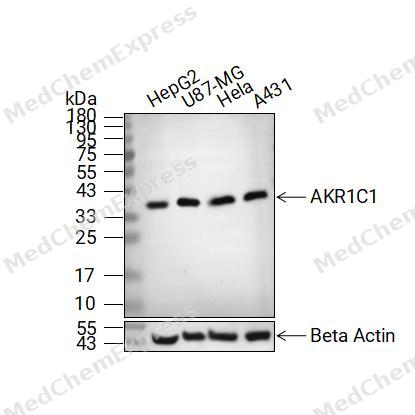 Western blot analysis of extracts from HepG2(lane2(20μg), U87-MG(lane3(20μg), Hela(lane4(20μg) and A431(lane5(20μg) using AKR1C1 Antibody (HY-P84483). Proteins were transferred to a PVDF membrane and blocked with 5% non-fat milk in TBST at 4°C overnight. The primary antibody (1/1000) and Loading control antibody (Beta Actin, HY-P80993, 1/10,000) was used in 5% non-fat milk in TBST for 2 hour at room temperature. Goat Anti-Mouse IgG-HRP Secondary Antibody (HY-P8004, 1/10,000) was used for 1 hour at room temperature.
 -
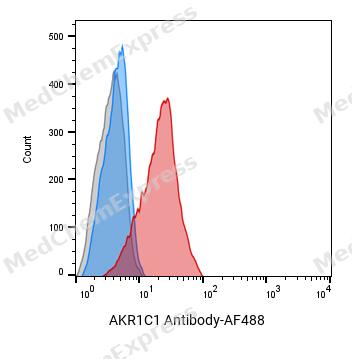 Flow cytometric analysis of 1X10^6 Hela cells labeling AKR1C1 Antibody(red).Cells were fixed with 4% paraformaldehyde and permeabilised with 0.2% Triton X-100. Then stained with the primary antibody at 1/400 dilution overnight at 4℃. AF 488 Goat Anti-mouse IgG H&L was used as the secondary antibody at 1/1,000 dilution for 45 minutes at room temperature. Mouse IgG Isotype Control (blue) was used as the isotype control, cells without incubation with primary antibody were used as the unlabeled control (black).
 -
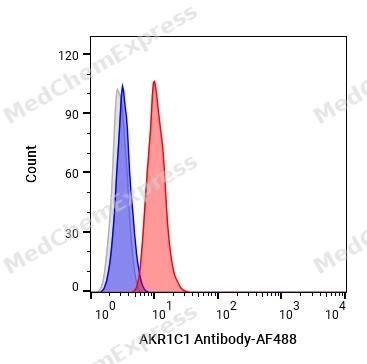 Flow cytometric analysis of 1X10⁶ HeLa cells labeling AKR1C1 Antibody(HY-P84483, red). Cells were fixed with 4% paraformaldehyde and permeabilised with 90% methanol. Then stained with the primary antibody at 1/200 dilution for an hour at 4℃. AF488-conjugated Goat Anti-Mouse IgG H&L (HY-P8005) was used as the secondary antibody at 1/1,000 dilution for 30 minutes at 4℃. Mouse IgG Isotype Control (HY-P80757, blue) was used as the isotype control, cells without incubation with primary antibody were used as the unlabeled control (black).


Background
-
Function
AKR1C1 is a Cytosolic aldo-keto reductase that catalyzes the NADH and NADPH-dependent reduction of ketosteroids to hydroxysteroids. Most probably acts as a reductase in vivo since the oxidase activity measured in vitro is inhibited by physiological concentrations of NADPH. Displays a broad positional specificity acting on positions 3, 17 and 20 of steroids and regulates the metabolism of hormones like estrogens and androgens. May also reduce conjugated steroids such as 5alpha-dihydrotestosterone sulfate. Displays affinity for bile acids[1][2][3][4].
-
Subcellular Localization
Cytoplasm, cytosol
-
Expression
Tissue_specificity:It was expressed in all tissues tested, including the liver, prostate, testes, adrenal glands, brain, uterus, breast, and keratinocytes. The highest levels were found in the liver, breast, and brain. -
Subunit
Monomer
-
SwissProt ID
-
Synonyms
C9; DD1; DDH; DDH1; H-37; HBAB; MBAB; HAKRC; DD1/DD2; 2-ALPHA-HSD; 20-ALPHA-HSD


Documentation
-
Data Sheet (234 KB)
-
SDS (252 KB)
- English - EN (252 KB)
- Français - FR (252 KB)
- Deutsch - DE (252 KB)
- Norwegian - NO (252 KB)
- Español - ES (252 KB)
- Swedish - SV (252 KB)
- Italian - IT (252 KB)
- Korean - KR (252 KB)
- Portuguese - PT (252 KB)
-
User Guide for Antibodies (1077 KB)

 Powered by Bioz
