



Calnexin Antibody
(Synonyms: CANX; Calnexin; IP90; Major histocompatibility complex class I antigen-binding protein p88; p90)Based on 4 publication(s) in Google Scholar
Calnexin Antibody is a Rabbit-derived and non-conjugated IgG polyclonal antibody, targeting to Calnexin.
-
Host:
Rabbit
-
Isotype:
IgG
-
Application:
WB, IHC-F, IHC-P, ICC/IF, ELISA
-
Reactivity :
Human, Mouse, Rat
-
Formulation:
Supplied in 1*PBS (pH 7.3), 50% glycerol and 0.5% BSA. Preservative: 0.02% sodium azide.
-
Conjugation:
Non-conjugated


To place orders, for customer services and technical support, please contact: MedChemExpress USA
Tel: 609-228-6898 E-mail: [email protected] [email protected]



-

HY-P80924
TSG101 Antibody (YA025) -
HY-P80608
CD81 Antibody (YA525) -
HY-P80604
CD63 Antibody (YA530) -
HY-P80610
CD9 Antibody -
HY-P82075
GM130 Antibody (YA1820) -
HY-P80369
VDAC1 Antibody (YA016) -
HY-P86450
Phospho-AKT(Ser473) Antibody (YA6142) -
HY-P81162
PI3 Kinase p110 alpha/PIK3CA Antibody (YA3537) -
HY-P86603
EEA1 Antibody (YA6295) -
HY-P86394
CD9 Antibody (YA6086) -
HY-P80046
Caspase-3 Antibody (YA557)
Publications Citing Use of MedChemExpress (MCE) Calnexin Antibody
More

Applications
| Application |
WB

WB: Western Blot
|
IHC-P
IHC-P: Immunohistochemistry-Paraffin
|
IHC-F
IHC-F: Immunohistochemistry-Frozen
|
ICC/IF
ICC/IF: Immunocytochemistry/
Immunofluorescence |
ELISA
ELISA: Enzyme Linked Immunosorbent Assay
|
|---|---|---|---|---|---|
| Dilution Ratio | 1:500-1:1000 | 1:50-1:300 | 1:50-1:300 | 1:100-1:300 | 1:10000 |


Product Details
Calnexin Antibody is a Rabbit-derived and non-conjugated IgG polyclonal antibody, targeting to Calnexin.
-
Host Rabbit

-
Clonality Polyclonal

-
Species ReactivityHuman, Mouse, Rat
-
Observed Molecular WeightObserved band size: 90-95 kDa
Note: Due to possible protein modifications or aggregation, the molecular weight should be confirmed by actual measurement, and the predicted value is for reference only.

-
Calculated Molecular Weight Predicted band size: 68 kDa

Entrez Gene: 821 Human ; 12330 Mouse ; 29144 Rat
SwissProt: P27824 Human ; P35564 Mouse ; P35565 Rat
OMIM: 114217 Human
Synthetic peptide corresponding to Human Calnexin.AA range:543-592
Endogenous
affinity purified
Non-conjugated
Unmodified
IgG


Product Properties
-
Appearance
Solution
-
Formulation
Supplied in 1*PBS (pH 7.3), 50% glycerol and 0.5% BSA. Preservative: 0.02% sodium azide.
-
Concentration
Batch-dependent, Please check the COA for the concentration of each lot. Check Lot Concentration
-
Storage & Stability
Stored at -20°C for 1 year. Avoid repeated freeze / thaw cycles.
-
Shipping
Shipping with blue ice.


Publications (4)
-
Journal Impact Factor
-
Most Recent
-
Transl Neurodegener
NDST3 suppression restores lysosomal acidification and ameliorates amyloid-β and MAPT/tau pathology in Alzheimer's disease. [Abstract]2026 Apr 21;15(1):16. PMID: 42015299 -
J Transl Med
Tumor-derived exosomal lncRNA-MIR193BHG promotes bone metastasis of breast cancer by targeting the miR-489-3p/DNMT3A signaling axis in osteoclasts. [Abstract]2025 Jan 31;23(1):142. PMID: 39891171 -
Mol Med Rep
Exosomal SphK1 from colorectal cancer cells promotes cancer cell migration and activates hepatic stellate cells. [Abstract]2025 Mar;31(3):73. PMID: 39930826 -
Transl Cancer Res
Extracellular vesicles isolated from curcumin-medium weakened RKO cell proliferation and migration. [Abstract]2024 Jun 30;13(6):2596-2604. PMID: 38988906


Verification Images
-
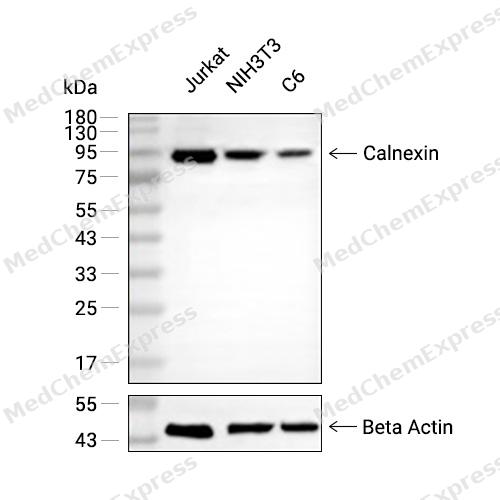 Western blot analysis of extracts from Jurkat (lane 2(20μg), NIH3T3 (lane 3(20μg) and C6(lane 4(20μg) using Calnexin (HY-P80578) Rabbit mAb. Proteins were transferred to a PVDF membrane and blocked with 5% non-fat milk in TBST for 2 hour at room temperature. The primary antibody (1/1000) and Loading control antibody (Beta Actin, HY-P80438, 1/10000) was used in 5% non-fat milk in TBST at 4°C overnight. Goat Anti-Mouse/Rabbit IgG-HRP Secondary Antibody (1/10000) was used for 1 hour at room temperature.
 -
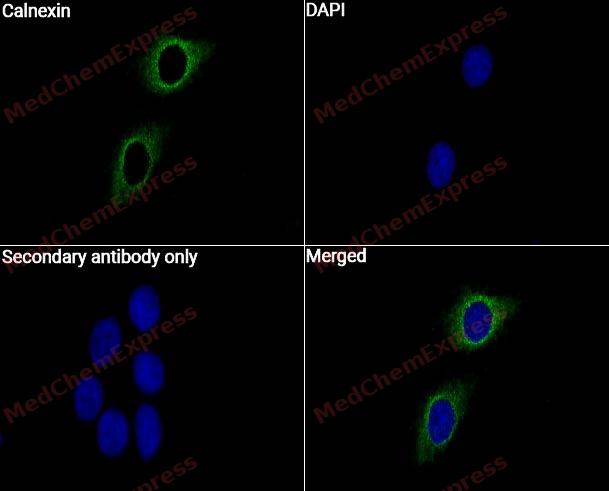 Immunocytochemistry analysis of Hela cells labeling Calnexin with Calnexin Antibody (HY-P80578)at 1/50 dilution. Cells were fixed in 4% paraformaldehyde for 15 minutes at room temperature, permeabilized with 0.1% Triton X-100 for 10 minutes at room temperature, then blocked with QuickBlock™ Blocking Buffer for Immunol Staining for 10 min at room temperature. Cells were then incubated with Calnexin Antibody (HY-P80578) at 1/50 dilution in QuickBlock™ Blocking Buffer for Immunol Staining at 4 ℃. Alexa Fluor® 488-conjugated AffiniPure Goat Anti-Rabbit IgG H&L(HY-P8002, Green) was used as the secondary antibody at 1/1,000 dilution. PBS instead of the primary antibody was used as the secondary antibody only control. The Nuclear counterstain was DAPI (Blue).
 -
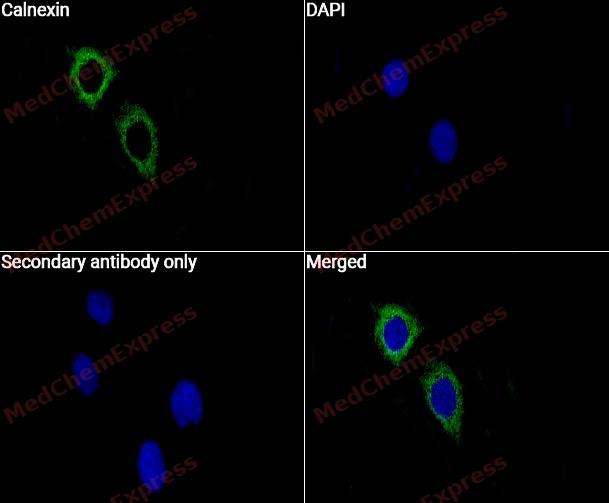 Immunocytochemistry analysis of Hela cells labeling Calnexin with Calnexin Antibody (HY-P80578) at 1/100 dilution. Cells were fixed in 4% paraformaldehyde for 15 minutes at room temperature, permeabilized with 0.1% Triton X-100 for 10 minutes at room temperature, then blocked with QuickBlock™ Blocking Buffer for Immunol Staining for 10 min at room temperature. Cells were then incubated with Calnexin Antibody (HY-P80578) at 1/100 dilution in QuickBlock™ Blocking Buffer for Immunol Staining at 4 ℃. Alexa Fluor® 488-conjugated AffiniPure Goat Anti-Rabbit IgG H&L(HY-P8002, Green) was used as the secondary antibody at 1/1,000 dilution. PBS instead of the primary antibody was used as the secondary antibody only control. The Nuclear counterstain was DAPI (Blue).
 -
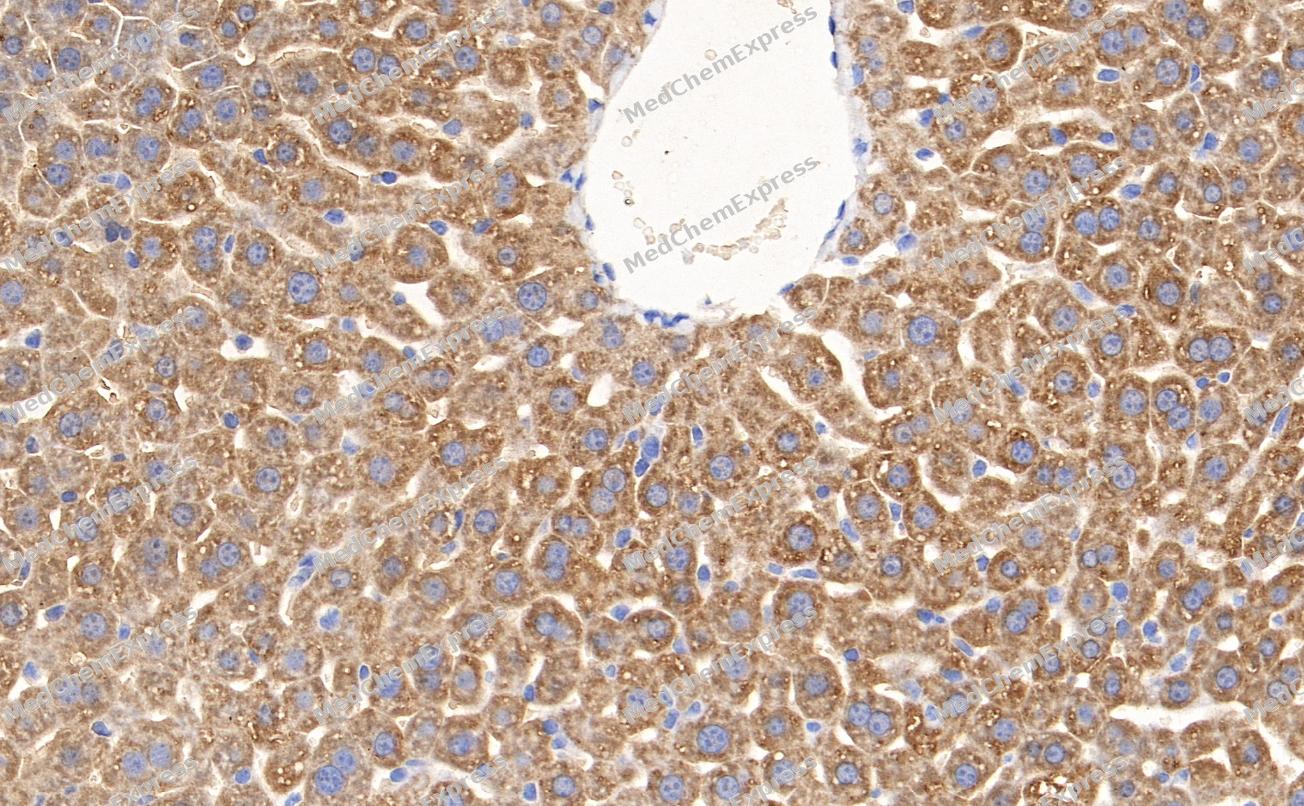 Immunohistochemical analysis of paraffin-embedded Mouse liver tissue using Calnexin Antibody. The section was pre-treated using heat mediated antigen retrieval with Tris-EDTA buffer (pH 9.0) for 8 minutes. The tissues were blocked in QuickBlock for 20 minutes at room temperature, washed with ddH2O and PBS, and then probed with the primary antibody (HY-P80578, 1/100) in 4℃ overnight. The detection was performed using an HRP conjugated compact polymer system. DAB was used as the chromogen. Tissues were counterstained with hematoxylin and mounted with DPX.
 -
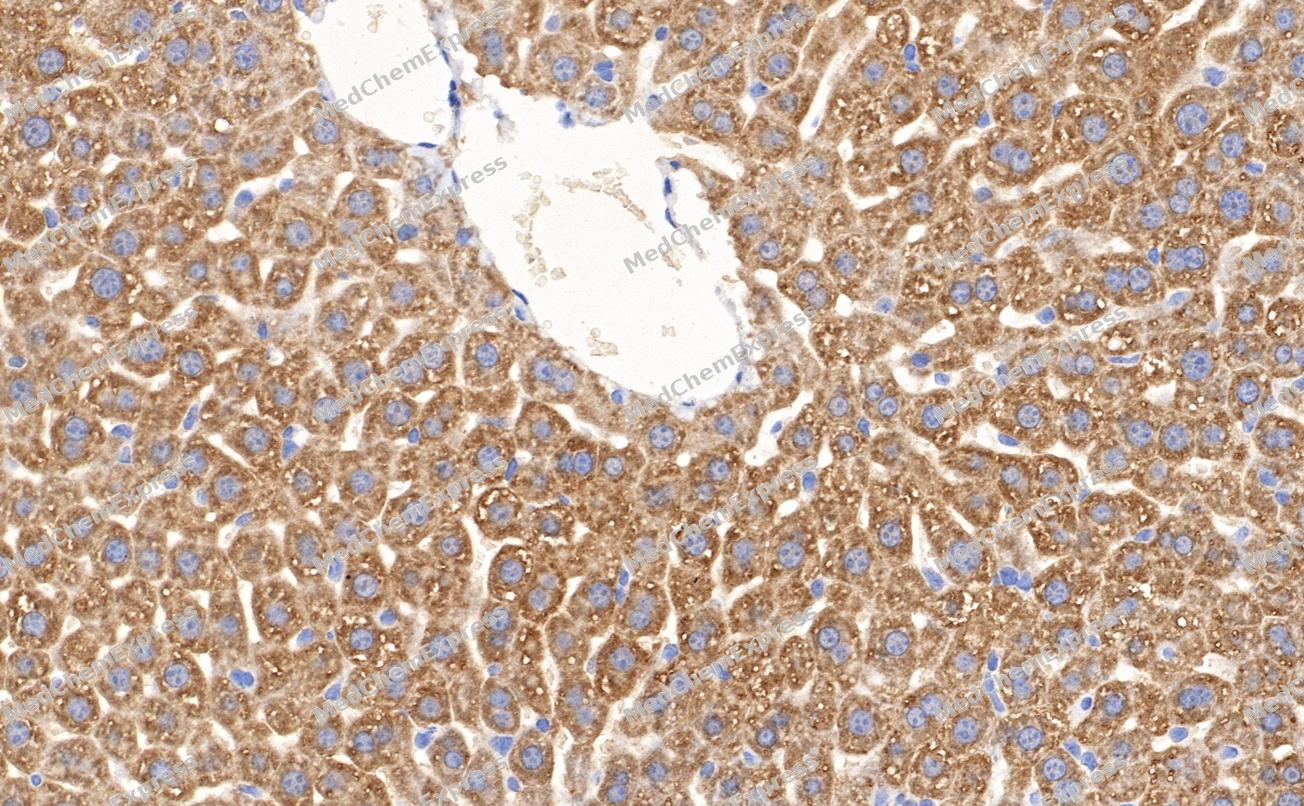 Immunohistochemical analysis of paraffin-embedded Mouse liver tissue using Calnexin Antibody. The section was pre-treated using heat mediated antigen retrieval with Tris-EDTA buffer (pH 9.0) for 8 minutes. The tissues were blocked in QuickBlock for 20 minutes at room temperature, washed with ddH2O and PBS, and then probed with the primary antibody (HY-P80578, 1/100) in 4℃ overnight. The detection was performed using an HRP conjugated compact polymer system. DAB was used as the chromogen. Tissues were counterstained with hematoxylin and mounted with DPX.


Background
-
Function
Calnexin is a Calcium-binding protein that interacts with newly synthesized monoglucosylated glycoproteins in the endoplasmic reticulum. It may act in assisting protein assembly and/or in the retention within the ER of unassembled protein subunits. It seems to play a major role in the quality control apparatus of the ER by the retention of incorrectly folded proteins. Associated with partial T-cell antigen receptor complexes that escape the ER of immature thymocytes, it may function as a signaling complex regulating thymocyte maturation. Additionally it may play a role in receptor-mediated endocytosis at the synapse
-
Subcellular Localization
Endoplasmic reticulum membrane; Single-pass type I membrane protein; Mitochondrion membrane; Single-pass type I membrane protein; Melanosome membrane; Single-pass type I membrane protein
-
Isoforms & Post-Translational Modification
P27824 has 3 isomers: P27824-1: 67568 Da (predicted); P27824-2: 71503 Da (predicted); P27824-3: 55598 Da (predicted).
Phosphorylated at Ser-564 by MAPK3/ERK1. Phosphorylation by MAPK3/ERK1 increases its association with ribosomes (By similarity);Palmitoylation by DHHC6 leads to the preferential localization to the perinuclear rough ER. It mediates the association of calnexin with the ribosome-translocon complex (RTC) which is required for efficient folding of glycosylated proteins;Ubiquitinated, leading to proteasomal degradation. Probably ubiquitinated by ZNRF4 -
Subunit
Interacts with MAPK3/ERK1 (By similarity). Interacts with KCNH2 (PubMed:16361248). Associates with ribosomes (By similarity). Interacts with SGIP1; involved in negative regulation of endocytosis (By similarity).
-
SwissProt ID
-
Synonyms
CANX; Calnexin; IP90; Major histocompatibility complex class I antigen-binding protein p88; p90
-
Research Field
Tags & Cell Markers
Documentation
-
Data Sheet (234 KB)
-
SDS (252 KB)
- English - EN (252 KB)
- Français - FR (252 KB)
- Deutsch - DE (252 KB)
- Norwegian - NO (252 KB)
- Español - ES (252 KB)
- Swedish - SV (252 KB)
- Italian - IT (252 KB)
- Korean - KR (252 KB)
- Portuguese - PT (252 KB)
-
User Guide for Antibodies (1077 KB)

 Powered by Bioz
