



CD81 Antibody (YA525)
(Synonyms: CD81; TAPA1; TSPAN28; CD81 antigen; 26 kDa cell surface protein TAPA-1; Target of the antiproliferative antibody 1; Tetraspanin-28; Tspan-28; CD81)Based on 1 publication(s) in Google Scholar
CD81 Antibody (YA525) is a Rabbit-derived and non-conjugated IgG monoclonal antibody, targeting to CD81.
-
Host:
Rabbit
-
Isotype:
IgG
-
Application:
WB, IHC-P, ICC/IF, FC
-
Reactivity :
Human
-
Formulation:
Supplied in 50 mM Tris-Glycine (pH 7.4), 0.15 M NaCl, 40% Glycerol and 0.05% BSA. Preservative: 0.01% Sodium azide
-
Conjugation:
Non-conjugated


To place orders, for customer services and technical support, please contact: MedChemExpress USA
Tel: 609-228-6898 E-mail: [email protected] [email protected]



-

HY-P80604
CD63 Antibody (YA530) -
HY-P80924
TSG101 Antibody (YA025) -
HY-P80578
Calnexin Antibody -
HY-P80610
CD9 Antibody -
HY-P8001
HRP-conjugated Goat Anti-Rabbit IgG H&L -
HY-P81771
ApoE Antibody (YA1516) -
HY-P80185
Hsp70 Antibody (YA359) -
HY-P86394
CD9 Antibody (YA6086) -
HY-P85952
CD63 Antibody (YA5644) -
HY-P80068
CD9 Antibody (YA524)
Publications Citing Use of MedChemExpress (MCE) CD81 Antibody (YA525)
More

Applications
| Application |
WB

WB: Western Blot
|
IHC-P
IHC-P: Immunohistochemistry-Paraffin
|
ICC/IF
ICC/IF: Immunocytochemistry/
Immunofluorescence |
FC
FC: Flow Cytometry
|
|---|---|---|---|---|
| Dilution Ratio | 1:500-1000 | 1:200-1000 | 1:100 | 1:200-500 |


Product Details
CD81 Antibody (YA525) is a Rabbit-derived and non-conjugated IgG monoclonal antibody, targeting to CD81.
-
Host Rabbit

-
Clonality Recombinant,Monoclonal

-
Species ReactivityHuman
-
Observed Molecular WeightObserved band size: 22 kDa
Note: Due to possible protein modifications or aggregation, the molecular weight should be confirmed by actual measurement, and the predicted value is for reference only.

-
Calculated Molecular Weight Predicted band size: 26 kDa

Entrez Gene: 975 Human ; 12520 Mouse ;
SwissProt: P60033 Human ; P35762 Mouse ; Q62745 Rat
OMIM: 613496 Human
Synthetic peptide corresponding to Human CD81 aa34-63 & aa113-201.
Endogenous
affinity purified
Non-conjugated
Unmodified
IgG


Product Properties
-
Appearance
Solution
-
Formulation
Supplied in 50 mM Tris-Glycine (pH 7.4), 0.15 M NaCl, 40% Glycerol and 0.05% BSA. Preservative: 0.01% Sodium azide
-
Concentration
Batch-dependent, Please check the COA for the concentration of each lot. Check Lot Concentration
-
Storage & Stability
Stored at -20°C for 1 year. Avoid repeated freeze / thaw cycles.
-
Shipping
Shipping with blue ice.


Publications (1)
-
Journal Impact Factor
-
Most Recent


Verification Images
-
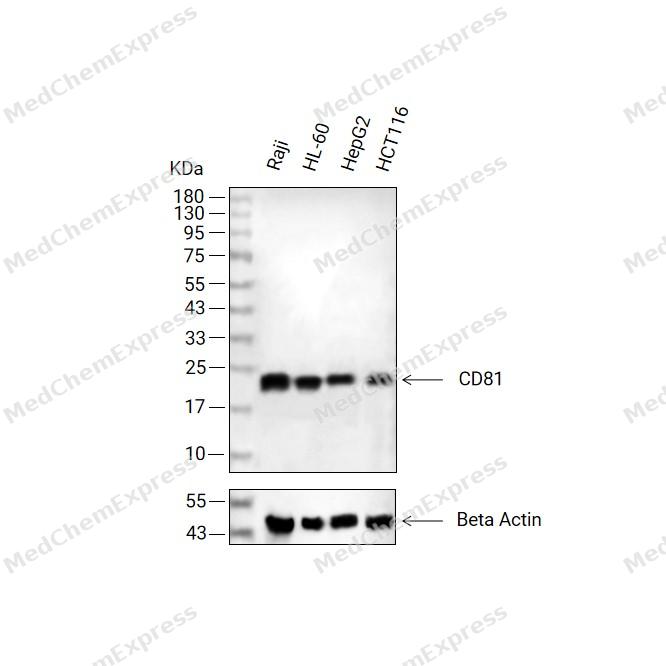 Western blot analysis of extracts from Raji (lane2(20μg), HL-60 (lane3(20μg), HepG2 (lane4(20μg) and HCT116 (lane5(20μg) using CD81 Antibody (HY-P80608). Proteins were transferred to a PVDF membrane and blocked with 5% non-fat milk in TBST at 4°C overnight. The primary antibody (1/1000) and Loading control antibody (Beta Actin, HY-P80993, 1/10,000) was used in 5% non-fat milk in TBST for 2 hour at room temperature. Goat Anti-Rabbit IgG-HRP Secondary Antibody (HY-P8001, 1/10,000) was used for 1 hour at room temperature.
 -
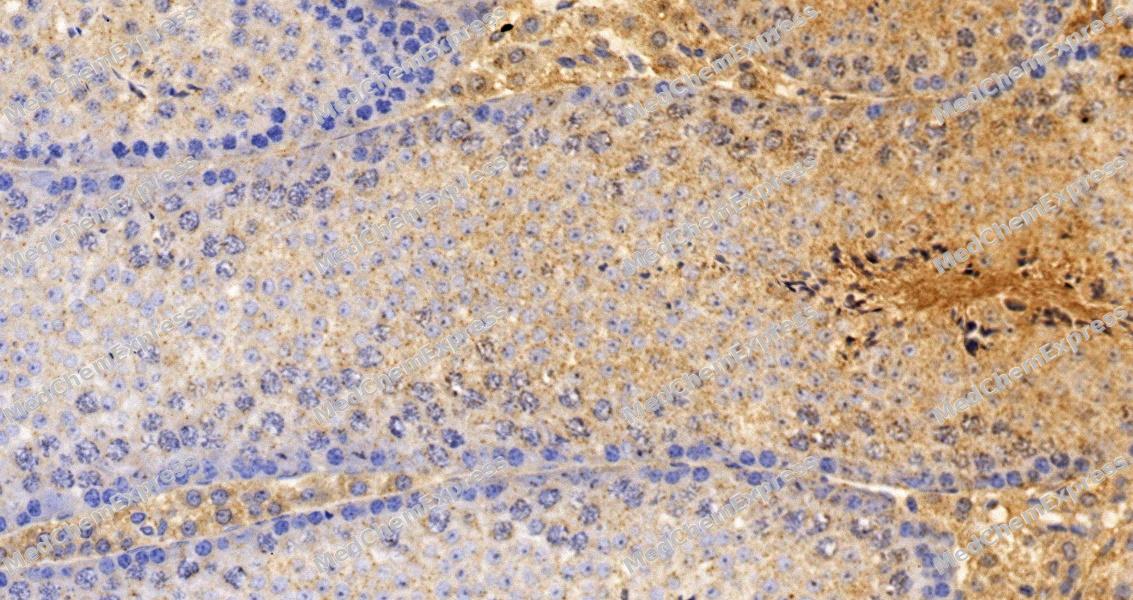 Immunohistochemical analysis of paraffin-embedded mouse testis tissue using CD81 Antibody. The section was pre-treated using heat mediated antigen retrieval with Tris-EDTA buffer (pH 8.0) for 8 minutes. The tissues were blocked in QuickBlock for 20 minutes at room temperature, washed with ddH2O and PBS, and then probed with the primary antibody at 1/100 dilution in 4℃ overnight. The detection was performed using an HRP conjugated compact polymer system. DAB was used as the chromogen. Tissues were counterstained with hematoxylin and mounted with DPX.
 -
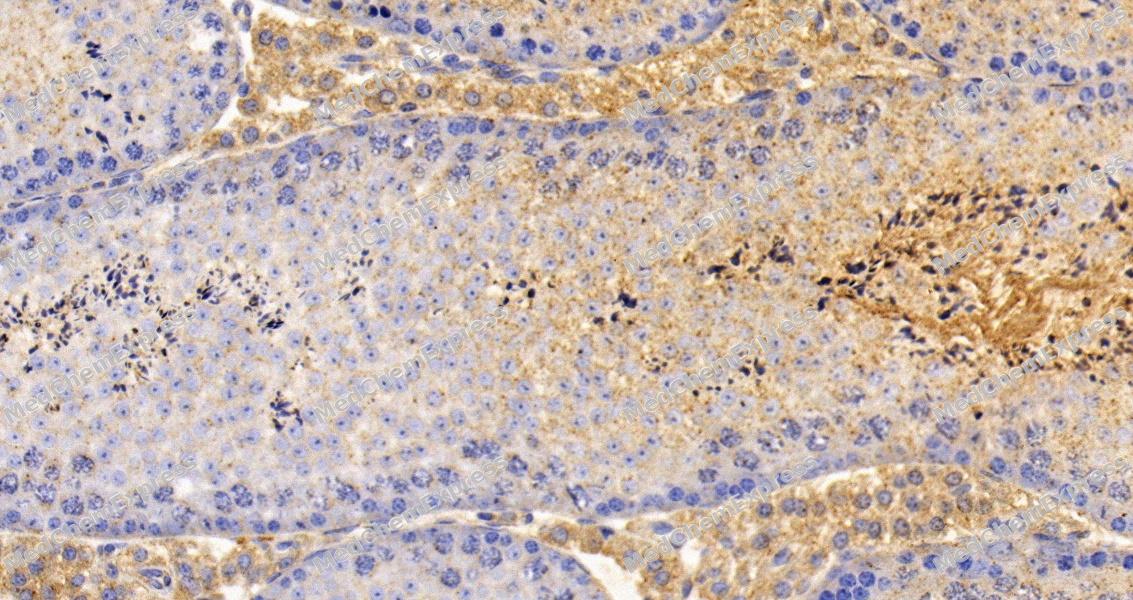 Immunohistochemical analysis of paraffin-embedded mouse testis tissue using CD81 Antibody. The section was pre-treated using heat mediated antigen retrieval with Tris-EDTA buffer (pH 8.0) for 8 minutes. The tissues were blocked in QuickBlock for 20 minutes at room temperature, washed with ddH2O and PBS, and then probed with the primary antibody at 1/100 dilution in 4℃ overnight. The detection was performed using an HRP conjugated compact polymer system. DAB was used as the chromogen. Tissues were counterstained with hematoxylin and mounted with DPX.
 -
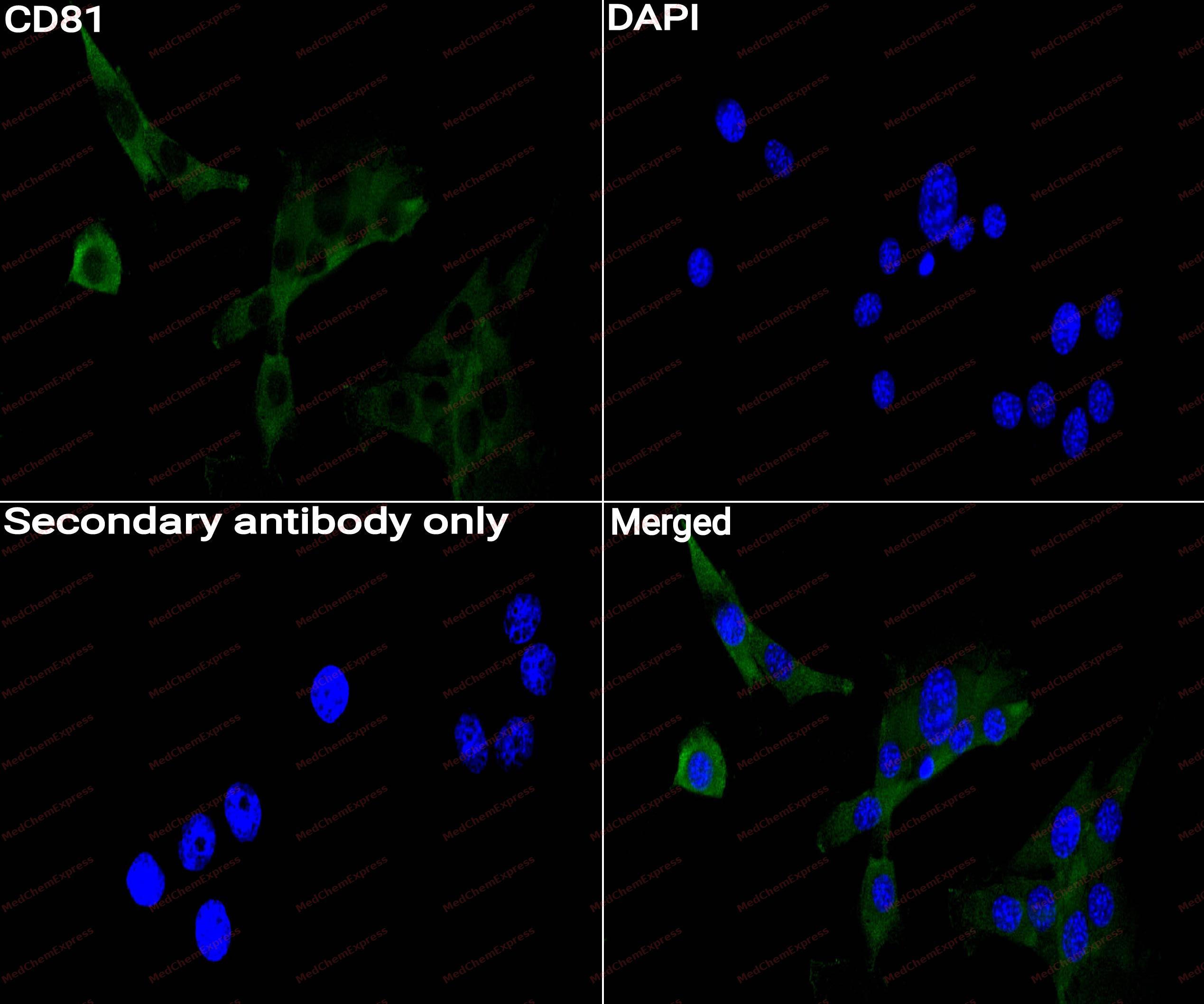 Immunocytochemistry analysis of C2C12 cells labeling CD81 with CD81 Antibody (HY-P80608) at 1/50 dilution. Cells were fixed in 4% paraformaldehyde for 15 minutes at room temperature, permeabilized with 0.1% Triton X-100 for 10 minutes at room temperature, then blocked with QuickBlock™ Blocking Buffer for Immunol Staining for 10 min at room temperature. Cells were then incubated with CD81 Antibody (HY-P80608) at 1/50 dilution in QuickBlock™ Blocking Buffer for Immunol Staining at 4 ℃. Alexa Fluor® 488-conjugated AffiniPure Goat Anti-Rabbit IgG H&L(HY-P8002, Green) was used as the secondary antibody at 1/1,000 dilution. PBS instead of the primary antibody was used as the secondary antibody only control. The Nuclear counterstain was DAPI (Blue).
 -
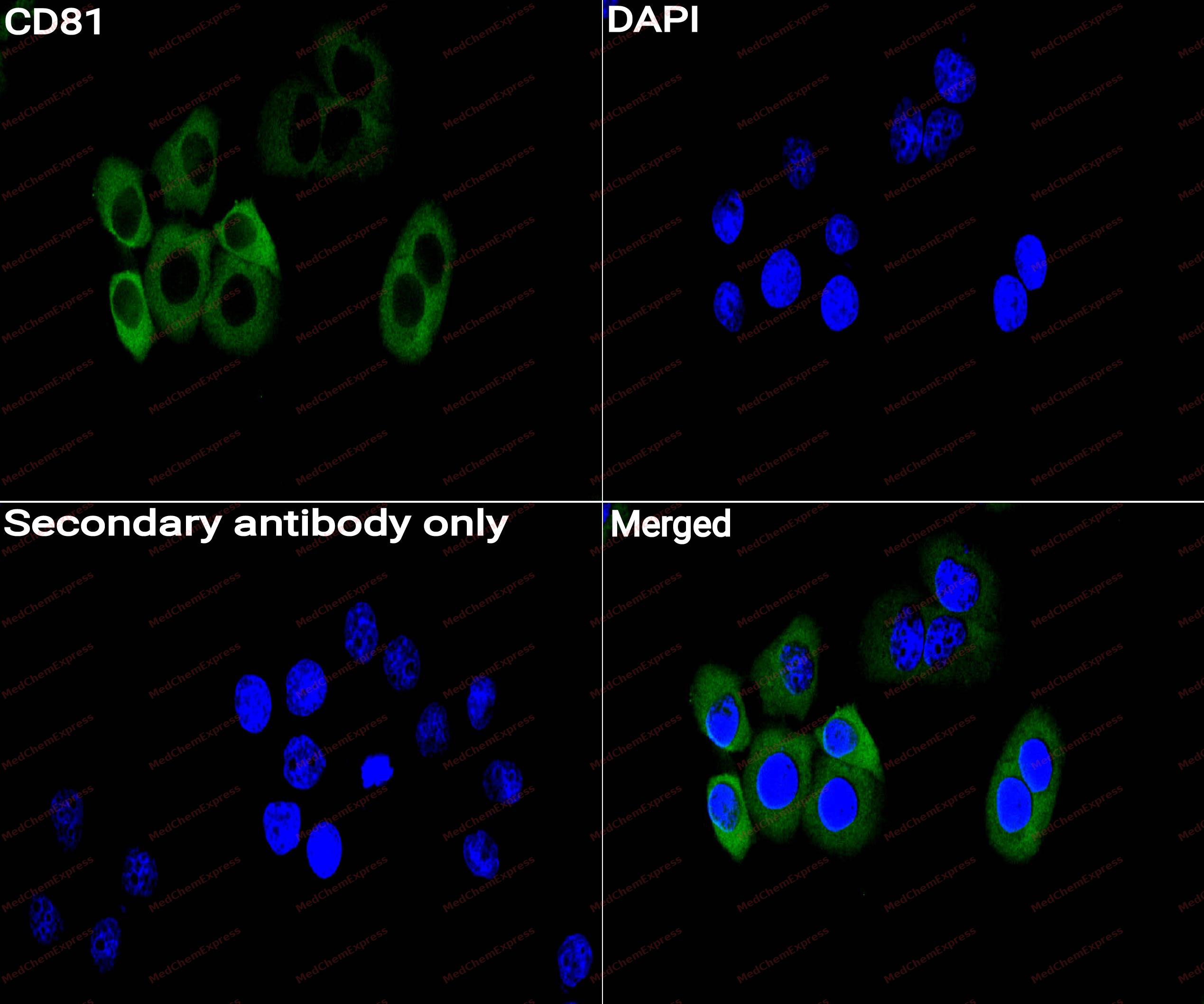 Immunocytochemistry analysis of SHSY5Y cells labeling CD81 with CD81 Antibody (HY-P80608) at 1/50 dilution. Cells were fixed in 4% paraformaldehyde for 15 minutes at room temperature, permeabilized with 0.1% Triton X-100 for 10 minutes at room temperature, then blocked with QuickBlock™ Blocking Buffer for Immunol Staining for 10 min at room temperature. Cells were then incubated with CD81 Antibody (HY-P80608)at 1/50 dilution in QuickBlock™ Blocking Buffer for Immunol Staining at 4 ℃. Alexa Fluor® 488-conjugated AffiniPure Goat Anti-Rabbit IgG H&L(HY-P8002,Green) was used as the secondary antibody at 1/1,000 dilution. PBS instead of the primary antibody was used as the secondary antibody only control. The Nuclear counterstain was DAPI (Blue).


Background
-
Function
CD81 is a Structural component of specialized membrane microdomains known as tetraspanin-enriched microdomains (TERMs), which act as platforms for receptor clustering and signaling. Essential for trafficking and compartmentalization of CD19 receptor on the surface of activated B cells. Upon initial encounter with microbial pathogens, enables the assembly of CD19-CR2/CD21 and B cell receptor (BCR) complexes at signaling TERMs, lowering the threshold dose of antigen required to trigger B cell clonal expansion and antibody production. In T cells, facilitates the localization of CD247/CD3 zeta at antigen-induced synapses with B cells, providing for costimulation and polarization toward T helper type 2 phenotype. Present in MHC class II compartments, may also play a role in antigen presentation. Can act both as positive and negative regulator of homotypic or heterotypic cell-cell fusion processes. Positively regulates sperm-egg fusion and may be involved in acrosome reaction. In myoblasts, associates with CD9 and PTGFRN and inhibits myotube fusion during muscle regeneration. In macrophages, associates with CD9 and beta-1 and beta-2 integrins, and prevents macrophage fusion into multinucleated giant cells specialized in ingesting complement-opsonized large particles. Also prevents the fusion of mononuclear cell progenitors into osteoclasts in charge of bone resorption. May regulate the compartmentalization of enzymatic activities. In T cells, defines the subcellular localization of dNTPase SAMHD1 and permits its degradation by the proteasome, thereby controlling intracellular dNTP levels. Also involved in cell adhesion and motility. Positively regulates integrin-mediated adhesion of macrophages, particularly relevant for the inflammatory response in the lung; (Microbial infection) Acts as a receptor for hepatitis C virus (HCV) in hepatocytes. Association with CLDN1 and the CLDN1-CD81 receptor complex is essential for HCV entry into host cell; (Microbial infection) Involved in SAMHD1-dependent restriction of HIV-1 replication. May support early replication of both R5- and X4-tropic HIV-1 viruses in T cells, likely via proteasome-dependent degradation of SAMHD1; (Microbial infection) Specifically required for Plasmodium falciparum infectivity of hepatocytes, controlling sporozoite entry into hepatocytes via the parasitophorous vacuole and subsequent parasite differentiation to exoerythrocytic forms[1][2][3][4][5][6][7][8][9][10].
-
Subcellular Localization
Cell membrane; Multi-pass membrane protein; Basolateral cell membrane; Multi-pass membrane protein
-
Expression
Tissue_specificity:Expression on B cells (protein level) (PubMed: 20237408) . Expression on hepatocytes (protein level) (PubMed: 12483205) . Expression on monocytes/macrophages (protein level) (PubMed: 12796480) . Expression on both naive and memory CD4-positive T cells (protein level) (PubMed: 22307619) . -
Subunit
Homodimer (PubMed:20375010). Part of a complex composed of CD19, CR2/CD21, CD81 and IFITM1/CD225 in the membrane of mature B cells. Interacts (via the second extracellular domain) with CD19; this interaction is initiated early during biosynthesis in the ER and enables trafficking of only properly folded CD19 (PubMed:1383329, PubMed:16449649). Part of a complex that includes MHC class II/HLA-DR molecules and IFITM1 (PubMed:8409388). Interacts with IFITM1 (PubMed:2398277, PubMed:26354436). Interacts with IFITM2 and IFITM3 (By similarity). Part of integrin-tetraspanin complex composed of CD9, CD81, beta-1 and beta-2 integrins in the membrane of monocyte/macrophages (PubMed:12796480). Interacts (via the second extracellular domain) with integrin ITGAV:ITGB3 (PubMed:27993971). Interacts with CD247/CD3 zeta, ICAM1 and CD9 at the immune synapse on T cell membrane (PubMed:23858057). Part of a GPCR-tetraspanin complex consisting at least of ADGRG1, CD81, possibly CD9, and GNA11 in which CD81 enhances the association of ADGRG1 with GNA11 (PubMed:15004227). Part of a complex composed of CD9, CD81, PTGFRN and IGSF8 (By similarity). Interacts directly with IGSF8 (PubMed:11504738). Interacts with CD53 and SCIMP (PubMed:21930792). Interacts with SAMHD1 (via its C-terminus) (PubMed:28871089). Interacts with glypican GPC3 and with the transcriptional repressor HHEX; binding to GPC3 decreases the availability of free CD81 for binding to HHEX, resulting in nuclear translocation of HHEX and transcriptional repression (By similarity). Interacts with CLDN1 (PubMed:20375010, PubMed:21516087). Interacts with CLDN6 and CLDN9 (PubMed:20375010)
-
SwissProt ID
-
Synonyms
CD81; TAPA1; TSPAN28; CD81 antigen; 26 kDa cell surface protein TAPA-1; Target of the antiproliferative antibody 1; Tetraspanin-28; Tspan-28; CD81
-
Research Field
Tags & Cell Markers
Documentation
-
Data Sheet (262 KB)
-
SDS (251 KB)
- English - EN (251 KB)
- Français - FR (251 KB)
- Deutsch - DE (251 KB)
- Norwegian - NO (251 KB)
- Español - ES (251 KB)
- Swedish - SV (251 KB)
- Italian - IT (251 KB)
- Korean - KR (251 KB)
- Portuguese - PT (251 KB)
-
User Guide for Antibodies (1077 KB)
References
[1]. Shoham T, et al. Building of the tetraspanin web: distinct structural domains of CD81 function in different cellular compartments. Mol Cell Biol. 2006 Feb;26(4):1373-85. [Content Brief]
[2]. van Zelm MC, et al. CD81 gene defect in humans disrupts CD19 complex formation and leads to antibody deficiency. J Clin Invest. 2010 Apr;120(4):1265-74. [Content Brief]
[3]. Zimmerman B, et al. Crystal Structure of a Full-Length Human Tetraspanin Reveals a Cholesterol-Binding Pocket. Cell. 2016 Nov 3;167(4):1041-1051.e11. [Content Brief]
[4]. Cherukuri A, et al. B cell signaling is regulated by induced palmitoylation of CD81. J Biol Chem. 2004 Jul 23;279(30):31973-82. [Content Brief]
[5]. Sagi Y, et al. Complementary costimulation of human T-cell subpopulations by cluster of differentiation 28 (CD28) and CD81. Proc Natl Acad Sci U S A. 2012 Jan 31;109(5):1613-8. [Content Brief]
[6]. Rocha-Perugini V, et al. CD81 controls sustained T cell activation signaling and defines the maturation stages of cognate immunological synapses. Mol Cell Biol. 2013 Sep;33(18):3644-58. [Content Brief]
[7]. Secrist H, et al. Ligation of TAPA-1 (CD81) or major histocompatibility complex class II in co-cultures of human B and T lymphocytes enhances interleukin-4 synthesis by antigen-specific CD4+ T cells. Eur J Immunol. 1996 Jul;26(7):1435-42. [Content Brief]
[8]. Schick MR, et al. The TAPA-1 molecule is associated on the surface of B cells with HLA-DR molecules. J Immunol. 1993 Oct 15;151(8):4090-7. [Content Brief]
[9]. Takeda Y, et al. Tetraspanins CD9 and CD81 function to prevent the fusion of mononuclear phagocytes. J Cell Biol. 2003 Jun 9;161(5):945-56. [Content Brief]
[10]. Rocha-Perugini V, et al. CD81 association with SAMHD1 enhances HIV-1 reverse transcription by increasing dNTP levels. Nat Microbiol. 2017 Nov;2(11):1513-1522. [Content Brief]

 Powered by Bioz
