



PI3 Kinase p110 alpha/PIK3CA Antibody (YA3537)
(Synonyms: PI3 kinase p110 subunit alpha; caPI3K; MGC142161; MGC142163; p110 alpha; Phosphatidylinositol 3 kinase catalytic alpha polypeptide; Phosphatidylinositol 3 kinase catalytic 110 KD alpha; Phosphatidylinositol 4 5 bisphosphate 3 kinase catalytic subunit alpha isoform; Phosphoinositide 3 kinase catalytic alpha polypeptide; PI3 kinase p110 subunit alpha; PI3K; PI3KC A; PIK3C A; PK3CA; PtdIns 3 kinase p110; PI3-kinase P110α; PI3-kinase p110 subunit alpha; PI 3 Kinase catalytic subunit alpha; PK3CA_HUMAN; PI3 kinase P110α.)
Based on 1 Customer Validation
PI3 Kinase p110 alpha/PIK3CA Antibody (YA3537) is a Rabbit-derived and non-conjugated IgG monoclonal antibody, targeting to PI3 Kinase p110 alpha/PIK3CA.
-
Host:
Rabbit
-
Isotype:
IgG
-
Application:
WB, ICC/IF, IP
-
Reactivity :
Human, Mouse, Rat
-
Formulation:
Supplied in 50mM Tris-Glycine(pH 7.4), 0.15M NaCl, 40%Glycerol, 0.01% sodium azide and 0.05% BSA.
-
Conjugation:
Non-conjugated


To place orders, for customer services and technical support, please contact: MedChemExpress USA
Tel: 609-228-6898 E-mail: [email protected] [email protected]



-

HY-P80535
AKT1+AKT2+AKT3 Antibody (YA635) -
HY-P80846
Phospho-PI3 Kinase p85/p55 (Tyr467/Tyr199) Antibody -
HY-P80789
Phospho-AKT (Thr308) Antibody -
HY-P80578
Calnexin Antibody -
HY-P86450
Phospho-AKT(Ser473) Antibody (YA6142) -
HY-P81211
phospho-PI3 Kinase p110 beta (Ser1070) Antibody -
HY-P80276
Phospho-AKT1(Ser473) Antibody (YA227) -
HY-P80231
mTOR Antibody (YA281) -
HY-P80837
Phospho-mTOR (Ser2448) Antibody (YA171) -
HY-P80009
AKT1/2/3 Antibody (YA633)


Applications
| Application |
WB

WB: Western Blot
|
ICC/IF
ICC/IF: Immunocytochemistry/
Immunofluorescence |
IP
IP: Immunoprecipitation
|
|---|---|---|---|
| Dilution Ratio | 1:500-1:1000 | 1:50-1:200 | 1:20 |


Product Details
PI3 Kinase p110 alpha/PIK3CA Antibody (YA3537) is a Rabbit-derived and non-conjugated IgG monoclonal antibody, targeting to PI3 Kinase p110 alpha/PIK3CA.
-
Host Rabbit

-
Clonality Monoclonal,Recombinant

-
Species ReactivityHuman, Mouse, Rat
-
Observed Molecular WeightObserved band size: 110 kDa
Note: Due to possible protein modifications or aggregation, the molecular weight should be confirmed by actual measurement, and the predicted value is for reference only.

-
Calculated Molecular Weight Predicted band size: 110 kDa

Entrez Gene: 5290 Human ; 18706 Mouse ; 170911 Rat
SwissProt: P42336 Human ; P42337 Mouse ;
OMIM: 114500 Human
A synthesized peptide derived from human PI 3 Kinase catalytic subunit alpha.
Endogenous
affinity purified
Non-conjugated
Unmodified
IgG


Product Properties
-
Appearance
Solution
-
Formulation
Supplied in 50mM Tris-Glycine(pH 7.4), 0.15M NaCl, 40%Glycerol, 0.01% sodium azide and 0.05% BSA.
-
Concentration
Batch-dependent, Please check the COA for the concentration of each lot. Check Lot Concentration
-
Storage & Stability
Stored at -20°C for 1 year. Avoid repeated freeze / thaw cycles.
-
Shipping
Shipping with blue ice.


Verification Images
-
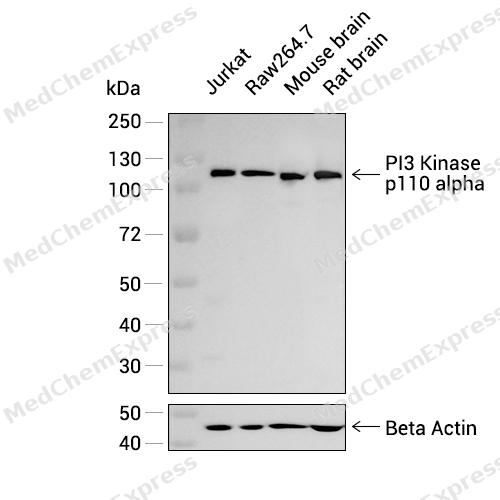 Western blot analysis was performed on extracts from Jurkat (lane 1, 20 μg), RAW264.7 (lane 2, 20 μg), Mouse brain (lane 3, 20 μg), and Rat brain (lane 4, 20 μg) using PI3 Kinase p110 alpha Rabbit mAb.Proteins were transferred to a PVDF membrane and blocked with 5% non - fat milk in TBST at 4°C overnight.The primary antibody (1:1000 dilution) and the loading control antibody (beta-Actin, HY-P83730, 1:5000 dilution) were incubated in 5% non-fat milk in TBST for 1 hour at 37°C.Goat Anti - Rabbit IgG - HRP Secondary Antibody (1:20000 dilution) was then applied for 40 minutes at 37°C.
 -
 Immunocytochemistry analysis of Hela cells labeling PI3 Kinase p110 alpha/PIK3CA with PI3 Kinase p110 alpha/PIK3CA Antibody (HY-P81162) at 1/100 dilution. Cells were fixed in 4% paraformaldehyde for 15 minutes at room temperature, permeabilized with 0.1% Triton X-100 in PBS for 15 minutes at room temperature, then blocked with quick block buffer for 10 minutes at room temperature. Cells were then incubated with PI3 Kinase p110 alpha/PIK3CA Antibody (HY-P81162) at 1/100 dilution in quick block buffer overnight at 4 ℃. AF488-conjugated Goat Anti-Rabbit IgG H&L(HY-P8002, Green) was used as the secondary antibody at 1/1,000 dilution. PBS instead of the primary antibody was used as the secondary antibody only control. The Nuclear counterstain was DAPI (Blue).
 -
 Immunocytochemistry analysis of HepG2 cells labeling PI3 Kinase p110 alpha/PIK3CA with PI3 Kinase p110 alpha/PIK3CA Antibody (HY-P81162) at 1/100 dilution. Cells were fixed in 4% paraformaldehyde for 15 minutes at room temperature, permeabilized with 0.1% Triton X-100 in PBS for 15 minutes at room temperature, then blocked with quick block buffer for 10 minutes at room temperature. Cells were then incubated with PI3 Kinase p110 alpha/PIK3CA Antibody (HY-P81162) at 1/100 dilution in quick block buffer overnight at 4 ℃. AF488-conjugated Goat Anti-Rabbit IgG H&L(HY-P8002, Green) was used as the secondary antibody at 1/1,000 dilution. PBS instead of the primary antibody was used as the secondary antibody only control. The Nuclear counterstain was DAPI (Blue).


Background
-
Function
PI3 Kinase p110 alpha/PIK3CA is a Phosphoinositide-3-kinase (PI3K) phosphorylates phosphatidylinositol (PI) and its phosphorylated derivatives at position 3 of the inositol ring to produce 3-phosphoinositides. Uses ATP and PtdIns(4,5)P2 (phosphatidylinositol 4,5-bisphosphate) to generate phosphatidylinositol 3,4,5-trisphosphate (PIP3). PIP3 plays a key role by recruiting PH domain-containing proteins to the membrane, including AKT1 and PDPK1, activating signaling cascades involved in cell growth, survival, proliferation, motility and morphology. Participates in cellular signaling in response to various growth factors. Involved in the activation of AKT1 upon stimulation by receptor tyrosine kinases ligands such as EGF, insulin, IGF1, VEGFA and PDGF. Involved in signaling via insulin-receptor substrate (IRS) proteins. Essential in endothelial cell migration during vascular development through VEGFA signaling, possibly by regulating RhoA activity. Required for lymphatic vasculature development, possibly by binding to RAS and by activation by EGF and FGF2, but not by PDGF. Regulates invadopodia formation through the PDPK1-AKT1 pathway. Participates in cardiomyogenesis in embryonic stem cells through a AKT1 pathway. Participates in vasculogenesis in embryonic stem cells through PDK1 and protein kinase C pathway. In addition to its lipid kinase activity, it displays a serine-protein kinase activity that results in the autophosphorylation of the p85alpha regulatory subunit as well as phosphorylation of other proteins such as 4EBP1, H-Ras, the IL-3 beta c receptor and possibly others. Plays a role in the positive regulation of phagocytosis and pinocytosis[1][2][3].
-
Subunit
Heterodimer of a catalytic subunit PIK3CA and a p85 regulatory subunit (PIK3R1, PIK3R2 or PIK3R3) (PubMed:26593112).
-
SwissProt ID
-
Synonyms
PI3 kinase p110 subunit alpha; caPI3K; MGC142161; MGC142163; p110 alpha; Phosphatidylinositol 3 kinase catalytic alpha polypeptide; Phosphatidylinositol 3 kinase catalytic 110 KD alpha; Phosphatidylinositol 4 5 bisphosphate 3 kinase catalytic subunit alpha isoform; Phosphoinositide 3 kinase catalytic alpha polypeptide; PI3 kinase p110 subunit alpha; PI3K; PI3KC A; PIK3C A; PK3CA; PtdIns 3 kinase p110; PI3-kinase P110α; PI3-kinase p110 subunit alpha; PI 3 Kinase catalytic subunit alpha; PK3CA_HUMAN; PI3 kinase P110α.


Documentation
-
Data Sheet (260 KB)
-
SDS (254 KB)
- English - EN (254 KB)
- Français - FR (254 KB)
- Deutsch - DE (254 KB)
- Norwegian - NO (254 KB)
- Español - ES (254 KB)
- Swedish - SV (254 KB)
- Italian - IT (254 KB)
- Korean - KR (254 KB)
- Portuguese - PT (254 KB)
-
User Guide for Antibodies (1077 KB)
References
[1]. Meier TI, et al. Cloning, expression, purification, and characterization of the human Class Ia phosphoinositide 3-kinase isoforms. Protein Expr Purif. 2004 Jun;35(2):218-24. [Content Brief]
[2]. Buchanan CM, et al. Oncogenic mutations of p110α isoform of PI 3-kinase upregulate its protein kinase activity. PLoS One. 2013;8(8):e71337. [Content Brief]
[3]. Maheshwari S, et al. Kinetic and structural analyses reveal residues in phosphoinositide 3-kinase α that are critical for catalysis and substrate recognition. J Biol Chem. 2017 Aug 18;292(33):13541-13550. [Content Brief]

 Powered by Bioz
