



mTOR Antibody (YA281)
(Synonyms: FRAP, FRAP1, FRAP2, RAFT1, RAPT1, MTOR, Serine/threonine-protein kinase mTOR, FK506-binding protein 12-rapamycin complex-associated protein 1, FKBP12-rapamycin complex-associated protein, Mammalian target of rapamycin, Mechanistic target of rapamycin, Rapamycin and FKBP12 target 1, Rapamycin target protein 1, Tyrosine-protein kinase mTOR, mTOR)Based on 3 publication(s) in Google Scholar
mTOR Antibody (YA281) is a Rabbit-derived and non-conjugated IgG monoclonal antibody, targeting to mTOR.
-
Host:
Rabbit
-
Isotype:
IgG
-
Application:
WB, IHC-P, ICC/IF, IP, IF-Tissue
-
Reactivity :
Human, Mouse, Rat
-
Formulation:
Supplied in 1*TBS (pH7.4), 0.05% BSA and 40% Glycerol. Preservative: 0.05% Sodium Azide.
-
Conjugation:
Non-conjugated


To place orders, for customer services and technical support, please contact: MedChemExpress USA
Tel: 609-228-6898 E-mail: [email protected] [email protected]



-

HY-P80837
Phospho-mTOR (Ser2448) Antibody (YA171) -
HY-P80469
Phospho-mTOR (Ser2448) Antibody (YA691) -
HY-P80535
AKT1+AKT2+AKT3 Antibody (YA635) -
HY-P80788
Phospho-AKT1 (Ser473) Antibody (YA228) -
HY-P80008
AKT1 Antibody (YA634) -
HY-10219
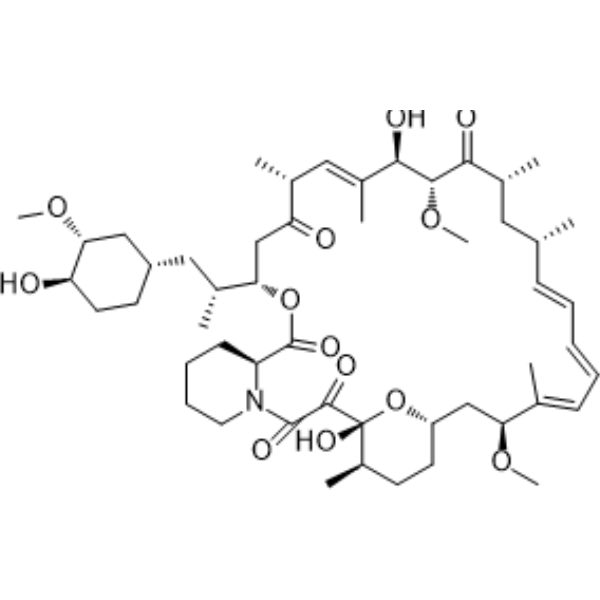
RapamycinmTOR Inhibitor -
HY-P8001
HRP-conjugated Goat Anti-Rabbit IgG H&L -
HY-P80276
Phospho-AKT1(Ser473) Antibody (YA227) -
HY-P80846
Phospho-PI3 Kinase p85/p55 (Tyr467/Tyr199) Antibody -
HY-P8003
AF594-conjugated Goat Anti-Rabbit IgG H&L -
HY-P86383
Phospho-mTOR(Ser2448) Antibody (YA6075) -
HY-P81211
phospho-PI3 Kinase p110 beta (Ser1070) Antibody
Publications Citing Use of MedChemExpress (MCE) mTOR Antibody (YA281)
More
 3 Publications Citing Use of MCE mTOR Antibody (YA281) (8)
-
WB
-
WB

-
WB

-
WB

-
WB


Applications
| Application |
WB

WB: Western Blot
|
IHC-P
IHC-P: Immunohistochemistry-Paraffin
|
ICC/IF
ICC/IF: Immunocytochemistry/
Immunofluorescence |
IF-Tissue
IF-Tissue: Immunofluorescence-Tissue
|
IP
IP: Immunoprecipitation
|
|---|---|---|---|---|---|
| Dilution Ratio | 1:5000 | 1:200-1:1000 | 1:50-1:200 | 1:500 | Use at an assay dependent concentration. |


Product Details
mTOR Antibody (YA281) is a Rabbit-derived and non-conjugated IgG monoclonal antibody, targeting to mTOR.
-
Host Rabbit

-
Clonality Recombinant,Monoclonal

-
Species ReactivityHuman, Mouse, Rat
-
Observed Molecular WeightObserved band size: 289 kDa
Note: Due to possible protein modifications or aggregation, the molecular weight should be confirmed by actual measurement, and the predicted value is for reference only.

-
Calculated Molecular Weight Predicted band size: 289 kDa

Entrez Gene: 2475 Human ; 56717 Mouse ; 56718 Rat
SwissProt: P42345 Human ; Q9JLN9 Mouse ; P42346 Rat
OMIM: 616638 Human
Synthetic peptide corresponding to Human mTOR.AA range:2400-2440.
Endogenous
Protein A affinity purified.
Non-conjugated
Unmodified
IgG


Product Properties
-
Appearance
Solution
-
Formulation
Supplied in 1*TBS (pH7.4), 0.05% BSA and 40% Glycerol. Preservative: 0.05% Sodium Azide.
-
Concentration
Batch-dependent, Please check the COA for the concentration of each lot. Check Lot Concentration
-
Storage & Stability
Stored at -20°C for 1 year. Avoid repeated freeze / thaw cycles.
-
Shipping
Shipping with blue ice.


Publications (3)
-
Journal Impact Factor
-
Most Recent
-
Phytomedicine
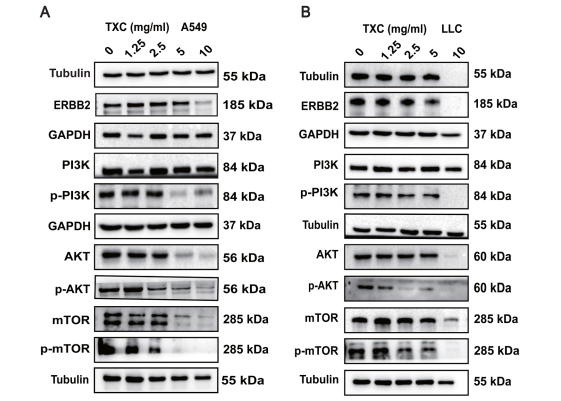
Tougu Xiaotong capsules inhibit lung cancer and gefitinib-resistant cells by blocking ERBB2/PI3K-AKT-mTOR signaling and triggering ferroptosis. [Abstract]2026 Jan:150:157741. PMID: 41477979
mTOR Antibody (YA281) purchased from MedChemExpress. Usage Cited in: Phytomedicine. 2026 Jan:150:157741. [Abstract]
A549 and LLC cells were treated with increasing doses of TXC for 24 h, followed by western blotting for ERBB2, PI3K, phospho-PI3K, AKT, phospho-AKT, mTOR, phospho-Mtor.
mTOR Antibody (YA281) purchased from MedChemExpress. Usage Cited in: Phytomedicine. 2026 Jan:150:157741. [Abstract]
Western blot analysis of ERBB2, PI3K, phospho-PI3K, AKT, phospho-AKT, mTOR, phospho-mTOR, HMOX1, and GPX4 in HCC827 and HCC827-GR cells treated with TXC or gefitinib.
mTOR Antibody (YA281) purchased from MedChemExpress. Usage Cited in: Phytomedicine. 2026 Jan:150:157741. [Abstract]
Following 12 h of cotreatment, Western blotting for ERBB2, PI3K, phospho-PI3K, AKT, phospho-AKT, mTOR, phospho-mTOR, HMOX1, GPX4, P-gp, and MRP1 in HCC827 and gefitinib-resistant HCC827-GR cells.
-
Biochem Pharmacol
Deubiquitinase USP5 promotes acute myeloid leukemia through C2CD5 stabilization and PI3K/AKT/mTOR/HIF-1α-driven glycolysis. [Abstract]2026 Feb:244:117591. PMID: 41344512
mTOR Antibody (YA281) purchased from MedChemExpress. Usage Cited in: Biochem Pharmacol. 2026 Feb:244:117591. [Abstract]
Western blot analysis of indicated proteins in MOLM-13 cells infected with sh- sh-NC, sh-C2CD5-1# or sh-C2CD5-2#.
mTOR Antibody (YA281) purchased from MedChemExpress. Usage Cited in: Biochem Pharmacol. 2026 Feb:244:117591. [Abstract]
Western blot analysis of indicated proteins in MOLM-13 cells infected with sh-NC, shUSP5-1# and sh-USP5-2#. Quantification of protein levels normalized to total β-tubulin is shown below

mTOR Antibody (YA281) purchased from MedChemExpress. Usage Cited in: Biochem Pharmacol. 2026 Feb:244:117591. [Abstract]
Western blot analysis of indicated proteins in MOLM-13 cells transduced with sh-NC + EV, sh-USP5 + EV and sh-USP5 + C2CD5. Quantification of protein levels normalized to total β-tubulin is shown below.
-

mTOR Antibody (YA281) purchased from MedChemExpress. Usage Cited in: SSRN. 2025 Sep 23.
The expression of p-mTOR, mTOR, p-PI3K, PI3K, p-AMPK, and AMPK in the brain tissue of CRS mice after ZZCD intervention.

mTOR Antibody (YA281) purchased from MedChemExpress. Usage Cited in: SSRN. 2025 Sep 23.
The expression of p-mTOR, mTOR, p-PI3K, PI3K, p-AMPK, and AMPK in hippocampal microglia compared with untreated CRS mice.


Verification Images
-
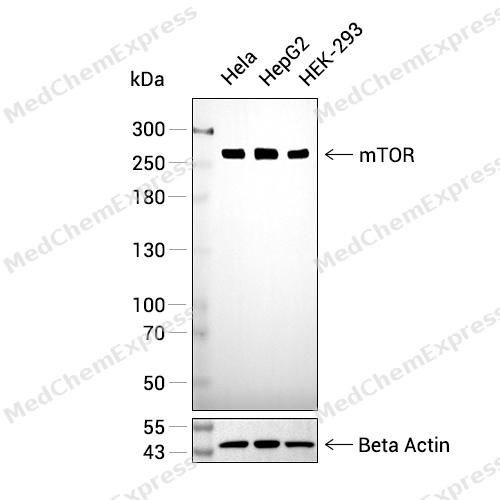 Western blot analysis of extracts from Hela (lane 2(20μg), HepG2 (lane 3(20μg), HEK-293 (lane 4(20μg) using mTOR Antibody (HY-P80231) Mouse mAb. Proteins were transferred to a PVDF membrane and blocked with 5% BSA in TBST for 2 hour at room temperature. The primary antibody (HY-P80231, 1/1000) and Loading control antibody (Beta Actin, HY-P80438, 1/3000) was used in 5% BSA in TBST at 4°C overnight. Goat Anti-Mouse/Rabbit IgG-HRP Secondary Antibody (HY-P8004/HY-P8001, 1/10,000) was used for 1 hour at room temperature.
 -
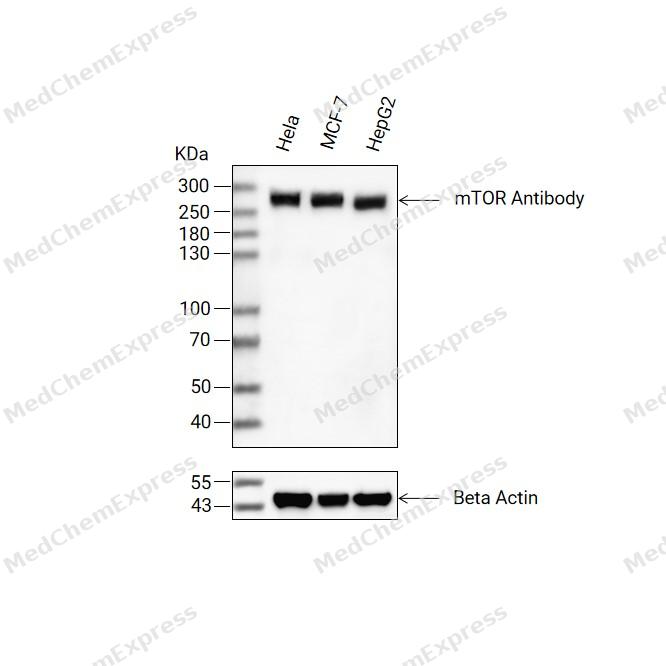 Western blot analysis of extracts from Hela(lane 2(20ug) , MCF-7(lane 3(20ug) and HepG2(lane 4(20ug) using mTORAntibody (HY-P80231) Rabbit mAb. Proteins were transferred to a PVDF membrane and blocked with 5% non-fat milk in TBST for 2 hour at room temperature. The primary antibody (1/1000) and Loading control antibody (Beta Actin, HY-P83730, 1/10000) was used in 5% non-fat milk in TBST at 4°C overnight. Goat Anti-Mouse/Rabbit IgG-HRP Secondary Antibody (1/10000) was used for 1 hour at room temperature.
 -
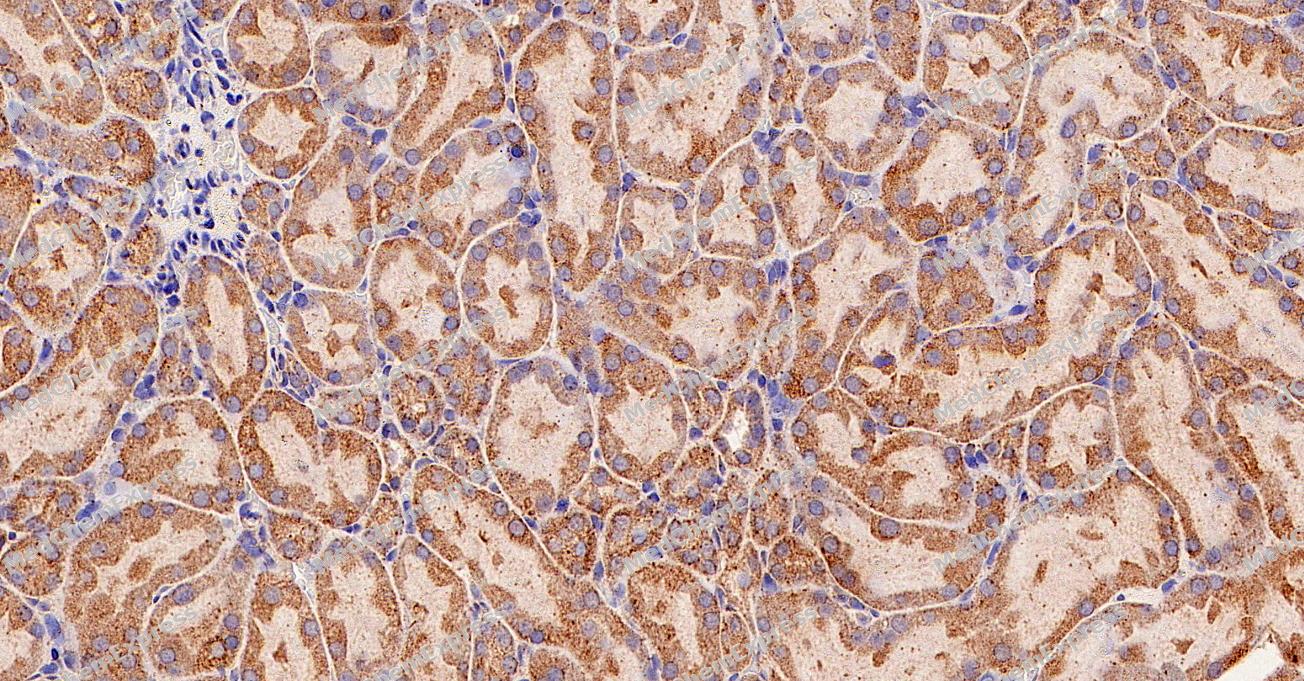 Immunohistochemical analysis of paraffin-embedded Rat kidney tissue using mTOR Antibody (YA281). The section was pre-treated using heat mediated antigen retrieval with Tris-EDTA buffer (pH 9.0) for 8 minutes. The tissues were blocked in QuickBlock for 20 minutes at room temperature, washed with ddH2O and PBS, and then probed with the primary antibody (HY-P80231, 1/500) in 4℃ overnight. The detection was performed using an HRP conjugated compact polymer system. DAB was used as the chromogen. Tissues were counterstained with hematoxylin and mounted with DPX.
 -
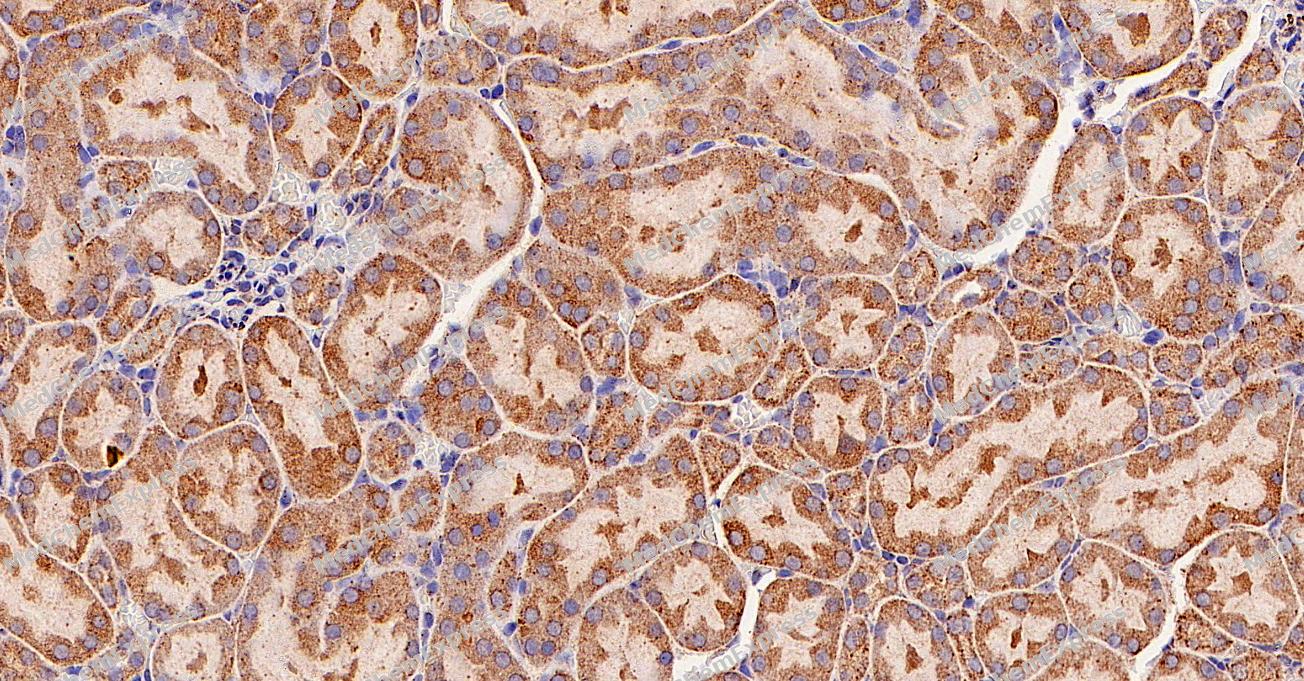 Immunohistochemical analysis of paraffin-embedded Rat kidney tissue using mTOR Antibody (YA281). The section was pre-treated using heat mediated antigen retrieval with Tris-EDTA buffer (pH 9.0) for 8 minutes. The tissues were blocked in QuickBlock for 20 minutes at room temperature, washed with ddH2O and PBS, and then probed with the primary antibody (HY-P80231, 1/500) in 4℃ overnight. The detection was performed using an HRP conjugated compact polymer system. DAB was used as the chromogen. Tissues were counterstained with hematoxylin and mounted with DPX.


Background
-
Function
mTOR (mammalian target of Rapamycin) is a protein that in humans is encoded by the mTOR gene. mTOR is a serine/threonine protein kinase that regulates cell growth, cell proliferation, cell motility, cell survival, protein synthesis, and transcription. mTOR belongs to the phosphatidylinositol 3-kinase-related kinase protein family. mTOR integrates the input from upstream pathways, including growth factors and amino acids. mTOR also senses cellular nutrient, oxygen, and energy levels. The mTOR pathway is dysregulated in human diseases, such as diabetes, obesity, depression, and certain cancers. Rapamycin inhibits mTOR by associating with its intracellular receptor FKBP12. The FKBP12-rapamycin complex binds directly to the FKBP12-Rapamycin Binding (FRB) domain of mTOR, inhibiting its activity.
-
Subcellular Localization
Lysosome membrane; Peripheral membrane protein; Cytoplasmic side; Endoplasmic reticulum membrane; Peripheral membrane protein; Cytoplasmic side; Golgi apparatus membrane; Peripheral membrane protein; Cytoplasmic side; Cell membrane; Peripheral membrane protein; Mitochondrion outer membrane; Peripheral membrane protein; Cytoplasmic side; Cytoplasm; Nucleus; Nucleus, PML body; Microsome membrane; Cytoplasmic vesicle, phagosome
-
Expression
Tissue_specificity:It is expressed in multiple tissues, with the highest concentration in the testes. -
Subunit
Part of the mechanistic target of rapamycin complex 1 (mTORC1) which contains MTOR, MLST8 and RPTOR
-
SwissProt ID
-
Synonyms
FRAP, FRAP1, FRAP2, RAFT1, RAPT1, MTOR, Serine/threonine-protein kinase mTOR, FK506-binding protein 12-rapamycin complex-associated protein 1, FKBP12-rapamycin complex-associated protein, Mammalian target of rapamycin, Mechanistic target of rapamycin, Rapamycin and FKBP12 target 1, Rapamycin target protein 1, Tyrosine-protein kinase mTOR, mTOR
-
Research Field
Cell Biology
Documentation
-
Data Sheet (262 KB)
-
SDS (254 KB)
- English - EN (254 KB)
- Français - FR (254 KB)
- Deutsch - DE (254 KB)
- Norwegian - NO (254 KB)
- Español - ES (254 KB)
- Swedish - SV (254 KB)
- Italian - IT (254 KB)
- Korean - KR (254 KB)
- Portuguese - PT (254 KB)
-
User Guide for Antibodies (1077 KB)
References
[1]. Laplante M, et al. mTOR signaling in growth control and disease. Cell. 2012 Apr 13;149(2):274-93. [Content Brief]
[2]. Panwar V, et al. Multifaceted role of mTOR (mammalian target of rapamycin) signaling pathway in human health and disease. Signal Transduct Target Ther. 2023 Oct 2;8(1):375. [Content Brief]
[3]. Yong J, et al. Regulation of transcriptome plasticity by mTOR signaling pathway. Exp Mol Med. 2025 Aug;57(8):1623-1630. [Content Brief]
[4]. Ballesteros-Álvarez J, et al. mTORC2: The other mTOR in autophagy regulation. Aging Cell. 2021 Aug;20(8):e13431. [Content Brief]
[5]. Patel CH, et al. More TOR: The expanding role of mTOR in regulating immune responses. Immunity. 2025 Jul 8;58(7):1629-1645. [Content Brief]
[6]. Dai DF, et al. The mTOR signaling pathway in cardiac aging. J Cardiovasc Aging. 2023;3(3):24. [Content Brief]
[7]. Wang F, et al. Crosstalks between mTORC1 and mTORC2 variagate cytokine signaling to control NK maturation and effector function. Nat Commun. 2018 Nov 19;9(1):4874. [Content Brief]
[8]. Schaub T, et al. mTORC1 and mTORC2 Differentially Regulate Cell Fate Programs to Coordinate Osteoblastic Differentiation in Mesenchymal Stromal Cells. Sci Rep. 2019 Dec 27;9(1):20071. [Content Brief]
[9]. Mao B, et al. Overview of Research into mTOR Inhibitors. Molecules. 2022 Aug 19;27(16):5295. [Content Brief]

 Powered by Bioz
